
Mike Parsons
Wholeness Now
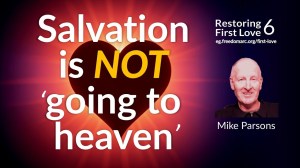
Salvation is not about “going to heaven after death.” Surprisingly, the words “saved” and “heaven” never appear together in the Bible. Salvation means restoration to wholeness in the present, not something that happens after death. The idea of being “promoted to heaven” or “crossing the Jordan” is part of a religious system that has promoted a mistaken tradition.
Salvation is about experiencing wholeness here and now, bringing us into the true identity of who we are. If you have been indoctrinated to think that your salvation depends on your efforts in any way, you will remain stuck in trying to secure it. This was my experience, coming from an evangelical background, where salvation seemed to depend on my ability to trust God, my faith, or what I did in asking God into my life.
Rather than realising what had already been accomplished, I viewed salvation as an ongoing effort—trying to be good enough and acceptable to God through practices like reading the Bible, praying every day, witnessing, and fulfilling the perceived requirements of being a “good Christian.” But who said we were supposed to do those things? Jesus did not—the church did. Deconstruction is the process of removing that indoctrination and replacing it with truth, renewing and transforming our minds.
All of humanity is included
Even if someone does not believe they are saved, they still are; they just do not believe it yet. This is the truth: all of humanity is included in what the Father already accomplished through Jesus to forgive, redeem, and reconcile us to himself. The work is finished, and everyone has been declared righteous, justified, and forgiven. Whether or not someone believes this truth, it remains the truth.
The New Covenant was made between the Father and the Son and included all of humanity. Teaching that we must make a free will decision to be included is ‘a church-invented heresy’, as Don Keithley says. “Our free will decision is simply to accept what has already happened, to realise that we are already included—not to make it happen. If Jesus included the doubter, Thomas, the denier, Peter, and the traitor, Judas, I seriously doubt anyone is excluded from his work today.”
No one is excluded from what Jesus came to do and to finish. He came to take away the sin—the lost identity—of the world, not just a few people but the whole world, and every person in it. What we believe about God does not define him, and our doctrines do not even define us, though they often label us. Many of us have been labelled by what we believe, whether Baptist, Charismatic, Pentecostal, Anglican, or any other denomination. But God knows the truth about us, and what he knows, demonstrated in Christ, is what defines us.
Equal Value
Jesus is what God believes about us. The love God has for his Son, Jesus, is the same love He has for us. When we are reconciled to God, it is important to understand that God was in Christ, reconciling the world to himself. The term ‘world’ here is the Greek word kosmos, and ‘reconciliation’ in this sense is an accounting term. The debit and credit must balance.
The value we hold for God is the same value God holds for Jesus. This is a profound truth: we are of equal value to God as Jesus. Understanding this is key to grasping the fullness of our identity and value in the eyes of God.
The truth that sets us free
Adam’s choice to walk independently of God did not change the nature of God the Father. God still desires a relationship with us, just as he did with Adam. The Father still longs to walk with us in the garden, to restore that relationship. We need to see that this relationship can be restored, and this realisation is an essential part of our journey.
Deconstruction takes different forms. Some people reject the conditional love taught by religion and walk away from organised faith, while others discover unconditional love outside of religion. God is love, and this is a fundamental truth. However, God does not deconstruct us by focusing on the lies we believe, but by revealing the truth that sets us free. This process renews our minds to the truth, and in doing so, those false beliefs naturally fall away.
The truth we know through experience will set us free. So let us focus on positive solutions, not negative problems. Do not try to deconstruct your beliefs with the same thinking that created them. Instead, allow God to encounter you in such a way that it changes what you believe, leading to a transformation based on truth, not on doctrine.
The ‘Second Coming’
Many Christians are still waiting for the second coming of Jesus. However, as I have discussed before, the ‘second coming’ already happened, in AD 70. This means that many are looking for the wrong event. Creation does not recognise Christians waiting to be rescued; it recognises sons and daughters who are living out the truth. Religion has deeply ingrained in us a fear of the future—the fear of tribulation, of the rapture, of trouble to come.
But we do not not need to fear the future. The Spirit of Truth was given so that we, as sons and daughters, might shape the future. Fear never comes from God, and perfect love casts out fear. Therefore, let’s ensure we are not operating out of fear, worrying about what might happen tomorrow, but instead live in the blessing and provision of today. There is no ‘Great Tribulation’ on the horizon. There may be personal tribulations, but God will be with us through them. The biblical ‘Great Tribulation’ was the end of the old age, the age of the old covenant, and it has already passed.

If you enjoy these teachings, please take a moment to like, comment, and subscribe, whether here or on YouTube—it really helps. Thank you very much!

 Sons of Issachar