414. Living in the Spirit

Mike Parsons –

Eternity symbol

I did the same thing when I was on my journey. I found that whenever I was in a setting where I could just let go—usually in a worship setting or something similar at the time—I would notice my hand just drawing this sign. And I remember thinking, “What am I doing?” It felt a bit strange, but I just went with it because I didn’t really care what anyone else thought. I decided to just go with it.
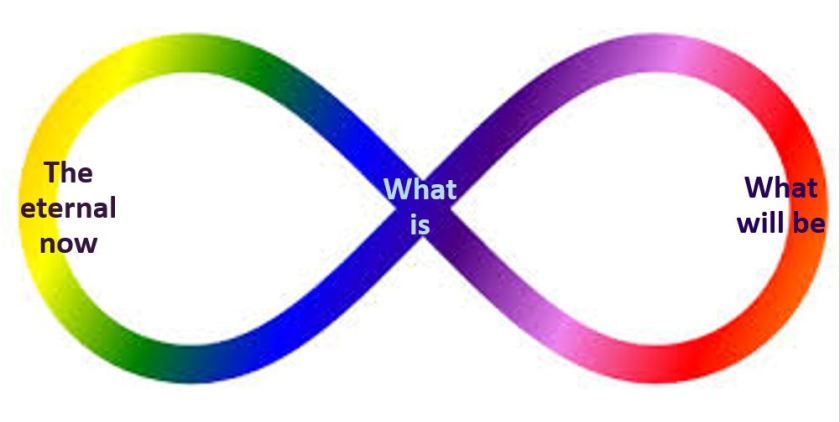
Eventually, God began to show me that I was connecting with something, and He was unveiling an understanding of where I was in the beginning—the origin of my identity in Him—then bringing that into the present and outworking it in the present to create the future. It’s a continual pathway, drawing from where we are in relationship with God in the eternal now, living in intimacy with Him, and outworking that in the present, which then brings the future into place. What I do today becomes history, so today I can establish my future for tomorrow. Tomorrow is going to come, but what I do today can prepare for it out of what was in the eternal now—what was, what is, and what will be.

From doing to being

Sometimes people talk about the end and beginning of a circle, saying the end of one thing is always the beginning of another, which is true in a sense. But actually, God told me, “No, it’s not a circle; it’s this sign, the sign of my eternal covenant with man.” We were predestined to return to face-to-face relationship with Him, and that relationship enables us to outwork who we are in that state of being—what was, what is. I can just be.

I had always been very active because I’m quite an active person. I like to do things. So I was always focused on what I was doing today and how I was outworking things. It became a lot of activity. But God pulled me back from that place and showed me that it’s not about what I’m doing today—it’s about who I am today. My state of being has a greater impact than just what I do. Because what I do can sometimes come from a need, a desire, or something that isn’t necessarily from the heart of God. But if I’m flowing from what was and always is—because God is always in that eternal state—then I can simply be.

I started off doing and eventually became someone who could be. And that was really liberating because it meant I only needed to be in relationship with the Father, connected to His heart. That connection would inspire and motivate me to outwork His heart every day. But I didn’t have to keep asking, “What should I do today?” or “What needs to be done?” I just needed to be me. Because if I am me, that naturally creates space for the outworking of who I am in any situation. I could be more relaxed, at peace, at rest, without always wondering, “What should I be doing?” or “God, what are you doing?” It became a heart-to-heart relationship instead of a list of tasks.

In the beginning, God did give me lists because He met me where I was. But He didn’t leave me there. One day, He just stopped giving me anything to do and simply embraced me. And I remember struggling with that because I thought, “I’m not doing anything!” But He was showing me that being in that oneness was far more important than what I thought I needed to do. Being enabled a flow rather than duty, obligation, or what I thought I should be doing.

Just because I know how to do something doesn’t mean I need to do it.

Just because I know how to do something doesn’t mean I need to do it. And God demonstrated that to me over and over again. There were times when things were happening, and I’d go to God and ask, “Can I do something here?” And He’d say, “No, it’s all right. I’ve got it covered.” Someone else was doing something, and later on, I would find out who those people were. And that was great, because then I realised God was already at work in them. He didn’t need me, but if he did ask me to do something, that would be good. But I knew it would be coming out of a place where I was feeling his heart about it.

Connected in the spirit

And actually, sometimes feeling his heart about a situation but not having any sense that I should do something doesn’t mean I have to be passive, because I can still be encouraging others who God has assigned to do it. In a sense, when we’re connected in the spirit—because we’re all one in the spirit—then my encouragement can help somebody else feel secure in what they’re doing. So my heart wouldn’t be, “Oh, I wish I was doing that,” but rather, “How can I help encourage whoever is doing that so they are able to do it in the way God would want them to?”

My thoughts are always that way—I’m part of the whole, and God has many different ways of doing things. And of course, we can be doing things in the spirit without necessarily needing to know what we’re doing cognitively. I’m doing that all the time. That’s a state of being multi-dimensional, doing things in many different places without needing to be there in a conscious way, because my spirit is there. All our spirits are seated in heavenly places with Christ; we just haven’t mostly learned how to engage with it. But we’re there, so our spirit is active even if we’re not aware of what we’re doing. But we can become more aware as our soul and spirit begin to learn how to engage—until we don’t need to consciously engage because it’s just happening.

I can engage right now with whatever I might be doing in the spirit realm, but most of the time, I don’t need to, because that actually gives me more time to be here in a way that enables me to be at peace and at rest. It allows me to be a demonstration of that and to live it out with a more creational perspective. Before, I was so focused on what I was doing in the spirit realm that the earthly realm almost seemed secondary. But God really showed me the value of this realm—of living here and outworking who we are there, here: “on earth as it is in heaven“—in a way that made me much more connected to creation. I had more time to feel and sense what was going on around me, whereas before, my focus was so much on what I was doing in heaven that earthly things seemed less important. But actually, it’s creation that is waiting for the revealing of the sons of God, longing to be set free.

The groan of creation

There is an aspect of our sonship that is very much about the restoration of how God intended things to be here. And I found that having a more relaxed way of living with creation around me enabled me to tune into that more—to feel that groan and sense what was going on. Sometimes, even the earth groans at what we do to it and what we do to ourselves. You often see physical events happening in the world when significant things happen with people. There’s a kind of disturbance that we can bring peace into. We don’t want so-called natural disasters to follow human disasters—if we can bring peace so that the earth doesn’t react to what’s happening among people.

Reconcile the earth

There’s a lot going on in the world right now—many places where things are unfolding. I believe that, as sons of God, we have the ability to bring peace into these situations. Even if external peace isn’t happening between people, we can still reconcile the earth itself so that there isn’t a reaction from creation to what’s going on. I think that’s really important—that we are peacemakers. It would be great if we could bring peace into every environment; but at the very least we can bring peace between the earth, the creation we are part of, and anything negative that is going on.

If you find these posts helpful, please like, share, comment and subscribe so they reach others who can enjoy them too. Thank you!

Related posts by Mike Parsons

413. Before the Foundation of the World

Mike Parsons

The Lamb slain from the foundation of the world

All who dwell on the earth will worship him, whose names have not been written in the Book of Life of the Lamb slain from the foundation of the world. (Revelation 13:8 NKJV).

Before the foundation of the world, Jesus did not physically die; rather, he offered himself in identification with humanity, should we fall into a state of perceived separation from God. His self-offering was not about death itself but about fully embracing our condition so that we could ultimately live. The phrase “the Lamb slain before the foundation of the world” speaks to this identification. However, since God never desired sacrifices or offerings, he did not orchestrate Jesus’ death in a punitive sense. Instead, Jesus willingly gave himself so that we would always be restored.

Jesus came as a man to redefine our understanding of God. To accomplish this, he had to fully identify with us in the flesh, living as we do. By experiencing our humanity, he took on our death, not as a punishment from God but as an act of love. Humanity, not God, put Jesus to death. Yet, through his death, he overcame its power, bringing about the resurrection that includes us all. His coming was essential—not to appease divine wrath but to restore our lost identity and reunite us with the Father. While he did not die before the foundation of the world, he committed himself to our redemption from the very beginning, ensuring that no matter what, we would always be restored to relationship with God. Ephesians 1:4 (Mirror Bible) affirms this, stating that God’s plan has always been to restore us to face-to-face innocence.

So some are excluded?

However, you are not in the flesh but in the Spirit, if indeed the Spirit of God dwells in you. But if anyone does not have the Spirit of Christ, he does not belong to Him. (Romans 8:9).

The passage in Romans 8:9 must be understood in context. It speaks of the mind and spirit and our choice to identify with either life in Christ or the law of sin and death. If our mindset remains focused on sin and death, we live as if we do not belong to Christ. When Jesus said, “Depart from me, I never knew you,” it was not about literal ignorance but covenantal relationship. If people continued living under the old covenant, refusing the relationship Jesus offered in the new, they remained unknown to him in that sense. The passage does not imply that some are excluded from Christ, but rather that those who think and live according to the old ways act as if they are outside of him. In reality, the Spirit is in all, breathed into humanity just as he was into the disciples, making all people part of the new creation. The issue is not whether we belong to him, but whether we recognise and live in that truth.

The issue is not whether we belong to him, but whether we recognise and live in that truth.

As Proverbs states, “As a man thinks in his heart, so is he.” If our thinking remains rooted in the law of sin and death, we experience separation—not because Christ is absent, but because our mindset does not align with the truth of who we are in him. We are not cut off from God; rather, we live as if we are. The passage emphasises the importance of shifting our perspective, rejecting the old covenant mindset, and embracing the truth of life in the Spirit. When we do, we experience the reality that Christ is in us, and we are fully his.

Lost?

Being lost does not mean being disowned. The parables of the lost sheep, the lost coin, and the prodigal son illustrate this truth. The lost sheep still belonged to the shepherd; the lost coin was still owned by the woman, though it was temporarily out of reach; and the prodigal son remained a son, even though he had distanced himself from his father. The problem was never one of ownership but of connection. Likewise, all people belong to Christ, but those who do not recognise their identity in him live as if they are lost. The solution is simply to awaken to the truth and return to that place of belonging.

The key is to remain in a place of rest—resting in the knowledge that there is no condemnation for those in Christ Jesus. We have been set free from the law of sin and death, and we are called to live in the fullness of that freedom. Rather than striving or struggling, we are invited to abide in this truth, resting in the life Christ has already secured for us.

If this blog and video have helped you, please share, like and comment. That brings it toothers’ attention. Subscribe too, whether here or on YouTube – then you won’t miss any!

412. Beyond the Gospel | The mixture of faith and culture

Mike Parsons –


Mixture

The difficulty with what the Western world exported to Africa and beyond is that it was a mixture. We brought an evangelical gospel that wasn’t truly biblical, along with legalism, Victorian morality, and cultural traditions—things like formal Sunday attire and denominational structures. This mixture meant that alongside introducing people to Jesus, we also imposed religious systems and doctrines that were never part of the gospel.

Having spoken in Africa, I’ve personally apologised for this, recognising how British culture became entangled with the message of Christ, creating a rigid, legalistic system of religion. So I understand why people are challenging it—because I am too. I’ve been deconstructing my own beliefs, reassessing what I was taught, and recognising how much of it was shaped by religious programming rather than the truth.

But I’m not afraid of people questioning, because Jesus is the truth. He is the light, and he reveals himself. He has made himself known to people in places untouched by Western Christianity, even where his name was never spoken. Many missionary stories recount tribes saying, “We know him. He has visited us.” This proves that encountering Jesus is not confined to any one culture’s presentation of the gospel.

Religious baggage

So if people throw off religious baggage, I don’t fear they will lose their way. Truth and light always reveal who God truly is. And it doesn’t matter whether Jesus is seen as Black, White, Middle Eastern, or any other representation. Paul himself said he became all things to all people, and Jesus does the same—meeting people in ways they can relate to. Dr. O, for example, speaks of encountering Jesus as a Black man, which makes perfect sense in his context. Christ identified with all of humanity, taking on every identity to redeem us all.

Ultimately, these are external matters. Our true identity isn’t in race, culture, or background—it’s in being sons of God. When we fully know who we are, those externals no longer define us. It’s not wrong to celebrate them, but they don’t determine our worth. Who we are is the person God created, shaped and formed in his vast thoughts. That identity frees us from comparison, superiority or inferiority—we simply are who God made us to be.

Truth that transcends

God is restoring lost identity. Religion—and any system that tries to shape identity—inevitably distorts it into its own image. We must be shaped in God’s image, not by man-made constructs. Many seek their destiny, wanting to understand God’s plan for their lives. But your destiny scroll is simple: it’s you. Knowing who you are allows you to live out your purpose in any situation. There’s not just one predetermined path—many paths align with God’s heart, as long as they flow from true identity.

People want a detailed list of what they should be doing, because they are afraid of getting it wrong. They think God will be angry or disappointed with them, but he never is. He loves us and wants us to know and walk in the truth, living in daily relationship with him. That’s where our purpose unfolds—simply being who we are as sons, in union with the Father.

So I’m not concerned about cultural shifts or temporary changes. God is shaking man-made systems—religious, political, and otherwise—so that people stop placing their trust in them. The only unshakable thing is his kingdom, his rule, which is a rule of love. Seeing from a spiritual reality—God’s perspective—means embracing truth that transcends human constructs. And that truth will always challenge the perspectives we previously held.

Summary of the remainder of the video

True identity

We often define ourselves by circumstances or achievements, but our true identity is found in him. Transformation isn’t about striving—it’s about being. As we embrace intimacy with the Father, he reshapes us into who we were always meant to be. His thoughts lift us above earthly limitations, aligning us with his truth.

Romans 12 warns against being pressed into the world’s mould—letting external opinions and circumstances shape us. Instead, we are called to transformation (metamorphosis), like a caterpillar becoming a butterfly. We are not meant to stay bound in the cocoon; we are meant to fly. We are called to live from our true identity, fully aligned in spirit, soul and body.

Transformation isn’t about striving but embracing the Father’s revelation of who we are. God gently reshapes our thinking, freeing us from past mindsets and religious distortions.

I don’t want to be shaped by a religious mould any more than I want to be shaped by a worldly mould – I want to be shaped by what God says and by what his intention was for me.

As his presence dwells in us, we manifest his love on earth. We were made to bring heaven to Earth, not shaped by the world or religion but by God’s original design. I don’t want to be shaped by a religious mould any more than I want to be shaped by a worldly mould – I want to be shaped by what God says and by what his intention was for me. When we live in intimacy with him, we reflect his heart and purpose in all we do.

No separation

Our identity is key—when we embrace it, we align with God’s original design, living in wholeness, free from sickness and limitation. Instead of striving to believe, we rest in heavenly truth, allowing it to transform our reality. True transformation comes from intimacy with God, from aligning with the Father’s heart, feeling what he feels, and acting from that place. Jesus fully embraced emotion—he laughed, cried, and was moved with compassion. We are called to do the same, not suppressing our feelings or allowing them to control us, but being guided by them as they flow in harmony with God’s love.

Oneness with God means there is no separation between his thoughts and ours. We don’t act independently but in complete union, embodying his love and reflecting his nature. As we embrace this reality, we become true ambassadors of his love, prioritising others above ourselves and living in the fullness of our divine identity.

Unconditional love

Loving unconditionally in this way is difficult for us because we are conditioned by our experience of relationships that come with expectations. God loves us unconditionally, allowing us to make choices, even wrong ones, without control or condemnation. He always seeks to bring good from our failures, never standing over us saying, “I told you so.” In human relationships, our love is tested when mistakes are made. Do we choose grace and understanding, or pride and the need to be right? True love prioritises relationship over being proven correct. The more we experience God’s love, the more we can reflect it—just as Jesus intended.

God seeks relationship

Sin is lost identity, not wrong behaviour. Religion emphasises behaviour, insisting that change is necessary to be accepted by God. As a result, many who don’t conform are excluded from our churches, not because they are unacceptable to God, but because they don’t fit denominational or cultural expectations. God requires nothing—he simply invites us to come as we are, and transformation follows in relationship with him.

Religion focuses on actions, but the deeper issue is separation from God. Adam and Eve chose independence, losing their sense of who they were. Ever since, humanity has struggled with shame and the illusion of separation, though God has never turned away.

God seeks relationship, not behaviour modification

God’s love invites us to return, not by fixing ourselves, but by embracing the identity he has already restored. Religion seeks to control through fear; but God seeks relationship, not behaviour modification. Living in our true identity frees us from sin-consciousness, and transforms how we live.


If these blogs and videos are helpful to you, please like, share, comment and subscribe – that helps others to find them too!

Related posts by Mike Parsons

363. Deconstructing the Pillars of Your Mind

215. Revealing the Sons of God

281. Scroll of Destiny: Just Being

203. Manifesto of Love


411. Go Beyond Your Comfort Zone!

Mike Parsons – 

The leaven of Herod and of the Pharisees

Jesus prepared his disciples for what was coming and the challenges they would face in the generation leading up to the final end of the Old Covenant. He warned them and prepared them for their sonship in the New Covenant, saying, “Beware the leaven of Herod and the Pharisees”—the political and religious spirit, or the mediatorial control and conformity that would try to influence them.

‘The slippery slope away from orthodoxy’

The Father began to speak to me about these things, challenging me. He said, “Do not worry. Do not be afraid. Trust that because we are in you, if you ask for something good—experiential truth or revelation—we will not allow deception or delusion.”

Now, why did the Father say that? Because the truth was, I was afraid to trust. He was trying to help me see that it was okay, that I wasn’t going down some wild path. I remember someone saying to me, “You’re on a slippery slope away from orthodoxy.” And I remember thinking at that moment, Yep, and I’m going to ski down that slope as fast as I can, because I did not want to be stuck in evangelical orthodoxy, which was not what the early church believed at all.

SERIES INFORMATION: This video is an excerpt from Mike's current teaching series, Restoring First Love. Get the full length videos every month, only at eg.freedomarc.org/first-love

Going ‘beyond beyond’

Then the Father went on. He said, “Those who have been deceived were leaning to their own understanding and never learned to hear our voice or know our heart. What we could not reveal to those first disciples has been continually released over the centuries to those mystics who took the time to listen for our voice.”

You can all go ‘beyond beyond‘, to find and fulfil your destiny without fear. Don’t be held back by fear. Perfect love casts out fear. Let God, as perfect love, cast all fear out of you so you can walk into the future with excitement, with joy, and with peace—and not be afraid.

Walking with the Father will take you beyond your comfort zones to explore the dimensions of your position within the very fabric of creation. There is no limit. You are going to go beyond. There is no need to fear deception when you know the Father’s love.

Sonship and heavenly authority

Again, the Father said to me, “Son, a new day is dawning, where so many more of my children will truly know me as a loving Father. I am revealing myself to those who are willing to look and seek first of all. But I am relentless in my pursuit, and I will never stop.”

And I love that about God—his relentless pursuit of us in love. He will never stop. His love will never fail.

The Father went on, “There is nowhere I will not go. My love is unrelenting and unstoppable. There is nothing anyone can do to stop me from loving them. They put me on the cross, but I chose to forgive them and used their own rejection and punishment to facilitate their reconciliation. I created all things for relationship. I have always had relationship with all things, but the time is coming for all things to know me. I gave myself as an offering for all who have become lost and independent—from before the foundation and fall of all created things.

“I cannot and will not be changed by anything or anyone. I am that I am—Spirit, Love, and Light. My precepts, statutes and principles are the immovable foundation that cannot be shaken or moved. I am the same yesterday, today and forever. I am love’s purest expression, and my deepest desire is that all my children—past, present, and future—will choose to accept my love and know me, so they can truly know themselves.”

That is what God is saying today. That is what he wants us to embrace.

Standing in the realms of heaven

We need that personal, intimate relationship with him to experience all that his name unveils and to be transformed so we can know our true sonship identity. Our governmental position and authority will reveal where we are seated in heavenly places—if we just keep following.

Zechariah 3:7 says:
“If you walk in my ways and perform my service, then you will both govern my house and be in charge of my courts, and I will grant you free access among these who are standing here.”

And they were standing in the realms of heaven, in the assemblies of God.

This describes our function as sons of God in heavenly places. But we need to know God as Father by personal experience if we are to mature as sons—to learn to rule his house, take charge of his courts, and stand in the assemblies and councils of God. That is our destiny as sons of God. But we must be prepared for this level of transformation so that we can embrace who we really are.

When we truly know we are accepted and loved, fear dissolves. We become free—to know and to be known. In this freedom, there is a fellowship and a sharing so honest, open and real that those involved dwell in one another. He dwells in us, and we dwell in him. There is union—without loss of individual identity—where hearts are shared, and we become one spirit when we are joined with him.

Summary of the remaining message of the video:

A New Season of Grace

Heaven’s cycles—judgment, justice, grace, mercy, rest—are shifting. Angelic orders assist in this transformation. As seasons change, our authority increases. The sons of God must arise, clearing the atmosphere to manifest heaven on earth. God is calling his sons to embrace their destiny.

I was led to re-energise the supernatural ‘blue light call’ from 2013 for sonship and heavenly authority, to which many have have already responded, engaging with their divine purpose.

Declarations of Sonship

Inspired by God’s decree, I spoke declarations that still vibrate with power.
Receive them, let them resonate, and rise to your calling.

Our Identity in God’s Name

Proverbs 18:10 says, “The name of the Lord is a strong tower; the righteous run into it and are safe.” Within the four faces of God, we are in the name of God, carrying His power of attorney; to be identified with the order of Melchizedek, identified with that name to govern, legislate and administrate in His name.

This is our call—to arise, embrace our destiny and step into the fullness of our true identity and origin as sons. I believe God is reaffirming this call today. Will you respond?

Activation – Atmosphere of Love

Close your eyes.
Be still.
Breathe in the Father’s love. Let it surround and fill you.

Step out, sink into his love, and meet him face to face.
Follow where he leads, without fear.

Stand in his name, in the four faces of God—
Man/Priest, Lion/King, Ox/Oracle, Eagle/Legislator.
See through his eyes.
Embrace your true sonship and authority.

Remain in this place of love and intimacy for as long as you want.

410. Mastering Energy Generation

Mike Parsons –


Fatigue and creative energy

Many people don’t know how to generate the energy needed to live day to day. They feel tired, weary and drained, lacking both creative energy and the vitality required for their daily lives. This happens because they don’t know how to focus the abundant life that exists at the core of their innermost being. They don’t know how to generate, activate and channel that energy effectively.

We have energy gates within our body that can facilitate this process, but most people are unaware of how to open and activate them. This isn’t something commonly taught—especially within Christian circles. In fact, many evangelicals would be horrified at the mere mention of “energy gates,” dismissing it as New Age or something strange they want nothing to do with.

Yet, in reality, they are missing out on a crucial part of how we were designed to function. Learning to generate and direct energy isn’t some mystical or foreign concept—it’s about understanding how to channel living water, or what some might call light energy, into our daily lives. There are many analogies for it, but we are talking about spiritual life—abundant spiritual life—flowing from within us.

Energy gates

Most people don’t even realise that they have gateways within their spirit, soul and body that are designed to allow this life force to flow freely. Instead of experiencing the full flood of abundant life, they live on a trickle—because they’ve never been taught how to open these gateways. In fact, many Christians have been taught the exact opposite, which is why so many struggle to understand the flow of life and energy within them.

They’ve never been taught that they are a tri-part being—spirit, soul and body—and that all three must function in union. They don’t know how to activate and open these inner doors so that they can live in a continuous state of being in communion with life itself.

Jesus is in us, the Spirit is in us, and the Father dwells within us. But are we truly embracing that? Or are we searching for an external source—for someone else to give us what we feel we lack?

A critique of traditional teachings

Many people seek healing by looking for an external impartation—someone to lay hands on them and transfer an anointed charge of energy that will heal them. But what happens afterwards? Many people who receive healing end up sick again or even dying later because they don’t know how to sustain the healing they received. They never learned how to generate and maintain that healing within themselves. They relied on someone else to provide it, so they never developed the ability to keep it. The majority of people who minister healing don’t teach others how to maintain health and well-being—they simply move on after laying hands and praying.

There are genuine people who operate in these gifts, and they see real miracles and healings. But how many of those healed return a year later to testify that they are still well? If the root causes of their sickness remain unaddressed, the healing is often temporary. Unless they deal with the underlying factors—whether physical, emotional or spiritual—the illness can return.

Unlocking abundant life energy

What we really need is to teach people how to live in abundant life, how to embrace well-being as a way of life, rather than just seeking instant healing. Abundance isn’t just about financial wealth—it’s about emotional, spiritual and physical wealth. It’s about living in a state of fullness.

Jesus promised us abundant life, but the enemy seeks to rob, kill and destroy. If he can keep people from knowing the truth, if he can convince them to believe lies, then they will never live in the abundance that is already theirs. They have been robbed without even realising it.

It all comes down to our relationship with God as the source of life. What source are we drinking from? Are we drawing from the eternal fountain of life within us, or are we relying on external sources? Are we looking to church, ministries, or Christian teachings instead of directly connecting with Jesus?

Jesus said, “If you drink the water I give you, rivers of living water will flow from within you.” He was speaking about the Spirit—the very life of God within us. That is the source we need to draw from. It’s not about following techniques for healing or looking for external solutions—it’s about living in the overflow of life itself.

And that is only possible through relationship. It’s not a formula. It’s not a ritual. It’s a relationship—a deep, ongoing connection—with the source of life.


Related posts by Mike Parsons

409. Miracles Are A Lesser Way | The Truth About Healing (Part 2)

Mike Parsons –


Union of spirit, soul and body

If we do anything that contradicts loving our bodies, we need to apologise for that. Our body is an equal partner within the union of spirit, soul and body, so we must work together in harmony. I personally operate within the cells of my body to ensure health and well-being. But if I do something that contradicts that—if I am careless—then I take responsibility for it.

For me, this often happens with accidents in the garden or workshop. But one particular experience stands out.

In the tunnels

While on holiday in Vietnam, we visited the Cu Chi tunnels—an underground network built by the Viet Cong near Saigon, where thousands of people once lived. They were incredibly small, only about two foot six high, making it difficult for me to move around. The tunnel was dark, 100 metres long, with exit points every 20 metres. I was about 50 metres in when the tunnel made a slight turn that I couldn’t see.

In the darkness, I slipped, headbutting the floor. I took the skin off my chin, nose, top lip, forehead, and eye. My eye socket was bruised, leaving me with a big black eye, and there was blood everywhere. At first, I wasn’t sure what had happened—I just felt wetness running down my face and thought, “Oh no, I’ve cut my head open.”

Eventually, I got out of the tunnel and had to deal with the fear and trauma immediately. I didn’t want it to take root, so I consciously started smiling, refusing to let negativity set in. When Debbie saw me, she reacted with concern, asking what I had done. But rather than panic, I focused on staying calm. I found some water, washed off all the blood, and assessed the damage. I looked like a mess, but I was determined not to let fear, worry or anxiety take hold.

I knew it was my fault—yes, it was an accident and I had slipped, and  because my elbows and knees were too close to the tunnel walls, I had no way to stop my fall—it was just a two-foot-six bang into the ground! But what mattered was how I dealt with it. I immediately worked with my body, ensuring there would be no infection. I washed the wounds with water from a bamboo spout—who knows what was in it—but I consciously chose the reality that there would be no infection and that my body would heal quickly.

I dealt with the trauma. I released the trauma immediately. I worked in cooperation with my body, and within less than a week the whole injury had gone and I had no physical marks. I had thought “I’m going to come home with a great big scar on my face” but actually I did not. I had to capture my thoughts, because I was thinking “how long is this going to take to heal?” but then  I chose “No, I’m going to work with the cells of my body to repair themselves quickly.” And that’s exactly what happened.

People in the tour group were amazed. ” Well, you healed quickly!” And I did, within less than a week. But I did not want (a) anything to hinder my enjoyment of the holiday or (b) any infection. Some of the Canadian ladies kept offering me antiseptic and antibiotic creams, saying, “Here, you should use this.” But I politely declined. I wanted to let the wounds breathe because exposure to air often speeds up healing. I was intentional about working with my body rather than just assuming healing would happen on its own.

Miracles are a lesser way

Many people believe in healing but don’t necessarily know how to cooperate with it. Some rely on gifts of healing, wanting someone else to lay hands on them and make everything better. While gifts of healing do exist, they are not a guarantee. Some people believe that Jesus died so they could be healed, but they don’t necessarily understand how to work with that truth. They expect healing to happen in a moment—instant and effortless.

Miracles do happen, and I’m not saying they don’t, but miracles are actually a lesser way of living. God’s desire is for us to live in health, not just to keep receiving miraculous healings, or relying on others to heal us, but to learn how to walk in health as children of God – because that is our inheritance.

Denial isn’t the answer

Sometimes, we don’t fully understand why healing doesn’t manifest for someone. We don’t know what’s happening inside them—emotionally, spiritually or physically. I’ve visited and prayed for people who were terminally ill and who insisted, “I’m not going to die. I completely believe I will be healed.” But sometimes, something didn’t feel right. There were moments when I sensed I couldn’t fully agree with them because, deep down, it felt like they were not being real – that they were in denial rather than in genuine faith. Christian Scientists, for example, tend to deny the existence of illness and sickness altogether, but denial isn’t the answer. We have to learn to engage with our bodies, to cooperate with them, and to work through the process of healing.

If you enjoy these blogs and videos would you please take a moment to like, share, comment and subscribe? It really does help! Thank you very much.


408. The Truth About Healing (Part 1): A Shift in Mindset and Identity

Mike Parsons – 


A state of living

Many people view healing as something to receive from God rather than a state of living in health (and ultimately, immortality). I believe this is where a mindset shift is needed.

A lot of people believe that God heals. Some believe that the Kingdom of God is ‘now and not yet,’ so they can give themselves an excuse—“Well, it’s not yet, so it might not happen.” Others believe healing is included in the atonement—that Jesus died for our sickness just as He did for our sin and death, because they are all interconnected. The wages of sin is death, and sickness is what leads to death, so these things are linked to our lost identity.

Identity and inheritance

Sin is a loss of identity, so if the wages of lost identity is death, then knowing who we truly are brings life. But we have to know who we are. Many people have a general Christian sense of what the Bible says, but do they truly know their identity? Do they know that health, wholeness, and even immortality are part of their inheritance? As children of God, our inheritance includes the fullness of abundant life—health, wholeness, and all the blessings God desires for us.

Many people struggle to love their bodies. Some have bought into the belief that since their body will die one day, it’s inevitable that it will deteriorate. If everyone dies, then surely the body must break down at some point. This is a deeply ingrained way of thinking. But I believe this perspective needs to change.

The body as an equal

Recognising our identity also means recognising that our body is just as important as our spirit and soul. It’s not a lesser part of us—it’s not something temporary that will simply wear out before we receive a new one. Spirit, soul and body are meant to function in union, without contradiction or competition. When we understand this, we can begin to see that within the core of our innermost being, we have the capacity to generate health. The River of Life flows within us, supplying the energy needed to renew and replenish the cells of our physical bodies.

Unfortunately, much of evangelical teaching has treated the body as secondary—something to be discarded one day, so the focus is on the soul and spirit. But we need to honour our body just as much as our spirit and soul. This means loving our body, cooperating with it, treating it with respect, honour and blessing.

A healthy lifestyle

You cannot abuse your body and expect it to remain whole. If we truly love and value our body as much as our spirit and soul, we will care for it accordingly. This includes how we eat, how we rest, and how we maintain our overall health. Some assume, “Well, God will take care of it,” but we are also responsible for working together with Him—spirit, soul, and body together. There are practical things we can do to support our health, such as ensuring we get proper nutrition, taking necessary vitamins, and maintaining a balanced diet. It’s not about extreme diets or fads, but about balance—avoiding excessive sugar and salt, understanding what it means to nourish ourselves properly.

It’s also about maintaining a healthy lifestyle—getting enough sleep, exercising, and having a mindset of love and care towards our body. When we truly value our body, we will look after it. We cannot expect to live in health if we consistently abuse our body.


If you enjoy these blogs and videos, please take a moment to like, share, comment and subscribe. Thank you!

Related posts by Mike Parsons