They didn’t believe it in the early church. There was no penal
substitutionary atonement. The atonement, or what Jesus did on the cross, was Christus Victor, mostly. Christ victorious over what? Our lost identity, our death, over everything. A very different view of what Jesus did.
But Protestantism very quickly picked up on penal substitutionary atonement and it became the cornerstone of Calvinism and lots of other streams of thought. When that got removed, and when that evangelical pillar crumbled, all the other pillars started to wobble.
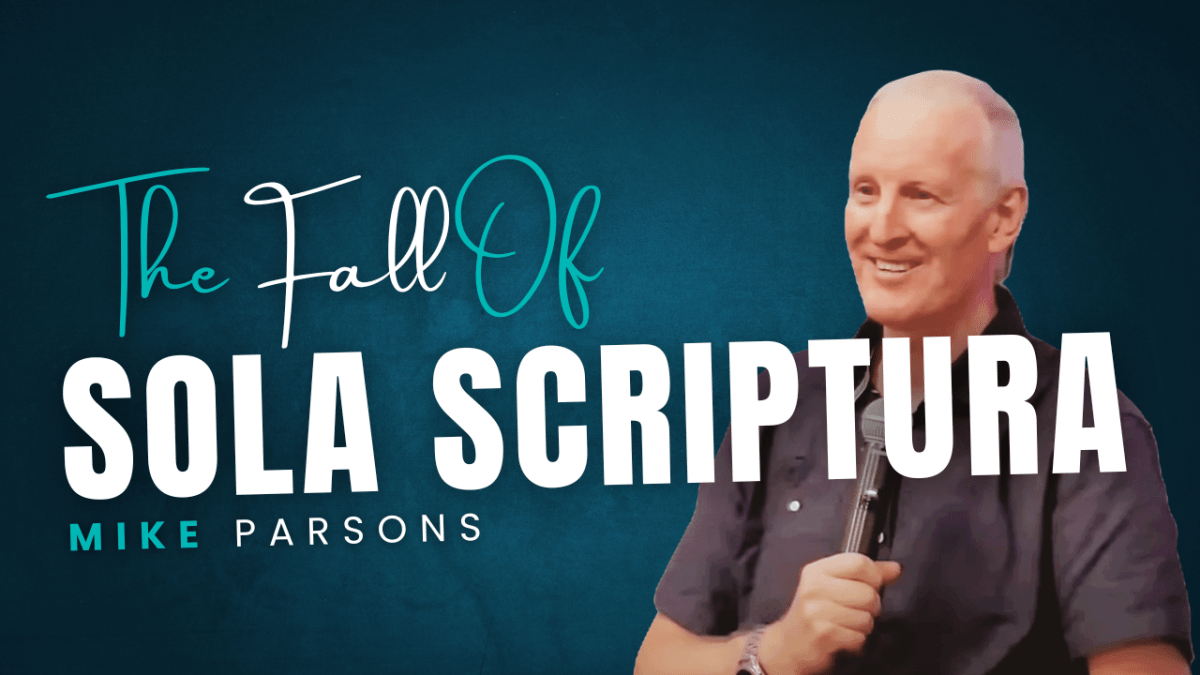
So sola scriptura was the second pillar. Well, without evangelicalism holding it up, that went over, which is why it changed my whole view about the Bible, the way I see the Bible, and the Bible being ‘the word of God’ and all that stuff: “It’s got to be in the Bible!” and all the challenge that came
with that, because God totally took me to task over it.
Problem two with penal substitutionary atonement theory is that it makes a wrathful violence the solution to everything. PSA claims that God’s justice will not allow Him to just forgive sin; instead, His wrath must be poured out – on an innocent, in this case, Jesus – and His justice be satisfied so He can forgive the guilty (us). And again, that concept presents God as a completely violent and wrathful Being, when He is love. He’s not anger. He’s not wrath. He’s not violence. He’s love.
That is the second real, big, giant problem with the theory of atonement – and the the word ‘atonement’ really just means ‘why Jesus died on the cross’ – ‘what He was doing on the cross’ – it makes wrathful violence the solution to all our problems: in short, violence is actually the answer. Well we know that can’t be true because of Jesus’ teaching, and Jesus’ life, and everything He represented. PSA claims that God must violently punish to satisfy His justice. Now, we can counter that by saying if God had to use violence to solve the problem, we elevate violence as a viable solution for people’s problems. “If God did it, then why can’t I do it?”
That actually is why people can justify the Crusades, and all sorts of persecution of people, and ‘salvation by the sword’, and all that type of thing that happened in the past because they were coming from an Old Testament perspective. And God wasn’t even that God in the Old Testament, because He’s the same, He never changes: He has always been love.
Their view of him was wrong and Jesus came to truly reveal what God was fully like. Even when Peter used a sword to cut off the high priest’s servant’s ear, what did Jesus do? He didn’t commend Peter for violently cutting off his ear, he put his ear back and healed him. Very clearly, the pictures and some of the illustrations that use the terminology of a sword coming to divide were examples of division, nothing to do with violence.
Another claim of PSA is that God punished Jesus on the cross as an expression of His wrath. Again I think we can counter that – the idea of God using violence directly contradicts the ethics taught and lived by Jesus, who is God. There is not one instance where Jesus who is God suggests this in His teaching, especially The Sermon on the Mount. Therefore it contradicts the core of Jesus’ teaching, which is to show mercy, to love our enemies and to never use violence to solve anything.
I think mercy triumphs over man’s desire and need for justice, for sacrifice for offering, and all the other things we have created in our own forms of religion.
Key takeaway
According to PSA, violence is actually the answer. Yet this directly contradicts the ethics lived and taught by Jesus.
This is part of an occasional series taken from ‘The Chariot of Ascension‘: in which Mike began to discuss 7 problems with PSA (as identified by Bryan Finley).
Our Patreon patrons give a small amount each month and can join us for our monthly group Zooms, get exclusive or early access to Mike’s teaching and enjoy further patron-only benefits. Or you can use the blue button to support our work with a one-time gift*. Thank you!
Note: This donation is securely handled through PayPal but you do not need to have a PayPal account yourself to make a one-time donation.
For repeating donations, if you do not have (or want) a PayPal account please support us through Patreon instead.
Penal substitutionary atonement refers to the doctrine that Christ died on the cross as a substitute for sinners. God imputed the guilt of our sins to Christ, and he, in our place, bore the punishment that we deserve (Theopedia).
Penal Substitutionary Atonement (PSA) Theory faces a significant challenge when we consider it in the light of Jesus’ life and teachings. There is a stark disparity between PSA and the person of Jesus, who is the incarnation of God and the very image of the Father. PSA appears to align with the Old Testament perception of God from a Hebrew standpoint rather than embracing the New Testament revelation embodied by Jesus.
PSA’s assertion that God cannot be in the presence of sin (due to His holiness) may resonate with evangelical doctrine. But in that case, none of us could be in God’s presence and He would not be able to even look at us. The idea that God turns His back on the world is nonsensical. And if God could not be in the presence of sin, then surely Jesus could not be either? And yet He spent time around prostitutes, tax collectors and sinners!
PSA also says that God cannot forgive sin without some form of punishment, contradicting Jesus’ consistent demonstration of unconditional forgiveness. Even on the cross, when He was undergoing punishment (by men, not by God) Jesus forgave without demanding punishment for anyone: “Father, forgive them; they do not know what they are doing.” PSA argues that God’s standard of justice is higher than ours and demands payment. In reality, it is we who demand payment, in the religious systems we have created.
Jesus challenged prevailing Hebrew notions of justice rooted in violence and retribution. He urged a shift from an “eye for an eye” mentality to a radical perspective of love, turning the other cheek and extending kindness to enemies. Genuine forgiveness harbours no resentment against enemies; and God, in His mercy, holds nothing against mankind. Let us allow the discrepancy between PSA and Jesus’ person and teachings to prompt a critical re-evaluation of our theological perspectives, to ensure we are aligning with the profound love and forgiveness exemplified by Jesus, even if this challenges the preconceived notions deeply ingrained in our theological traditions.
Love and forgiveness: God, in His mercy, holds nothing against us – and never has. Let’s ensure we are aligning with His profound love and forgiveness as exemplified by Jesus, even if this challenges our preconceived religious notions.
Our Patreon patrons give a small amount each month and can join us for our monthly group Zooms, get exclusive or early access to Mike’s teaching and enjoy further patron-only benefits. Or you can use the blue button to support our work with a one-time gift*. Thank you!Note: This donation is securely handled through PayPal but you do not need to have a PayPal account yourself to make a one-time donation.
For repeating donations, if you do not have (or want) a PayPal account please support us through Patreon instead.


![304. Wrath is not the solution | Penal Substitutionary Atonement [2]](https://freedomarc.blog/wp-content/uploads/2024/01/wrath-is-not-the-solution.jpg?w=1200)



![299. PSA Sounds Nothing Like Jesus! (Penal Substitutionary Atonement [1])](https://freedomarc.blog/wp-content/uploads/2024/01/nothing-like-jesus.jpg?w=1200)


 Sons of Issachar