If you do not see the video above, please click here.
Hebrews for the Hebrews
Hebrews was written to the Hebrews, which is evident from its content and the mindsets and beliefs the writer was addressing. The aim was to help them understand that the old covenant had ended and a new covenant had begun. Much of the letter was therefore written in that context. When we read passages such as, “If we go on sinning wilfully after receiving the truth, there no longer remains a sacrifice for sins,” some read this with a predisposed theological lens—for example, evangelicals might interpret this as a threat, but the reality is that there is only one sacrifice for sins, and it has already been made. If you sin, there isn’t another sacrifice—you’re already forgiven through Jesus. It’s not about going back to animal sacrifices or Christ’s work being insufficient because someone continues to struggle independently.
The following phrase, “a terrifying expectation of judgment and the fury of a fire that will consume the adversaries,” raises the question: who are the adversaries? It’s not people, but rather those things that cause us to operate in lost identity, leading us to act in ways contrary to our true nature. A judgment is a verdict—God declares, “That’s not good.” God is a consuming fire; He consumes everything opposed to the truth so you don’t have to live that way any longer.
The writer refers to those who ignored the law of Moses being put to death without mercy by the witness of two or three people. He’s speaking to Jewish believers, helping them understand their historical context and system. Just because something is said to this specific group doesn’t mean it universally applies today. This is a common issue—we don’t always consider audience relevance, asking who the letter was written to, why, and when. Hebrews was written before the destruction of the temple; these were covenantal issues. The writer is essentially saying, “Jesus has come; those following Judaism are trampling underfoot the Son of God, not accepting Him as Messiah, so your old system is coming to an end.”
Hebrews with a modern Western mindset
Much Christian theology reads Hebrews with a modern Western mindset, not recognising the original audience or situation. The statement, “It’s a terrifying thing to fall into the hands of the living God,” is terrifying for those living by the old covenant, as there is no grace for those who choose to continue living under the law.
We need to take the whole argument—not just individual verses—into account. The entire letter is addressed to Hebrews wrestling with whether to continue following the law of Moses. Judaizers—Jewish Christians—were trying to bring people, even Gentiles, back under the law. The writer of Hebrews asserts that the law is obsolete and has faded away. Under the old system, they couldn’t approach God directly; they were afraid to come to Mount Zion, so they set up a system of mediation with Moses and their priests. Now, however, the writer says you don’t need a mediation system—entry into the Holy of Holies is open to all, as we are now priests and kings after the order of Melchizedek. He was helping them understand the transition from old to new covenant.
Not the end of the world
Hebrews is not talking about final judgment at the end of the world; it’s a judgment on the system and the people who were choosing to remain in that system—lost identity bound up in a redundant religious structure. God’s judgment is that “this system doesn’t work”, and His consuming fire will destroy everything opposed to the true, grace-based salvation found in Jesus. That old religious system is the adversary, not people themselves. Jesus warned that those remaining in Jerusalem and the old system would be subject to destruction at the end of that age—meaning, of the old covenant age, not the end of the world. “The Heavens and the Earth” would be destroyed, which was a name for the Temple, where Heaven met Earth. And in the New Testament context, “the end” and the “last days” refer to the end of the old covenant age, but due to mistranslation, it is often rendered “end of the world” rather than “end of the age”—and this completely changes the meaning. Some English translations have elsewhere turned “this generation” into “this race,” further muddying the intended message.
The writer of Hebrews consistently points to Christ as the one true and final sacrifice for sin, once and for all. He was helping his readers understand the power of the crucifixion, the resurrection, and the reality of the new covenant—using language and concepts familiar to their Jewish context. Many modern readers misunderstand this because they interpret it through a contemporary Christian theological filter.
Old Testament quotations such as “Vengeance is mine, I will repay,” or “The Lord will judge his people,” are also misunderstood. God did judge the old covenant system, which came to an end. The new covenant was, in essence, re-birthed out of the ending of the old. As Jesus described in Matthew 24, these were the birth pangs of the new, not the death throes of the old—birth pangs lead to something being born.
Hebrews from the evangelical viewpoint
If you read Hebrews at face value, from the viewpoint of evangelical conditioning, you might draw all the wrong conclusions, missing the overall purpose of the book. For example, the passage about striving to enter rest refers to their striving within a religious system for something that the man-made system could never provide. We, on the other hand, already rest in the finished work of Jesus, included in Him. Yet people often think they need to strive because “the Bible says so”—but that is taking things out of context.
This shows the problems caused by the doctrine of sola scriptura, where every verse is read as something to apply directly to our lives today, without considering context. Such literalism creates many unnecessary difficulties for believers.
If you enjoy these video blogs, please take a moment to like, share, comment, and subscribe—it really does help. Thank you very much.
All Mike’s books, including The Eschatology of the Restoration of All Things, Into the Dark Cloud and Unconditional Love, are available to order from online and local booksellers or to buy as ebooks for instant download from our website.
More info at eg.freedomarc.org/books
Unconditional love has really been the focus of my life for quite a number of years. The experiences I have had of unconditional love have completely changed my whole belief system—especially concerning who God is, and therefore the reach of His love towards all of creation.
Those experiences of unconditional love have challenged my view of God. They have challenged many things I used to believe: doctrines, traditions and various other ideas. God’s love is unconditional. If it is not unconditional, then it is not love. That, I believe, is the key. If you put a condition on love, it becomes something you have to earn by fulfilling a requirement—and God’s love is not like that. It is unconditional, and that means it cannot be earned. It is love, freely given.
It is unconditional for everyone and for everything. That love knows no boundaries, no limitations, no barriers. I believe God wants everybody to know His love.
But unconditional love has so deeply challenged some of the belief systems I used to hold. I now realise that some of the things I believed were nothing more than religious tradition or myth. Some of the doctrines I held actually kept me in bondage and prevented me from experiencing unconditional love.
Now, it is that same unconditional love which has set me free—as I have experienced it in my relationship with Jesus and the Father through the Spirit. I believe only the experience of unconditional love will bring freedom from the religious deception that most of us have encountered in various forms throughout our lives.
If you have never been brought up in any kind of wrong religious setting, then praise God. But for most of us, there are things we have struggled with, things we have misunderstood, or things we once believed that we now know are not actually true. That is certainly the case for me.
There are so many beliefs I now realise were conditioned into me—programmed into me—by my upbringing, by my religious experiences in church and in other contexts.
The thing that probably challenged me most—and was the most difficult—was what happened when I began to reflect on the power of love and the power of the resurrection, that love overcame death. And that brought me face to face with a huge question: what happens to people after they die?
I began to realise I had been programmed with a religious belief—something I now refer to as the hell myth. I say myth, because the English word “hell” is not actually a biblical word at all. Yet that myth held a lot of sway in my life, even though it was not really something I felt deeply convicted about. It was not something I had arrived at through study or prayer. It was more a kind of unspoken assumption: I suppose that is just how it is. I never liked it. But it seemed unavoidable.
Now, I believe that unconditional love is the very essence of who God is—His character and His nature. It reflects who He is. He does not change depending on the situation. He is not one version of Himself in the Old Testament and another in the New. He is Father, Son and Spirit—and God is love.
God is light.
God is spirit.
God is a consuming fire.
And because of that, there are no situational ethics with God. He is consistent. He is reliable. He does not change. Therefore, we can depend on Him. We do not need to be afraid of Him. He is not going to be pleased with us one day and then grumpy the next—like He got out of bed the wrong side, as it were. Of course, God does not sleep in a bed! But the point is: He does not change. He is the same—and that gives us a deep sense of security. We do not need to worry that He might change His mind about us, or that we might not have done well enough. God is the same yesterday, today and always will be—because He is I Am That I Am.
That is a declaration that He will never be anything other than who He is—and He is love.
A Slur on the Character and Nature of God
For most Christians, hell and eternal conscious torment are sacred cows—fixed, immutable doctrines. Many people simply cannot imagine there might be another way of understanding them. But I believe the world, in general, has rejected what is, in fact, a slur on the character and nature of God. God is unconditional love. And yet, much of the Church has accepted that slur—the idea that God would torment His children in fire forever. That He would give them a body that never wears out, so that they can be burned for all eternity.
Is that a loving God?
Not from my experience.
That is not what He is like at all.
So then, what does happen to people after they die? It is an important question, because many people are afraid of death—afraid of what comes next. If we know the answers, we can help them make the right choices now, before they die. And even after death, I believe it is not too late.
Is death more powerful than unconditional love? Absolutely not, because unconditional love has overcome death. My own experiences—encounters in which Jesus and the Father have shown me what happens after death—have convinced me completely that people go into the consuming fire of God’s presence, into the fire of His love. And because of that, I am absolutely confident that death is not the end of choice for anyone.
Unconditional love wins in the end—because God is patient. God is kind.
God will never give up. Love will never fail. Therefore, that love will win everyone in the end, so that they too can experience it for themselves.
I did not always believe this. I was conditioned—just like most people—to think that you had to choose Jesus before you died, because after that it would be too late and you would go to hell. But that is not what I now know to be true.
Into the Fire
Jesus and the Father took me into the fire. They showed me that you can preach to people in the fire, and that people in the fire can respond to that preaching. They can be reconciled back into a relationship with God. They can come into His love. They can become part of the cloud of witnesses. They can enter into their eternal destiny.
Now, I understand that many people struggle with this idea. But I have experienced it—over and over and over again. I have been into the consuming fire of God—both with Him, and on my own—many times. I have seen God’s love in action. And I have seen that the fire of God’s love is purifying and refining.
I have seen the power of that love first hand—the power to bring transformation into someone’s life when they accept and realise that God loves them. Even after death. Even after all the things they might have done in life to reject Jesus.
Love wins. The fire of God’s love never fails.
It never gives up. Love wins in the end.
The restoration of all things is founded on this truth:
God’s love will never fail, and He will never stop loving. Not until every person, every created being, comes into the relationship with Him they were made for—because we were created for relationship. He created all of creation for relationship.
Unconditional Love – new book out now Mike Parsons’ new book, Unconditional Love, is out on 20 June 2025. Order it from your favourite local or online bookseller today, or get the ebook instantly from our website. More details at eg.freedomarc.org/books.
References to Gehenna misunderstood
Where does our idea of “hell” come from? In the early Hebrew scriptures, it is not mentioned at all. In the Hebrew context, the concept of hell really only began to appear after the Babylonian exile and was then further shaped by Greek influences.
Jesus’ teaching has often been used to affirm the concept or theology of hell, but I believe that is an eschatological misunderstanding. The teaching Jesus gave about “the end” and what would happen was not referring to the end of time, with a future judgement and resurrection in which some would be punished. When Jesus spoke of the end, he was not referring to the end of the world. He was talking about the end of the old covenant age. There was fire and judgement associated with that, because the system itself was judged—and judged as having failed to produce righteousness.
Jesus used terms and language people would have understood, associated with fire and judgment. But these were generational issues. Jesus said all those things would take place within that generation. They have since been wrongly applied to the end of the world and have become associated with eternal conscious torment in the so-called fire of God’s judgment. In truth, it is not the fire of his judgment. It is the fire of his love.
These are not separate events—what happened at the end of the age and the references to people being thrown into Gehenna, the fiery rubbish dump outside Jerusalem. They refer to the same thing: the end-of-the-age judgment. Not the end of the world, as we have been led to believe. It is an eschatological issue.
If we understand that Jesus’ concept of “the end” was not the end of the world but the end of a particular age, then we can also see that Gehenna— often wrongly translated as “hell”—was not referring to some distant point in the future either. It was about that generation. Jesus’ teaching about the end of the old covenant age and the associated fiery judgment has been used to support an infernalist theology, but again, they refer to the same event. It is not about the end of the world, and it is not about eternal judgment.
In fact, the judgment has already taken place—and we have all been found innocent. That is absolutely essential for us to grasp. We have been judged innocent, not guilty—righteous, justified. There is no need for punishment.
All those Bible verses that have been used to affirm a belief in hell as penal retribution, or eternal conscious torment, are verses that have already been realised and fulfilled. They do not need to apply to anyone today—not to any of God’s children, not to anyone at all. That is really good news. It is not the fear-based, manipulative message that says people who do not know Jesus will go to hell. That is not good news. That is fear, used to control people into accepting Jesus. It is no different from the time of Christendom, when people were told to believe in Jesus or be put to the sword. This is the same idea, simply reworded: believe in Jesus, or go to hell.
When we are willing to look again, with fresh eyes and an open heart, I believe we will discover that death is not the end of choice. People can still accept what Jesus has done while in the refining fire of his loving presence, even after death. I would challenge anyone to produce a single Bible verse that actually states that death is the end of choice. There are none. The only one people sometimes use is the verse that says “after death, the judgment”. But that verse is not talking about physical death. It is not saying what we have been told it says—not in context, that is not what it means.
Ask the Holy Spirit to reveal this to you. Ask for the revelation of the Father’s heart towards what happens after death and for understanding of the concept of his fiery love.
I want everyone to know: you do not need to fear the future. You do not need to live in fear of torment or punishment. And we should never be using those kinds of ideas to scare people into accepting a God who is love. That is utterly inconsistent. God is love. He would not punish someone forever and ever just because they did not believe in him. He believes in you.
He believes in the world. Jesus came to take away the sin of the world. God has reconciled the world to himself in Christ, not counting anyone’s sins against them. Let us do the same. Let us have a ministry of reconciliation—a ministry of power—and let us be ambassadors of unconditional love to a world that so desperately needs it, that desperately needs to know God as love.
Only then can people be free from the destruction that comes from a lost or mistaken identity. God wants them to be whole. He wants all of us to come back into family, back into relationship, back into this amazing relationship with God, who is love.
I want to take us into a short activation. If there is any fear in your life—any doubt about your salvation, or about where you might end up, or even concerns for your loved ones—I invite you to let God, who is love, begin to remove that fear.
And if you have doubts about what I have taught today, you do not have to believe what I say. You have the right to believe whatever you choose. But I do ask you sincerely: ask God about it. Ask him to show you the reality of life, the power of unconditional love, the truth that nothing can separate anyone from it. Ask him to show you what that really means for people’s lives. Ask him to show you personally, so that you can have your own experience—something that affirms to you the truth of who he is: his unconditional love.
Activation: Safe and Secure
I encourage you now to close your eyes.
Begin to meditate.
Allow your breathing to slow down.
And begin to think about God as love.
Just be still.
Come to that place where you can be still and know.
Know that God is love.
Let his love surround you right now.
Let the power of his love flow over your physical body,
flow into your mind, into your heart and your emotions.
Let love, the power of love, overshadow you.
Father, I ask that you would reveal to everyone listening,
the power of your love.
Show anyone now if there is any fear in their lives—
fear of you, fear of punishment, fear of judgment, fear of the future…
Let your perfect love cast out fear.
Love on your children in such a way
that they are safe and secure in your arms of love.
You will never let them go.
You will never let them out of your hands of love.
You are keeping them safe and secure.
Just rest in that love.
Let his love touch you deep within your emotions.
Let it bring healing to anything in your past—
any fear or doubt you have
about where your loved ones are, if they have died physically.
Let the power of God’s love affirm to you
the truth of his consuming fire.
Father, I ask that you would show all who wish to see
what the refining, purifying fire of your love is.
Show them how death is not the end of choice.
Reveal yourself, reveal the truth.
Unveil the truth,
so that we may experience you.
Heaven is open.
Set the desires of your heart on engaging the Father.
Let the Father lead you.
Let him heal you, restore you,
fill you with the power of his love—
overwhelming love,
love that conquers death,
love that is stronger than the grave.
Rest in that love.
Rest in the power of that love.
Truly embrace it,
and for a few moments,
just wait there in the presence of God,
in his love.
That’s what happened with me. My eschatology got deconstructed, and then the same verses led me to a view where hell doesn’t exist in the form I thought it did. In fact, hell doesn’t exist at all, because it’s not even in the Bible. But it does talk about Gehenna, it does talk about Hades, it does talk about Sheol—the grave. So, it talks about those things, but it also talks about them in a restorative way, not in a punishment way.
I know it’s hard because I’ve been through it. But I’ve been through it, and I’ve continued the process of realising that a lot of what I was taught was referring to the period of transition—out of the old and into the new—until the end finally came. And that is the end. No prophecy came after that. It was all fulfilled.
Jesus actually said that. He said, “Unless this comes to an end,” and, “Unless every ‘i’ is dotted and every ‘t’ is crossed,” and all that, you know—then the end won’t come. Well, the end did come. So that is the end: all things were fulfilled. It says in Luke that all things were fulfilled; every prophetic statement was fulfilled. All the promises of God were fulfilled in Jesus. It says in Corinthians, all the covenants were therefore fulfilled, because covenants are promises. So, they all got fulfilled. And I think that draws a line under it.
So, let’s listen to God and Jesus and the Spirit every day, because they’re speaking to us—not through a book, but in an inner, small voice as they dwell in us. There are a lot of people who aren’t listening to that voice, and a lot of people, obviously, who don’t even know that voice exists in them yet. But God is not going to stop until they do, in revealing the truth of their inclusion in Christ, their reconciliation in Christ, and their forgiveness through what Jesus did on the cross—which is an amazing, good-news testimony that the world needs to hear. But, “They’re all going to be cast into hell if they don’t accept Jesus”—that’s not a good-news testimony. No, that’s bad news. Let’s give good news!
And I think the world will begin to find God—who is a God of love and who loves them too much to let them be lost eternally for punishment. He loves them too much for that. He loves them, and according to Ephesians 1:4 he’s already made sure—predestined them to become restored to face-to-face intimacy. It’s predestined, even before the foundation of the world, that everyone would eventually be restored. People can resist that restoration. But people cannot resist God’s love forever.
I don’t believe God’s love will ever fail. It will never stop until everyone is fully restored back into relationship with him. Because he loves us.
If you enjoy these videos, would you please take a moment to like, comment and subscribe? It really does help. Thank you very much.
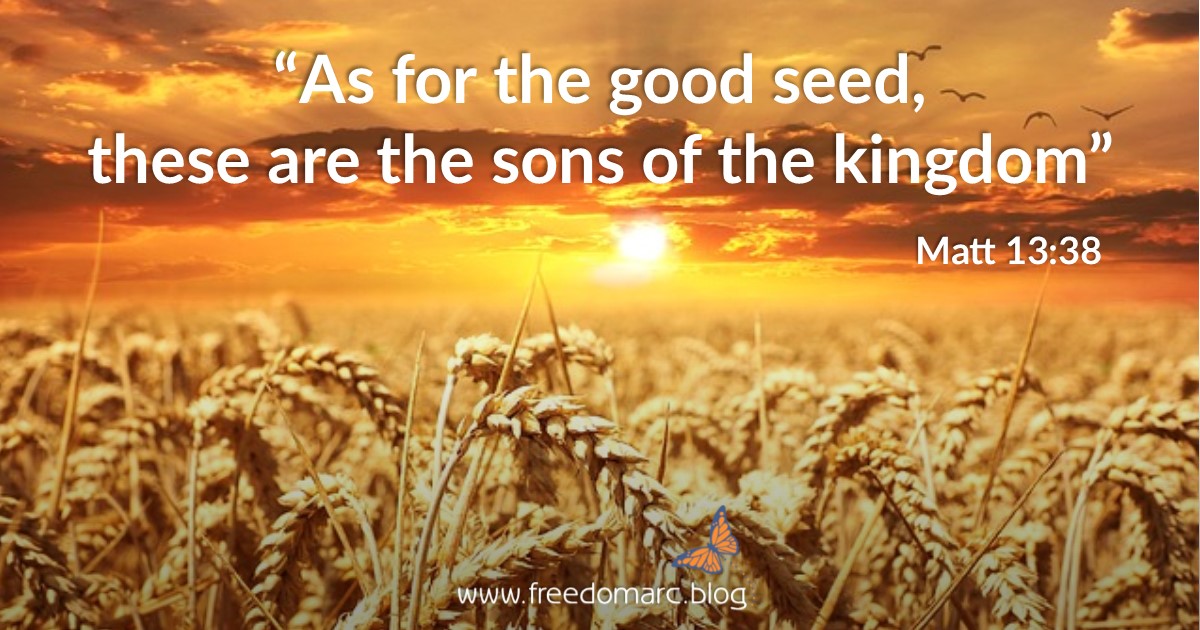
God is making us ready for the conflict that is inevitable if we are to bring in the harvest He is looking for. In the parable of the wheat and the tares in Matthew chapter 13, you will see that tares have been deliberately sown by the enemy to cause confusion and dismay. We are sons of the kingdom, but the sons of the evil one are out there and they are determined to oppose and obstruct us all the way.
Sons of the evil one
I am not just meaning worldly people. Jesus explained about these ‘sons of the evil one’ in Matthew 13:36-43: “Explain to us the parable of the tares of the field.” And He said, “The one who sows the good seed is the Son of Man, and the field is the world; and as for the good seed, these are the sons of the kingdom; and the tares are the sons of the evil one; and the enemy who sowed them is the devil, and the harvest is the end of the age; and the reapers are angels. The Son of Man will send forth His angels, and they will gather out of His kingdom all stumbling blocks, and those who commit lawlessness, Then THE RIGHTEOUS WILL SHINE FORTH AS THE SUN in the kingdom of their Father. He who has ears, let him hear’.
We are the good seed: we are the sons of the kingdom, so we need to manifest the kingdom. We cannot afford any longer to live like worldly people. The sons of the evil one have been planted on purpose to come into direct conflict with us as we seek to carry out God’s purposes. Some of them are sitting there on the tectonic plates even as you read this. They are operating in the atmosphere of the earth, with power and authority that is rightfully ours, and there will be conflict as we confront them and take it back.
Stumbling blocks
Jesus says that the harvest is at the end of the age, and that angels are involved in reaping it with us. And He says that ‘The Son of Man will send forth His angels, and they will gather out of His kingdom’ – not ‘out of the world’, you notice – ‘all stumbling blocks, and those who commit lawlessness’. The stumbling blocks are right there, in His kingdom, in His church, among God’s people.
This is serious. We could be a stumbling block. We could be opposing Him by doing it our own way. If so we risk Him saying, ‘Away from me, I never knew you’. There are people who have died and found themselves in a fiery place, which the Bible properly calls Hades (Greek) or Sheol (Hebrew), who thought they were going to heaven; I have seen them.. They were stumbling blocks. Stumbling blocks can be people; they can also be things in our lives that will cause us to trip up and fall. The dictionary defines a stumbling block as a ‘hindrance, offence, snare or trap’. The Greek word in the New Testament is ‘skandalon’, which gives us the word ‘scandal’ but actually means ‘the bait in a trap’. A ‘skandalon’ is something that leads us into a trap, it can be false faith, something that draws us into sin or error.
God wants to remove stumbling blocks from His kingdom; He wants to remove them from us personally. During this period we will see ministries that will fall if they are not working according to His Kingdom; churches too, however big or successful they appear to be. Jesus is looking for a church that is holy and pure in the Kingdom of His Father.
‘He who has ears, let him hear’. That is a phrase Jesus uses when He wants us to pay particular attention to what He is saying. It means He is saying something especially serious that we need to get hold of properly. God is issuing a challenge to us. He wants to remove the stumbling blocks, so He is sending His angels, and for now they are watching and waiting for us to say, ‘Yes, God, do it. We submit, we agree to you removing those things that hinder us’. But they are not going to watch and wait much longer. This is our window of opportunity to say, ‘I do not want to be a stumbling block that gets in the way of God. I can see there is a rock fall coming, one way or another (Matt 21:44). So deal with me, change me’.
Judgment begins
It is time for judgment to begin with the house of God (1 Pet 4:17). The sword comes to bring judgment, to divide right from wrong. God will tell us what is right and what is wrong today, if we will listen. He is looking for those whose hearts are willing. That is why He wants us to know Him intimately, because He loves us so much that He wants to make us ready for what is coming. He doesn’t want us ensnared or entrapped. He doesn’t want us to stay as we are because the way we are just will not do on the next level.
He disciplines those He loves – disciplines, not punishes – and that speaks of both correction and direction. Ours is not the best way: He wants to show us a better way. Hebrews 12:11 tells us that ‘no discipline brings joy, but seems grievous and painful; but afterwards it yields a peaceable fruit of righteousness to those who have been trained by it [a harvest of fruit which consists in righteousness – in conformity to God’s will in purpose, thought, and action, resulting in right living]’ (Amplified Bible). We need to display that righteousness, so that it is not just that He calls us righteous but that we outwork it and that it produces righteousness in us.
He wants us to be conformed to His will, conformed to the image of His Son; He wants us to be revealed as His sons. And as we will see next time, He wants a bride for His Son, radiant in beauty; for that to happen we have to face up to the fact that some preparation is needed.
Engaging God on the Heavenly Pathways of Relationship and Responsibility
Equipping a Joshua Generation of supernatural sons of God to live according to the order of Melchizedek


 Unconditional Love – new book out now



 Sons of Issachar