

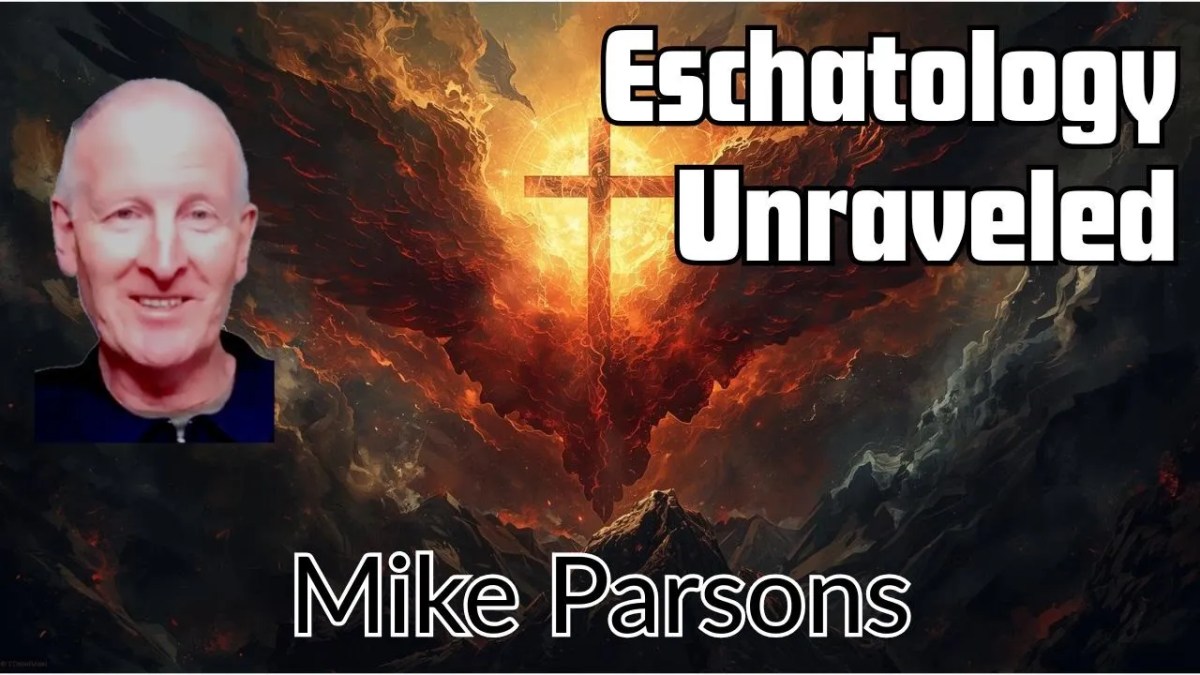
Mike Parsons –
There is still a great deal of mixture within the church when it comes to eschatology. Some people, for example, will reject the rapture entirely, yet still accept Zionism and a future millennium. For me, those ideas come from the same root system. They grow from the same tree, because those areas of eschatology have not yet been fully deconstructed.
In some cases, people have had revelation in one area but not in another. They are still emerging from an old programmed belief system, particularly dispensationalism, which was very prevalent among Pentecostal and charismatic movements. That system also included cessationism, the belief that spiritual gifts ended. Charismatics and Pentecostals rejected that aspect, because they clearly experience spiritual gifts, but many still retained other parts of the framework.
This leads to ideas such as six thousand years followed by a seventh, or a future age of rest. You can see where the symbolism comes from, but it is not meant to be literal. It speaks of spiritual rest, not of Jesus returning to establish a physical kingdom on earth. The kingdom of God is meant to fill the earth as leaven leavens the whole lump. It is not something Jesus comes to establish later, and it is not centred on Jerusalem or a particular ethnic nation.
Peter was very clear that those who were once not the people of God are now called the people of God. This has nothing to do with ethnicity or religion. It is about faith in Christ and relationship with him. Even under the old covenant, righteousness did not come through the law. Abraham was counted righteous before the law ever existed. The law never produced righteousness, so there is no reason to believe it would do so again in the future.
Paul makes it clear that there are not two peoples. There is one new humanity in Christ. Jew and Gentile are one new man. He even says there is no Jew and no Gentile. We should not define people by origin, but by their inclusion in the family of God. From one perspective, the whole world already belongs to God. Most people simply do not know it yet.
Paul writes that God was in Christ reconciling the whole cosmos to himself, not counting anyone’s sins against them. Jesus came to take away the sin of the world, not the sin of one group. Much confusion comes from poor translation and misunderstanding of terms such as world, age and cosmos. These distinctions matter.
There is still a great deal of deconstruction needed to remove dispensational thinking, particularly the idea that Matthew 24 refers to a future great tribulation. That tribulation already occurred. It was the judgment of the old system, which was found obsolete and faded away. I do not believe in a future tribulation, rapture or millennial reign.
If you follow the biblical narrative consistently, from creation through Christ and beyond, there is no need for man-made theological systems. Scripture does not describe ages of innocence, conscience, law, church or millennium. These frameworks were assembled by selectively combining verses out of context. Even the theologians who developed them would admit they constructed a system rather than discovered one.
Covenant theology can fall into a similar trap, trying to systematise the covenants rather than seeing their fulfilment in Jesus. Jesus is the fulfilment of all God’s promises. He is the true Israel of God. We did not make a new covenant with God. Jesus made the covenant with the Father and included us all in its benefits. That covenant will never be broken.
Previous covenants depended on human faithfulness. When Israel failed, God divorced Israel. Some Jewish groups recognise this and reject political Zionism entirely. They believe restoration can only come through the Messiah. The tragedy is that the Messiah has already come. Jesus has already included them.
All people are included in what Jesus accomplished on the cross. Jewish, Muslim, Hindu or any other religious identity does not exclude anyone. What excludes people experientially is remaining within religious systems of self-effort rather than receiving the finished work of grace.
Futurist theology creates fear. It raises endless questions about who establishes the kingdom, why it lasts a thousand years and why war is required. Whenever conflict arises in Israel, futurists quickly speak of Armageddon and promote war, because peace does not fit their theology. Jesus called us to be peacemakers, not war promoters.
I believe everything promised in Scripture is fulfilled in Christ. We are living in the outworking of that fulfilment now. There is no need for future prophecy systems. We are already in the period of restoration of all things.
There will always be differing viewpoints, even among those within similar mystical streams. People are entitled to their opinions. However, teachings that produce fear, confusion or expectation of catastrophe do not reflect the heart of God. God leads us into peace, not anxiety.
More people are beginning to recognise that these eschatological frameworks are undeconstructed belief systems inherited from evangelical conditioning. As inclusion and grace become clearer, these systems increasingly collapse under their own weight. If we truly believe in the restoration of all things, then we do not need to keep projecting fulfilment into the future. We are already living within it.
If you enjoy these videos, please take a moment to like, comment and subscribe. It really does help. Thank you very much.

 Sons of Issachar