
383. Greasy Grace or Limitless Grace?

Mike Parsons

You’re on dangerous ground when you take the evangelical position that the Bible is inspired, inerrant and infallible. Nowhere in the Bible does it claim that all its writings are inerrant, infallible and inspired.

For example, where does it say in the book of Isaiah that it was inspired by God? It doesn’t. Do I believe Isaiah prophesied with the inspiration of the Spirit? Yes, I do. Did he write it as a direct dictation from God? No, I don’t think so. He wrote and expressed what he felt God was saying to him, filtered through his own understanding. Would Isaiah have understood that the suffering servant was the coming Messiah? I don’t think so. But he wrote it because God inspired him to, or spoke to him about it.

We don’t need another book of stuff to argue over, or create more doctrines of God about!

Too much grace!

Many preachers warn against “greasy grace” but rarely show the same concern for excessive legalism. They always seem more worried about too much grace.

When it comes to Limitless Grace, this is not just grace upon grace; it’s the divine enabling power that works within us. As we grow in the awareness of this limitless grace, it transforms how we think and live. Limitless Grace, alongside triumphant mercy, is rooted in God’s unconditional love. If God’s love is unconditional, as it is, then his grace must also be limitless.

Unconditional love is God’s desire to work out that love for our good, to restore us to the place he intended from the beginning—a relationship with him, face-to-face, in innocence. Ephesians 1:4 speaks of this restoration to face-to-face innocence in love. If God’s love were conditional, grace would be limited. But because love is unconditional, grace must also be limitless.

God’s grace empowers us to return to our original purpose and identity by removing every obstacle that hinders us. Often, we think of ourselves through the lens of our upbringing, experiences, or societal expectations, which impose limitations. But God’s grace enables us to see ourselves as he sees us, unshackled by those hindrances.

I used to try to renew my mind by sheer effort, but it never worked because I was trying to fix the problem using the same flawed thinking. God renews our minds by giving us transformative experiences, revealing his unconditional love and limitless grace. These experiences change how we see him and, in turn, how we see ourselves.

Some misunderstand grace as “greasy grace” or “cheap grace,” as if it excuses any behaviour. But grace isn’t a cover for wrongdoing; it’s the empowerment to live differently. Grace is limitless because our capacity to act contrary to God’s love is vast. Yet, God’s grace is greater, ensuring we can always be restored to that place of innocence and relationship with him.

Grace is not about what we deserve or earn—it’s about God’s love for us. Critics of grace often argue that it promotes permissiveness, claiming it suggests that “God will love us no matter what we do, so it doesn’t matter how we live.” While it’s true that God’s love for us never changes, our actions do have consequences. They affect us—and others. That’s why God empowers us to live according to who we truly are in him, rather than who we think we are.

Unfortunately, much of evangelical Christianity is focused on law rather than grace. They see grace as “cheap” or “greasy,” fearing it excuses behaviour. But grace is not about fear of consequences or external control. I once spoke to a very evangelical man who admitted that the only thing stopping him from certain actions was the fear of God finding out. He was operating out of fear, not love.

God doesn’t want us to act rightly because we’re afraid of punishment; he wants us to live from a place of understanding and embracing his love and grace. When we see things as God does, we won’t want to do things that harm ourselves or others. That’s the true power of grace—it transforms us from within.

Grace does not excuse sin

Grace empowers us not only to avoid wrong choices but also to refrain from actions that contradict love. This empowerment is essential, yet some misunderstand it, accusing those who teach about unconditional love of promoting “greasy grace.” They claim God cannot excuse sin because he is righteous and holy. But what they misunderstand is that grace doesn’t excuse sin; it forgives us for it—even before we’ve committed it.

Grace allows us to see our actions from God’s perspective, enabling us to choose differently when we recognise something is harmful to ourselves or others. God loves us so deeply that he doesn’t want us to remain in harmful patterns. His grace renews our minds, helping us think differently and act differently.

The legalistic mindset focuses solely on law-based consequences—what happens if you do or don’t do something. It misunderstands God’s grace entirely. Grace doesn’t “cover” sin in a superficial sense; it forgives sin and empowers us to live beyond it. Sin, in this context, is not merely wrongdoing but a loss of identity. God has already forgiven us for being in that lost state and wants to restore us to the reality of who we truly are.

Triumphant mercy works alongside grace to overcome everything we do that contradicts God’s love. Mercy doesn’t ignore or tolerate wrongdoing; it works to bring us into a new way of living. This is why grace and mercy are empowering—they enable us to move beyond harmful patterns, not by fear or obligation but through love and forgiveness.

Evangelical perspectives

The idea of “greasy grace” reflects a complete misunderstanding of grace. Critics often claim that teaching about unconditional love and grace gives people an excuse to do whatever they want. But the reality is, people already do what they want. True grace transforms what we want, aligning our desires with God’s heart. Personally, I surrendered my free will years ago because I didn’t want to choose things in opposition to God. My desire now is to live in alignment with God’s love and purposes, not out of fear or duty but out of a shared desire to please his heart.

Unfortunately, evangelical perspectives often distort the meaning of grace, reducing it to an acronym or a rigid formula. Some view it as a way for God to tolerate us because of Jesus’ sacrifice, as though Jesus came to save us from God. But Jesus didn’t come to save us from God—he came to save us from ourselves and the consequences of living in a lost identity. The salvation he offers isn’t about avoiding an eternal punishment but about freeing us from the consequences of an independent path that leads to harm and separation from God in our perception.

Grace is often misunderstood in the evangelical framework because it’s tied to the idea that faith is something we must generate. However, faith itself is a gift that allows us to believe what is already true. Grace, grounded in unconditional love, has no prerequisites for us to receive it. It’s already there for us. When we accept it, we begin to enjoy its benefits, but it has always been available regardless of our actions.

Much of evangelical thinking wrongly assumes that grace is only extended after we perform certain actions—repentance, renunciation, or asking for forgiveness. But God has already responded to our independence by stepping into it, fully identifying with our lost state. The “wages” or consequences of independence were death—separation from God from our perspective, not his. God has always seen us through the lens of love, but we have viewed ourselves as separated from him, creating the illusion that we must earn our way back.

Legalistic, works-based religion arises from this flawed belief. But the truth is, there’s nothing we can do to make grace true—it already is. When we realise and accept this truth, we can enter into the joy and freedom it offers. Our acceptance doesn’t create grace; it simply allows us to experience it.

So critics of grace often frame it as a license to continue doing whatever we want. Yet true grace is the opposite—it’s the empowerment to live in alignment with God’s desires, in relationship with him, and free from fear, duty, or obligation. Grace changes the desires of our hearts because it allows us to know and experience God’s heart. This transformation empowers us to live as God intended—not as a requirement but as a joyful response to his love.

{Further topics are covered in the video].

382. Understanding Immortality | Beyond life and death

Mike Parsons


I think people understand one aspect of immortality—that you don’t die—but they often relate it only to a spiritual sense, like, “When you die, you go to heaven.” But that’s not immortality. That’s just your spirit and soul continuing to exist in another place. Immortality, as Jesus described in John 6, is physical. He said, “Eat my flesh, drink my blood, and you won’t die.” He made it clear it referred to physical death because he contrasted it with the bread eaten by the ancestors in the wilderness, who still died. He said, “This is the bread that’s come down from heaven. If you eat this bread, you won’t die.”

Now, obviously, many people who’ve eaten that bread have died, so there’s a disconnect between what Jesus said and our experience. That creates a problem for many because they see the countless Christians who’ve died since then and think, “Well, it didn’t work.” But the reality is, they didn’t believe it applied to physical death. Instead, they made an agreement with death, believing that dying was the path to heaven. For centuries, Christians have desired to die to reach heaven.

But if we go back to what Jesus said, the purpose of immortality becomes clear: God loves us unconditionally. He doesn’t want that love to end because “our time’s up.” Immortality is rooted in that unconditional love, enabling us to continually experience it here on earth and, eventually, in a fully reconnected heaven and earth. When that relationship is restored, we’ll no longer be limited to earth. We’ll have the freedom Adam would have had if he had continued ascending into maturity.

Jesus came to undo the works of the evil one, to destroy what robs, kills and destroys life. He didn’t destroy the evil one himself, but his works—anything that contradicts abundant life. Eternal life isn’t just about living forever; it’s about the quality of that life. Who’d want to live forever without the fullness of health and healing? Immortality must include healing, wholeness, and the vibrant quality of life God designed for us.

Eternal life reflects the life that flows from God’s eternal nature. It’s not just an endless number of days but the richness and multidimensional aspect of life. It’s about being unrestricted by time and space, not tied to Earth forever. The biblical terms translated as “forever” or “everlasting” don’t always mean what we assume. In the Old Testament, olam refers to a distinct period, an age. Similarly, the Greek term aion implies a defined era. So, when we understand these words correctly, immortality doesn’t mean stagnation—it allows for transformation and progression across ages.

This body, as God designed it, can be transformed to fit the requirements of each age or stage of existence. Immortality is about quality, capability, and the ability to live multidimensionally, not limited by earthly constraints. It’s about experiencing time differently, where time serves us rather than binding us. As we live in this reality, we’ll discover more of who God created us to be, moving into the abundant life Jesus promised.

I don’t want to live anything less than that abundant life. Jesus said we could have life in abundance, and I believe that promise will continually expand. It’s about living in the fullness of what God intended, fulfilling our destiny in this age and those to come. As we draw closer to God, who is light, our relationship with time and space will shift. We won’t be bound by current limitations.

Jesus demonstrated this multidimensional reality. He walked on water, passed through crowds, multiplied resources, and displayed mastery over creation. He operated from a place of complete understanding of how creation works, at a quantum level. We, as children of God, are called to be like him, made in his image and likeness. Jesus said we’d do everything he did and greater. To embrace this, our minds and consciousness must expand, enabling us to live in the fullness of who God designed us to be.

If you enjoy these blog posts, please like, share, comment, and subscribe—it really helps. Thank you!


368. No, Your Heart is “Not “Deceitfully Wicked”

Mike Parsons

The heart is deceitful

We cannot know who God really is other than through unconditional love, and we cannot know our true identity other than through unconditional love, because it is revealed in that loving relationship with God himself. The verse I want to highlight here is Jeremiah 17:9. When you compare the NIV with the Septuagint, you see how God’s view of mankind has been twisted by the incorrect translation of this verse.

In the NIV, it reads: “The heart is deceitful above all things.” That’s a powerful statement. “And beyond cure.” Well, that’s a pretty hopeless statement: “The heart is deceitful above all things and beyond cure. Who can understand it?” Now, that statement has had a major effect on how people view themselves and others, putting them in a position where the soul is never fully healed, made whole, or restored, because if it’s so wicked, deceitful, and beyond cure, how can it be? It’s beyond healing, beyond restoration. But I don’t believe that’s true.

The heart of man is deep

So, what does the Septuagint say? In Jeremiah 17:9 (which is Jeremiah 17:5 in the Septuagint due to the differences in verse structure), it says: “The heart of man is deep beyond all things, and it is the man. Even so, who can know him?” In reality, what this is saying is that our heart is not wicked, deceitful, and beyond cure. Instead, it is deep beyond anything we could understand ourselves, and it really is who we are. Therefore, we cannot know who we really are in our own flesh, in our own understanding; it has to come through our relationship with God.

This different translation shapes how we perceive ourselves and others. The NIV gives a very low view of humanity. I was conditioned by that view: man being wicked, corrupted, totally depraved. It created a theological spectrum of “worm theology” – the belief that you are no one and nothing, and you had better hope that God has mercy on you. Even after receiving salvation, many Christians still don’t believe who they truly are. They still believe they need to be humble and think poorly of themselves, giving them a diminished view of being sons and Christians, less than what God intended us to have.

The value of the soul

If our heart is deceitful, desperately wicked, and beyond cure, then what hope is there for us? It fosters the mindset of always being a sinner “saved by grace.” It’s a bit like the story of Winnie the Pooh and Eeyore, who always has this downbeat attitude: “Oh, I’m no good, and everything is going to be bad.” It creates that dynamic. This degrades the soul’s value and worth, leading to a belief that you can never really trust it.

When we first enter into a relationship where our spirit and soul are reconnected with the Holy Spirit, there’s a struggle between the soul and spirit. The soul is accustomed to dictating how we live based on what we believe, our upbringing, and our experiences, while the spirit brings us into the revelation of who we really are, revealing our true eternal nature. It draws us back to the fact that God has placed eternity in our hearts and wants to bring us into an amazing relationship, where we come home and return to Him.

That relationship is completely undermined by the degrading of the value of the soul. In the early church, especially within the Catholic tradition, this mindset led to self-persecution – people whipping themselves, kneeling on broken glass, and engaging in horrendous acts. Why did they think that way? Because they believed they were lesser than God intended. This view creates suspicion of the soul and devalues humanity. By degrading humanity, there’s a gospel message to sell: “We’re so bad, we need saving,” using the fear of punishment to sell that message.

Fearfully and wonderfully made

The reality is, God doesn’t view us as bad. He sees us through the lens of Jesus and who He made us to be – His sons. We’ve always been His sons; we’ve never not been His sons. But that’s not how I was taught to believe. I was taught to believe that I wasn’t good enough and never would be. And while we can’t be good enough in our own strength, when we become who we truly are, we begin to live out a whole different dynamic of sonship.

The Septuagint actually says the heart of man is deep beyond all things, and it is the man. The human heart is deep, multifaceted, and amazing, created in God’s image and likeness. Psalm 139 says we are fearfully and wonderfully made. God has a vast sum of amazing thoughts about us, and we need to learn those thoughts. Our minds need to be deconstructed from the negative things we might have believed, so we can know the truth of agreeing with God about who we really are.

Please like, share, comment, and subscribe at https://freedomarc.org/youtube

366. Decoding the Old Testament | Beyond the Literal

Mike Parsons

A very literal perspective

A lot of our understanding of the Old Testament comes from what we’ve been taught from a very literal perspective. However, much of the Old Testament can also be figurative. There’s poetry, and all sorts of things which can have a deeper meaning for us. In Noah’s day, the flood is often referred to in terms of Jesus being the Saviour, and it’s illustrative of how God came and rescued those who were willing to get on the ark.

What we must be careful of is not taking this too literally, as it was written with a different understanding of God. They didn’t have the New Testament understanding of God, nor did they know God in the way Jesus revealed Him. Their perspective was through their own understanding at the time. When we look at it now, we see it doesn’t line up with the God that Jesus came to reveal. So it’s our understanding that needs adjusting, not the idea that God was ever like that. God didn’t destroy the world.

Figuratively as well as literally

Now, there are those who say, “Yes, but the world was totally corrupt, and there were no genetically pure people left other than Noah.” Illustratively, of course, God desires that nothing within us be contrary to His image, the image He created us in. Our lives are being transformed by the renewing of our minds so that we come into that correct image. You can view these things figuratively as well as literally.

When it comes to questions like Sodom and Gomorrah—who caused the fire and brimstone? Well, who causes earthquakes? God doesn’t cause them. Who causes many other things? These are often the result of the natural world being in tension, not yet restored, groaning and longing for the sons of God to be revealed.

Fire and brimstone

Now, when you look at fire and brimstone—fire is often seen as God’s consuming fire. But we tend to think God destroyed them with fire. Fire could also be seen as a purifying force, a purification of what Sodom and Gomorrah represented, rather than a literal destruction of two cities. Some people believe they’ve found Sodom and Gomorrah, pointing to tar pits in the Middle East.

Brimstone actually means “God’s presence”—it’s the word “sulfur.” Brimstone is mentioned in the Book of Revelation, and the word used is “Theon,” from “Theos,” meaning “God.” So, brimstone signifies the presence of God, and God’s presence is purifying. These stories can be seen in that light. I know God didn’t cause these events because He doesn’t pour down judgment on people in that way. However, He does judge things that operate against the truth and will bring fire and brimstone to anything in our lives that hinders us from knowing and experiencing the truth and His love. But He’s not destroying people—He’s destroying the obstacles in our way.

There are different ways to look at it. Ultimately, I believe that God is love, God is good, and what He intends for us is to know His goodness and love. A lot of the Old Testament stories are figurative, but they’re written in a way that often doesn’t differentiate clearly between sowing and reaping. If someone sowed something bad, they reaped the consequences, not from God, but as a result of their actions.

The one who accuses

So, who brings about the consequence? The one who accuses and then comes to execute that accusation. We sow, and we reap the accusations against us for what we’ve sown. You could say the enemy brought the fire. In the undifferentiated view of God, if something bad happened, they thought God must have done it. But it could have been the enemy bringing the consequences of their behaviour, as the enemy seeks to rob, kill, and destroy.

Jesus said the enemy comes to do just that. So, who brought fire and brimstone? The enemy. Who brought the flood? You could say the enemy, or you could say the Earth itself reacted to the violence and horror, as described in Genesis 6, where violence was continual. The Earth washed itself clean. There are different ways to view it.

God is good

What I do know is that God is love, God is good, and He doesn’t kill or punish anyone, even if the Old Testament seems to say otherwise. Jesus came to reveal the truth. He said, “You’ve heard it said, but I’m saying to you,” and “If you’ve seen me, you’ve seen the Father.” Jesus didn’t destroy anyone. He only wanted to gather them to Himself because that’s what love does.

If you enjoy these videos, would you please take a moment to like, share, comment and subscribe, whether here or on YouTube. It really does help. Thank you very much.

364. The Hidden Texts

There were lots of writings that the early church had that were destroyed by Constantine. So, Constantine, in the Nicaean Council in 325, got all of the writings and letters that had been written, that they were using to preach from, took them all to that Council, decided which ones were acceptable, and then burnt the rest. Then they selected from the remaining writings during the Council of Carthage in 385, determining what they considered acceptable, which later became what we now know as the Bible, τὰ βιβλία, a library of books and letters. I don’t believe that God made the choices; I believe they did.

In the original version, there were different numbers of books. For example, what Protestants now refer to as the Apocrypha included 11 additional books. Some of the books Jesus quoted from, like the Book of Jasher, the Book of Enoch, and the Book of Jubilees, were among those not included in the final selection. I believe there were several such books that were referenced but ultimately left out.

Now, why didn’t they include them? Why did they include certain other things? Well, there seemed to be a bartering going on, from what I can understand, that there was a “Well, I want this one, and I want—well, if you’re having that one, we’re not having this one.” It wasn’t an inspired selection, that God told them to put these books in and take those books out. The Ethiopian Bible has 84 books, I think, and that’s one of the oldest recognised Bibles. The Protestant took all of those others out. Even the original King James had the Apocrypha in it, and then they took it out.

So, which books were the books that were in the Carthage one? Well, more than the 66 books that are in the present one—that’s the Protestant version. I remember asking people, “Well, why are these books not in the Bible?” and they were like, “Well, they’re not inspired.” That’s just nonsense. That’s just an excuse for saying, ‘Well, we don’t want these books because…’

And some are letters or documents that were written that were too controversial or complicated for them to accept. Because remember, why were they making a Bible? Because people couldn’t read, generally. You know, probably like less than 10% of the population could read. So, someone had to read it. So, why were the letters read out in the church? Because most people couldn’t read. That’s why they read them out.

So, they weren’t producing a Bible so people could read it. They were producing a Bible so they could actually say, “This is what we are going to tell people,” and they can’t hear anymore. Because, essentially, then what happened was, “Well, we’ve got a Bible, we don’t need to hear God anymore. God doesn’t speak anymore. He’s spoken through the Bible.” That’s what happened primarily.

And then, because most of the Bibles, in the Roman aspect of things, were done in Latin, they were written in another language, which most people couldn’t read because they didn’t really speak Latin. It was a written language, but it wasn’t the common language of the early church. Greek was, but it became the Roman language. And who could read that? Priests. So then it became a priestly thing to tell people and mediate. So it became a mediatorial system to control people because people couldn’t read it for themselves.

So someone had to read it. Well, what are they going to read? They’re going to read the bits [they like]. And well, then, how do people know what it’s saying? Well, because they’re telling them what it’s saying. So then you’ve got doctrine and theology being set by the Pope, effectively, who is “God’s vicar on Earth,” who has the divine authority to say what’s right and wrong. Which, seemingly, for me, is the Holy Spirit’s job, to guide us into the truth and lead us into the truth.

If you enjoy these blogs and videos, would you please take a moment to like, share, comment and subscribe? It really does help! Thank you very much.

363. Deconstructing the Pillars of Your Mind

Video summary

The Word of God

The traditional Evangelical view of the Bible as the inerrant and infallible word of God is problematic. The  true “Word of God” is Jesus, the Living Word, and direct experience of God through the Holy Spirit takes precedence over scriptural interpretation.

Biblical passages often used to support legalistic or fear-based theology, including those about the “deceitful heart” and “missing the mark,” point to humanity’s lost identity in God rather than inherent wickedness or behavioural failures.

Redemption

Jesus’ sacrifice on the cross was not to appease an angry God but to restore humanity’s true identity as children of God. Redemption is not earned through religious practices but is a free gift received through recognizing our inherent union with Christ.

Religious Conditioning and Personal Experience

Religious indoctrination, particularly within Evangelicalism, parallels cult-like control through fear and guilt. Personal experience with God, guided by love and discernment, is preferable to blind acceptance of religious dogma and trusting external authorities (including charismatic figures and self-proclaimed prophets).

Nine Pillars

In my personal journey of deconstruction, I once viewed the world through a framework of nine “pillars,” primarily rooted in Evangelical doctrines but also influenced by cultural and scientific conditioning. The process of each pillar being challenged and ultimately dismantled led to a transformed mind, grounded in love and direct relationship with God.

The Role of Love

Prioritise direct relationship with God through the Holy Spirit over rigid adherence to scripture or religious systems. Love is the ultimate measuring stick for discerning truth and evaluating personal experiences. Actively seek God’s guidance in a process of ongoing deconstruction and renewal, leading to greater intimacy with God and a more accurate understanding of our true identity in Christ.

352. Relational Beings of Limitless Potential

The complete fifth session of the current monthly teaching series by Mike Parsons, “Restoring First Love”, originally delivered live in a Zoom with our Patreon patrons. These full length sessions are normally only available to patrons and at eg.freedomarc.org/first-love.

Video Summary

“Mankind’s union with God is the original thought that inspired creation.”
– Francois Du Toit.

Reflecting on my journey with God, I see how He has led me into an extraordinary union and intimacy that I never imagined possible. Initially, I struggled to grasp His love for me beyond the theological, but He gradually revealed my true identity as His Son. In 2008 and 2010, my encounters with God began to go beyond Bible reading: I started meditating on specific verses but soon realised the connection to Heaven was always open.

Experiencing the rivers of Eden flowing through my heart deepened my intimacy with Him. Embracing my experiences without overanalysing them, I used journaling to revisit and deepen them. Opening my heart daily to God became a way of life, guiding me into constant communion.

During a group encounter, I encouraged people to picture a door and invite Jesus in. One participant’s experience in going back through that doorway inspired me to do the same. This shift allowed for a continuous flow between heaven and my heart, guided by Jesus, the Father, or the Spirit.

I engaged with the garden of my heart, resting and planting seeds of testimony by the River of Life; seeds which grew into trees, bearing fruit. My journey included discovering gemstones, scrolls, and a waterfall. Behind the waterfall, I encountered a cave where Enoch gave me transformative quests. These experiences brought me to the Tree of Life and the Throne of Grace. A profound moment under the waterfall showed me God’s love for everyone, even those who have caused harm, removing judgment and deepening my compassion.

On the Throne of Grace, I received a scroll of destiny from the Spirit of the Fear of the Lord. In an intense encounter, the consuming fire of God purified it, leaving only love. Plunging down a waterfall into the Father’s Garden, I felt a deep connection with creation and discovered the origin odf my design. This opened new realms of understanding and intimacy with the Father.

These encounters were all about drawing closer to God in intimacy. The more I have walked this path, the more I have understood the Father’s heart is focused on restoring both our sonship and all creation. In future sessions, I’ll share more about these revelations, and we can explore them together.

Activation: Deeper Into Love

A separate video of this activation is available on our Patreon page, free to view for all; it will be released on YouTube on September 5th.

I’d like to guide you through an activation, to engage wherever God leads you. The key to these experiences is to trust in God’s unconditional love, letting go of control and allowing Him to direct your journey. As you engage in this exercise, be open to the Father’s leading, and embrace the love He shows you.

To start, find a comfortable position, close your eyes, and begin to relax. Focus on connecting with God as your Father or Jesus as your friend and brother. Slow your breathing: inhale deeply through your nose, hold it for a moment, and then exhale slowly.

As you breathe in, draw in the unconditional love of the Father, filling every part of you with His love. Picture yourself cocooned in this love, safe and secure. Allow yourself to sink into the ocean of unconditional love, going deeper and deeper. Stay there for a few minutes.

If you wish to continue, picture a door in your spirit with a handle on your side. Open it and invite the Father, Son and Spirit to embrace you. Feel their love, acceptance and affirmation. Hear them say, “You are my beloved child, in whom I am well pleased.” Stay in this place of love and peace for as long as you like.

If you want to go yet further, envision following the flow of the river into Eden. Step into the river and let it carry you through the heavenly realms. Enjoy the river’s life-giving flow. Look into the water for gems or scrolls, pick up and eat those that attract you, and receive the life and truth they offer.

Stay there, or choose to follow the river upstream to a waterfall. Walk or float under it, feeling God’s love cascading over you. Let the sound of the waters resonate with your heart. Feel God’s love for you and for others. Allow this love to inspire you to forgive and love others as He loves you. Release any unforgiveness or hurt by choosing to forgive and let go.

Feel free to stay in this space or continue exploring as you wish.

345. The Rapture of the Saints

Mike Parsons – 

“The Rapture’s Coming!”

Every time there’s any sort of sign in the heavens, people say, “Oh yeah, the rapture’s coming, blah blah blah blah blah.” I mean, half the Amazon rainforest has been cut down to produce books about the rapture, and none of them came true. I’ve got a whole shelf filled with those books that people have either sent me or I used to have, that I keep just as a reminder that it’s never going to happen.

It won’t. It’s all based in a wrong understanding of God’s purpose, based in a theology which was a rejection of the Holy Spirit back in the 1820s. The Brethren – dispensation, millennialism, rapture theology all came from the same source. Zionism also. It’s all the fruit of a poisonous tree, sadly, but people buy into it hook, line and sinker. Any time there’s any sort of thing that happens in the world, you get all the crazies coming out, sadly. They’re well-meaning, a lot of them. It’s deceiving. It’s just a huge deception.

Whenever you reject the Holy Spirit, you’re opening yourself up for demonic deception. The whole Brethren movement, which was inspired by God for the priesthood of all believers, saw many believers come out of the institutions to look for a simpler way of engaging house to house. The Holy Spirit fell on them with prophecy, tongues, and gifts in the 1820s.

Ultimately, they rejected that, some of them. Deception came upon them, and then they needed a theology that explained why the Holy Spirit wasn’t for today, which they came up with: dispensationalism and cessationism as part of that. Then, along with that, came the rapture, the whole deception of it. Scofield was paid by a Jewish source to promote that because it plays into the hands of those who are looking for a one-world governmental system on earth. All it does is rob us of our authority to bring the Kingdom now and promotes fear.

Cult-like Deception

There was a lady in the States who killed two of her children because she didn’t want them to go through the [tribulation]. That was last year [2021] because it was supposed to be February the 24th that the rapture was going to happen. She actually killed two children because she did not want them to go through the tribulation. That’s how deceptive it was, but it becomes very cult-like because it’s a very controlling thing. We need to see it exposed; more and more people need to be set free from that deception. People will throw out the rapture, but they’ll keep the millennium because they’ve not yet realised it came from the same source. Or they’ll keep Zionism, not realising it came from the same source. That’s part of the problem: people are not discerning, and they don’t find out. They just believe what they’re told, and if you hear it enough, you think it must be true. That’s true. People do believe it because they’ve been told, and they kept being told.

I was brought up with it. I was in the Brethren Church. I know the roots of it. I researched it. I found all the books of the early Brethren fathers and what they shared, and how good it was in the beginning. But you could see when it went off, and you could see when deception came in because the writings changed. The tone of them changed. They became judgmental. The love went out of them. You can see it in just what was written, how it was written. Everything changed from the inspiration that they had.

If they had continued, you would have had Azusa Street-type revival 80 years before it happened. But they rejected it, and it took 80 years for that to come round again. The most ironic thing, and this is a huge irony, the Brethren movement does not allow women to speak, and they don’t believe in prophecy. But when the Holy Spirit was moving on that group, a woman called Mary Margaret McDonald prophesied a vision, and they based the rapture teaching on that prophecy. But they don’t believe women can speak, and they don’t believe prophecy, but they based the teaching on it and mixed it with a Jesuit priest’s teaching, and came up with that whole system of belief which hijacked the seminaries around the world for the best part of a hundred years.

Impact on Mainstream Christianity

It is still taught in most seminaries around the world, unless you come from a Reformed background. Most of the other charismatic seminaries teach it because they were totally hoodwinked by it. The Scofield Bible, which was commissioned and paid for with an agenda that wasn’t from a Christian, promoted that. The Scofield was a King James Version that contained all the notes related to the rapture, the seven dispensations and cessationism, all in the notes. That infiltrated the seminaries around the world, and then most of the missionaries’ teaching, and the evangelical movement were actually taught from those seminaries.

That’s why it’s so infiltrated mainstream because it got in through the seminaries, and then that went out through and infiltrated most of the evangelical movement. It wasn’t really until the charismatic movement started to bring people back to a restored relationship where they could hear God for themselves, that people started to question some of those things.

When I got baptised in the Spirit in 1986, the first thing God said to me was, “You need to understand kingdom and covenant.” Well, I thought I knew what kingdom and covenant meant because I’d been brought up in the Brethren movement. That’s all they talked about: the kingdom coming a thousand years after all this stuff. It took me three years of going back with God through the Bible, because He just did it. I didn’t read another book: I just went through the Bible. He showed me the whole error of all of it, and I found a whole different view of what is going to happen, which has led me and helped me to come and embrace restoration and everything else. But that was a long time ago.

I already had a lot of deconstruction from futurist eschatology 40 years ago. Now, it’s so easy to see how all this works together with what God is doing to restore. I didn’t have all of that negative stuff. I had a lot of demons cast out of me. I had a lot of religious spirits specifically from that movement. It was a deceptive movement: it was birthed in God – and rejected God for an error. When you do that, you open yourself up to deception. It has had probably the biggest deceptive influence on mainstream Christianity in the last 200 years. A huge deception.

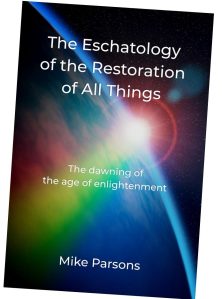
Mike goes into much more detail on these subjects in his book The Eschatology of the Restoration of All Things, available in paperback or as an ebook.  Click here or on the image above for details.

Support Freedom ARC#

The ‘new’ Patreon page Mike spoke of in the video is now well-established. Find out more by clicking the image below.

'Donate to Freedom ARC' button

Our Patreon patrons give a small amount each month and can join us for our monthly group Zooms, get exclusive or early access to Mike’s teaching and enjoy further patron-only benefits. Or you can use the blue button to support our work with one-time gift*.
Thank you!

Note: This donation is securely handled through PayPal but you do not need to have a PayPal account yourself to make a one-time donation.
For repeating donations, if you do not have (or want) a PayPal account please support us through Patreon instead.

342. “God Punishes Those He Loves!”

Mike Parsons

In this session, I continue my series Restoring First Love.

Misunderstandings about God’s nature, such as this belief that He punishes those He loves, often stem from incorrect interpretations of scripture. Hebrews 12:5-6, commonly cited to support this view, is actually a misquotation of Proverbs 3:11-12, which speaks of God’s discipline as loving guidance, not punishment. Evangelical theology, influenced by doctrines like penal substitution and eternal conscious torment in ‘hell’, has misrepresented God’s character, which can distort our understanding of His love and lead to harmful practices such as corporal punishment.

When I reflect on my own experience with spanking, I acknowledge that it was based on incorrect teachings about God’s nature. True discipline from God is about correction and guidance, not punishment. God’s desire is to help us grow and align with our true identity in Him.

Finally, an activation exercise will help us connect more deeply with God’s love. By focusing on Him and breathing in His unconditional love, you can experience intimacy and healing. Visualise opening the door to your spirit and inviting the Father in, allowing His love to heal wounds and remove negative feelings. Rest in His presence and experience His love more fully.

322. Spiritual Listening: Beyond Biblical Meditation

I find joy in spending time in God’s presence. I have moved beyond the need to only meditate on the Bible, because interpreting it can be complex and subjective. Instead, I allow God room to speak to me in various ways. I  relax, clearing my mind and focusing solely on the Father or on Jesus. I open my heart and mind, ready to receive communication from Him.

This can take various forms, whether it’s a thought, a picture, a vision, or simply a knowing. I have had visions that were vivid encounters, although they weren’t visual in the traditional sense. When we perceive spiritually, it’s not about light bouncing off objects into our eyes; it’s about tuning into a different wavelength and interpreting the impressions received by our spiritual senses. Just as different tastes or smells can be unfamiliar until we learn to recognise them, spiritual experiences require us to train our spiritual senses to filter out distractions and focus on what the Father is communicating. Whether it’s ascending into heavenly realms or standing before the Arc of the Presence or whatever else it may be, I am not seeing any of it with my physical eyes because I always journal these experiences with my eyes open. Yet, I am there. I am an active participant, but I am also translating my spiritual perceptions into descriptions of my experiences.

I have found that it’s more about enjoying being in the presence of God. Instead of focusing on visualising or hearing something in a specific way, simply relax and see what unfolds. Talk to God and listen for His response, asking Him to reveal something to you in His own way. For me, understanding doesn’t always come through visual or auditory experiences.

Even the word ‘see’ can refer to more than just visual perception: it can also mean to perceive or understand. The main idea is to grasp the concept, regardless of the method. In the early days, there was often a strong emphasis on ‘seeing’ as a prerequisite for spiritual experiences. Ian Clayton, for one, was quite insistent about this. But no-one else knows what exactly he sees or how he sees it. He shares what he has seen, just as I too share my own experiences! For me, it is about a deep knowing – an intuitive perception that comes from engaging with God repeatedly over time. I sense and feel His presence, and my emotions are often deeply intertwined with these experiences, with moments of intense emotion when I feel the waves of His love rolling over me.

Analysing or dissecting spiritual experiences can make it more challenging to receive them. If you rely heavily on logical, analytical thinking, you may struggle with this. It’s understandable to want to understand and control the process by seeking a set protocol or method to follow. However, spiritual connection is inherently relational, and it’s best to allow the relationship with God to unfold naturally.

I made a conscious decision to let go of my own agenda and simply ‘be’ in God’s presence, with no particular expectation of seeing or hearing anything specific. Every night before I go to sleep, I intentionally connect with God in the garden of my heart; surrounded by green pastures, beside quiet waters, with the Shepherd by my side. As I drift off to sleep, my spirit remains open and receptive to experiences in the heavenly realms, while my soul is restored as I rest securely in the Father’s embrace. When I wake, I may sometimes retain memories from my time in God’s presence. But if there are mornings when nothing comes to mind, that too is perfectly okay.

Key Takeaway

Find joy in spending time in God’s presence, and allow your relationship with Him to unfold naturally.

Support us

'Donate to Freedom ARC' button
Our Patreon patrons give a small amount each month and can join us for our monthly group Zooms, get exclusive or early access to Mike’s teaching and enjoy further patron-only benefits. Or you can use the blue button to support our work with one-time gift*.
Thank you!
Note: This donation is securely handled through PayPal but you do not need to have a PayPal account yourself to make a one-time donation.
For repeating donations, if you do not have (or want) a PayPal account please support us through Patreon instead.