


473. Why Do We Assume? | Questioning Our Beliefs and Practices

Mike Parsons

Not seeing the video above? Find it here.

We often make assumptions simply because we’ve never thought to question things, or even paused to ask, “Why am I doing this?” It’s so important to consider our motives. I’m not saying that people shouldn’t gather, worship, or take part in services—if that’s how they want to express themselves, that’s perfectly fine. But it’s worth asking ourselves and one another, “What’s at the heart of this? Why am I really doing it?”

A friend of mine, for instance, shared how God told her and her husband not to attend the Sunday meeting anymore. Her husband was delighted—he could use the time for other things—but she was horrified. Every time Sunday rolled around, she felt guilty for not going. It took her six months to work through that guilt. Guilt doesn’t come from God—it stemmed from her conditioning and an internalised mindset of what she thought she ‘should’ be doing. Once she processed those emotions, she found incredible freedom and began enjoying life outside of that obligation. She also found that her relationships changed: there were genuine friends who stuck by her whatever she did, and ‘church friends’ who were only present if she attended church. Real friends are those who stand by you through thick and thin, not just casual acquaintances from shared routines.

Whenever we feel compelled or would feel bad for not doing something, it’s worth asking ourselves: why? What is driving that feeling—guilt, compulsion, or freedom? God never wants us to be in bondage to something because we’ve assumed He desires it when it may not be His intent at all. Asking “Why am I doing this?” is always helpful, and I’ve had to do this myself many times. God has nudged me out of many such patterns. For example, a few years ago—around 2022—He told me to stop doing my annual Vision Destiny teaching series. The idea was that people should discover their own destinies with God and engage in their own conversations with Him, rather than relying on mine.

I realised that, even after stopping public teaching, I was still journaling out of habit. When I asked whether God wanted me to continue, He made it clear that it was up to me—He didn’t require it as a condition for our relationship. It was freeing to realise that my sense of duty was self-imposed, not divinely required. Eventually, I let go of journaling, and even changed how I approached my time with God in the mornings.

This shift wasn’t about having a better or worse relationship with God, just a different one. I learned that intimacy and union with God doesn’t depend on set routines or religious disciplines; it can be experienced just as deeply in everyday life, in the garden, the workshop, or wherever I am. Sometimes that connection comes through a conversation with God, but just as often it’s a felt sense of His presence throughout the day.

Since embracing this freedom and releasing the conditions I thought were required, my experience of God’s unconditional love has grown so much deeper. I realised that the expectations I thought God had of me were really just conditions I’d placed on myself. As I allowed those to fall away, I became freer, more connected, and filled with joy in everyday life, knowing that God’s love is unconditional and not dependent on any ritual or discipline.

If you enjoy these video blogs, please take a moment to like, share, comment, and subscribe—it really does help. Thank you very much.
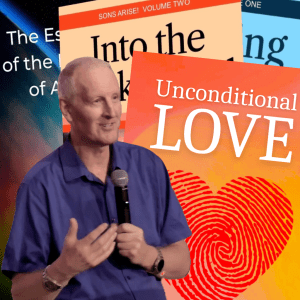

All Mike’s books, including Into the Dark Cloud and Unconditional Love, are available to order from online and local booksellers; or you can buy them as ebooks and download them instantly from our website.
More info at eg.freedomarc.org/books


307. God’s Unconditional Love For You

FREE – 2020 Vision Destiny

442. Unconditional Love – NO GUILT, NO SHAME

470. Beyond the Norm: Finding Joy Outside the System

Mike Parsons

No video above? Please click here.

Christians can’t have fun?

We can find ourselves really constrained within certain systems and among people who all think the same way—which leaves little room for personal growth or enjoying life. Christians, for example, often end up repeating the same routines—organising potluck meals and eating quiche and such things, which can become a bit staid and, frankly, rather dull and boring. That’s not to say Christians can’t have fun—but generally speaking, the world exists for us to discover, to enjoy, and to bring light into, ideally in a way that’s enjoyable and adventurous.

Sometimes I wonder why anyone would want to become a Christian when, so often, Christians come across as quite miserable. Then there’s the expectation of attending church three times on a Sunday. Why should that be necessary? If I’m enjoying myself by going out, why can’t I worship God in the fresh air? These mindsets persist: we invite people to join us, and then expect them to give up what they find pleasurable in order to join a ‘Christian club.’ In the process, such people often lose touch with real life—and many of the positive experiences they had with God in the past are lost. They end up just becoming ‘church people,’ which really doesn’t attract anyone.

Representatives of God’s love

Instead, we ought to show that life can be enjoyable, that we can have fun, love others, and care for them—that’s the sort of dynamic we should be bringing to the world. We’re meant to be representatives of God’s love, demonstrating care and compassion through what we do. When people hit a crisis, they’ll seek out those who are authentically loving, relatable, and understanding—the kind of people who can help them encounter God through genuine relationships.

I wholeheartedly believe in continuing to enjoy life. Since embracing this perspective, I enjoy life much more as I believe it was intended to be—without imposing a set of rigid rules and obligations that dictate where I should be and what I must do.

Going to church

I go to church meetings with Debbie because she enjoys fellowshipping with others. I like singing too, so I don’t mind joining in, but I doubt I would go if it weren’t for her. I value those friends and connections, but sometimes I do find it a struggle. In the home group, I occasionally bite my tongue to avoid offending others, but now and then God gives me permission to say something a bit provocative, to open up honest discussion. Ultimately, though, if Debbie didn’t attend the group, I wouldn’t go there either. This week, there’s football on—so I’ll watch that, as I’ll probably enjoy it more than wrestling with theological discussions I find hard to connect with. I don’t attend to cause trouble; I simply value the freedom to go or not to go.

No option

Reflecting on my past, especially when I was in church leadership, I remember having no option—I had to be there, unless I was on holiday. It was expected of me as a leader. I was often speaking—which meant there was little choice, and as I was being remunerated, there was a sense of obligation. I would have felt guilty for not going. Although it was genuinely more than just a job for me, there was still a mindset that I needed to “give them their money’s worth.” That way of thinking comes from conditioning: it is certainly not freedom.

If you enjoy these video blogs, please take a moment to like, share, comment, and subscribe—it really does help. Thank you very much.


All Mike’s books, including Into the Dark Cloud and Unconditional Love, are available to order from online and local booksellers; or you can buy them as ebooks and download them instantly from our website.
More info at eg.freedomarc.org/books

317. Leaving a Positive Light Deposit

328. Experiencing God’s Love: A New Approach to Evangelising Christians