
81. Come Up Here – Bringing Heaven To Earth

Mike Parsons
with Jeremy Westcott 

Over the past few posts we have looked at the first 20 characteristics of the Joshua generation. Before embarking on the other 20, this time I just want to explore something I have hinted at before but not really opened up fully with you.

The Moses generation

Remember how the Moses generation failed to enter in? They came out of Egypt but turned back instead of entering the Promised Land. The reason their mistakes are recorded in scripture is so that we can learn from them.

For I do not want you to be unaware, brethren, that our fathers were all under the cloud and all passed through the sea; and all were baptized into Moses in the cloud and in the sea; and all ate the same spiritual food; and all drank the same spiritual drink, for they were drinking from a spiritual rock which followed them; and the rock was Christ. Nevertheless, with most of them God was not well-pleased; for they were laid low in the wilderness. Now these things happened as examples for us, so that we would not crave evil things as they also craved.

Do not be idolaters, as some of them were; as it is written, “THE PEOPLE SAT DOWN TO EAT AND DRINK, AND STOOD UP TO PLAY.” Nor let us act immorally, as some of them did, and twenty-three thousand fell in one day. Nor let us try the Lord, as some of them did, and were destroyed by the serpents. Nor grumble, as some of them did, and were destroyed by the destroyer. Now these things happened to them as an example, and they were written for our instruction, upon whom the ends of the ages have come (1 Cor 10:1-11).

A billion labourers

The Moses generation did not cross over into their Promised Land because they saw they would have to face giants. Will we cross over into ours? The Joshua generation are going to equip a harvest of a billion labourers, equip them in the supernatural, to bring heaven to earth. Those billion are just the harvesters, who will eventually bring in the full and final harvest at the end of the age. There will need to be that many of them because the battle is going to become more and more intense, as light comes into the darkness, challenges it, and overcomes it. Those harvesters are the Jesus generation, the ones who will see Him return.

Some of those reading this will be of the Joshua generation and some of the Jesus generation; I hope none of you are of the Moses generation – I do not want you to stay in the wilderness.

On earth as it is in heaven

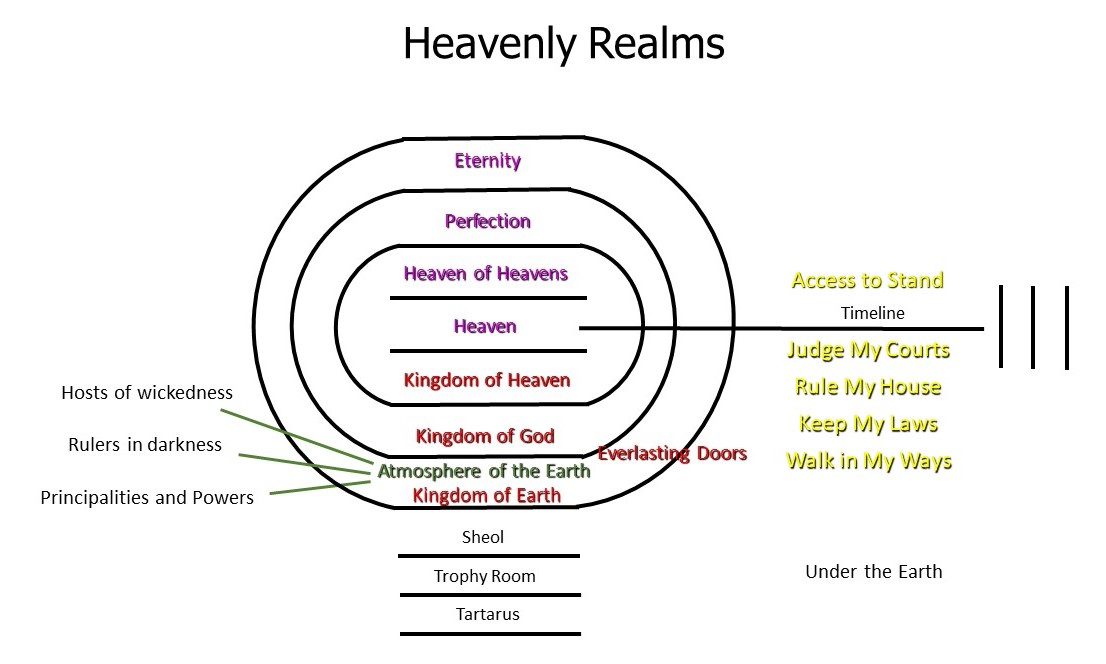
So here we are. God is outworking His purposes, and the ends of the ages have come: we need revelation from Him if we are to engage with how things are in the heavenly realms and bring them into the earthly realms. That is what it means when we pray ‘on earth as it is in heaven’: it is up to us to bring heaven to the earth.

The Joshua generation will be forerunners who have spied out the land. What we may not have realised fully until now is that our Promised Land is not only about earthly things. To operate in the fullness of the kingdom, we need to operate in heavenly as well as earthly realms. Some of our spying out will be done in the realms of earth, but some of it will be in the realms of heaven.

God offered Moses’ generation the land of promise, but the vast majority of them said, ‘We can’t go in’. And earlier in their journeying, He had been willing for the whole nation to meet with Him on the mountaintop, but they were afraid of the thunder and lightning, the fire and the smoke, so they said to Moses, ‘You go, and tell us what God says. We can’t go in’.

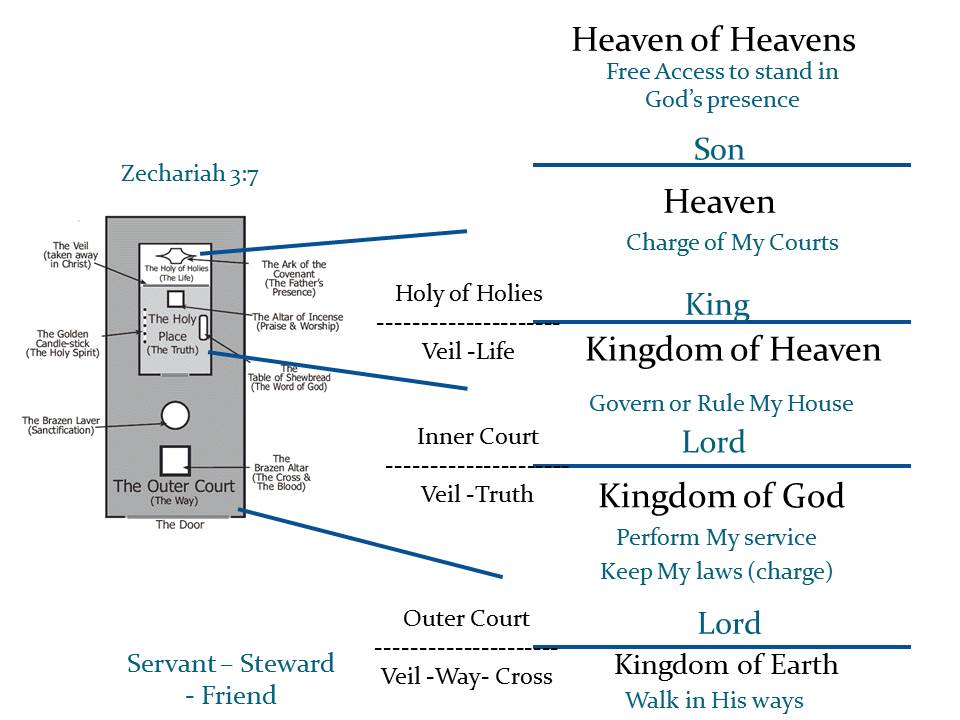
In the same way God offers us all access to the heavenly realms now, because Jesus has opened them up for us – that is what was signified by the veil of the temple being torn in two at the moment of His death. His purpose is that we can experience everything He intends for us. Like the children of Israel, though, many are saying ‘We can’t go in’.

Responsibility

The kingdom of God is about government, about authority, about rulership. God wants us to learn how to rule in our own lives, and how to rule in the realms of the spirit to bring heaven to earth. We need to learn how to lead and equip the Jesus generation to possess  the land of promise. The Hebrew word for ‘possess’ means ‘to inherit by seizing, dispossessing and become heirs’. We were made as spirit beings, to have access to the spiritual realms. When Adam was first created, he had access to the heavenly realms. There was nothing to stop him. Only sin [essentially a loss of identity] caused him to lose that access. The glory that he was clothed with was removed. Let me put it like this: it is as if a bandwidth of revelation was removed from him, so he could no longer see into the things which were of a higher bandwidth – the realms of heaven.

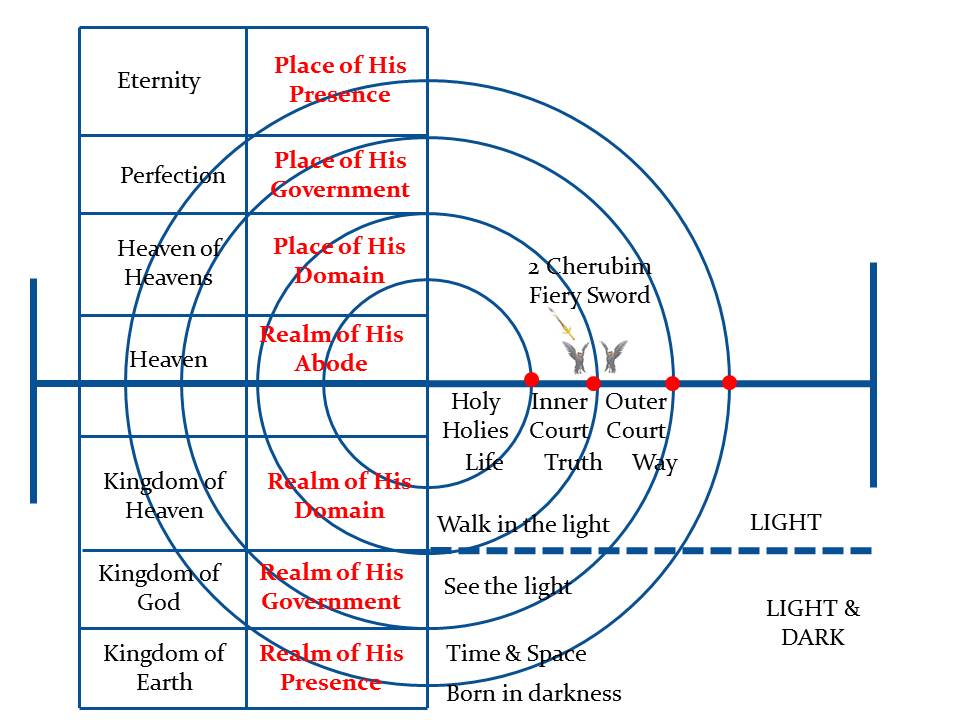
Now, everything about God’s kingdom has a beginning and an end, but the beginning and the end are always the same. That is why Hebrew thinking is always circular, not linear like Greek thinking. Linear thinking speaks about layers of heavens – first heaven, second heaven, third heaven – but the heavenly realms are not really that way at all. They are dimensions of authority. It may have seemed simpler to our western minds to express it as first/second/third, but it has been misleading. We read ‘third heaven’ in Paul’s writings and leap to the conclusion that there must at least be layers below that of a first and second heaven through which we have to travel to get to the third. Hebrew thinking implies no such thing.

For God’s kingdom to come on earth as it is in heaven, it will involve us fulfilling Adam’s mandate: to rule in the spirit realm and by so doing to reconfigure the natural realm. When we fulfil that mandate, we will see God’s glory fill the earth (Num 14:21).

We have to have experience of operating in the heavenly realms ourselves if we are to bring other people into it, and that is what God is doing amongst His people right now. He is opening things up so that we can gain that access, and begin to operate in two realms, earthly and heavenly. We learn to rule in heavenly realms, and then we bring that rule to bear in the realm of the natural.

Operate in authority

Before we can rule in the earthly realm, we need to operate in authority in heavenly places.

We have to go up and down before we can go to and fro. The trouble is, we have tried to bring heaven down while standing in the earthly realms. That is why we have been beaten up so much by the enemy: we have been trying to come against the spiritual forces of wickedness and darkness with the earthly dimension of authority we have here. We need to bring heavenly authority in order to defeat them. It is a different dimension of authority. To exercise heavenly authority we need to go up, and bring heaven down with us.

On the island of Patmos, in the spirit, John heard a voice saying ‘Come up here’ (Rev 4:1). That voice is still speaking to us today. Do you hear it?

Soundtrack: Open Door – Janine John Band (via YouTube)

Available in other languages

Are you part of the Joshua Generation?

We developed this just for you:

Engaging God on the Heavenly Pathways of Relationship and Responsibility
Equipping a Joshua Generation of supernatural sons of God to live according to the order of Melchizedek

Get started today!*

*Technology permitting: automated process on receipt of payment and completion of online registration form. Terms and conditions apply.

71. Defeat? Or Victory?

Mike Parsons
with Jeremy Westcott 

In the past couple of posts we have briefly sketched some of the widely-held views about the Millennium. So what did the early church believe about the scriptures we have been considering? And what has the church believed through the centuries?

Persecution

Up to AD 70 most of the focus of teaching was preparing believers to live in that persecution leading up to Jesus’ coming in judgment upon Jerusalem. Initially, then, the prevailing conditions were persecution by Jews. After AD 70 persecution continued, but it was persecution by the Romans. The church took on a Jewish apocalyptical view of a literal kingdom on earth. Some thought that the kingdom might be before Jesus returned; some thought it might be after. It was still a very difficult time, and they were looking for Jesus to come and do something.

Political control

KONICA MINOLTA DIGITAL CAMERA
“Rome-Capitole-StatueConstantin” by I, Jean-Christophe BENOIST. Licensed under CC BY 2.5 via Wikimedia Commons (see below)

A major change happened for the church with the conversion of the Roman Emperor Constantine in 310 AD – and not all of it good. The church was now accepted by the political authorities, and it was OK to be a Christian. But the church was also controlled by those political authorities, so that Greek thinking and Greek influence began to pervade it. At this time the prevailing view was amillennial: the old interpretation (which had made a lot of sense under persecution) seemed not to relate so well to the changed conditions, so people began to interpret things in a less literal way, and say it must all be spiritual. You can see the Greek mindset having its influence in that distinction.

Political control continued into the medieval period, 596-1517 AD, as church and state started to mix together. Politically motivated and powerful popes, the crusades, the Holy Roman Empire, the whole idea of Christendom: all these arose during this time. The church was used by those in power to exercise control. Hardly anybody could read the Bible for themselves because it was available only in a not-very-accurate Latin translation, and that meant the priests had control of the whole system. Postmillennial theology became the norm. Their expectation was that things would get better, that the church would increase to fill the world  – but to achieve that they expected to use the sword, and to compel people to become Christians by killing those who would not comply. The preaching of the gospel was certainly not done in a way we would recognise today.

Reformation and revivals

After that came the Reformation (1517-1648). The truth began to be restored to the church and people began to question both the spiritual and the political authority of the Roman establishment. They continued to hold a postmillennial view, still expected things to get better, and saw the restoration of truth as part of that process.

Charles_g_finneyThen we come to a period where the Holy Spirit was poured out in revivals in both England and America: Wesley and Whitfield and so on in the UK; the First and Second Great Awakenings in the USA with Jonathan Edwards, Charles Finney (photo) and others. Those revivalists were predominantly postmillennialists: they believed that Jesus would be coming back after the church had succeeded in its mission. Maybe that was because they saw the church actually succeeding; they saw revivals in which many thousands were saved and the work of the Holy Spirit was very obvious.

Tares sown in

But from 1826-50, so much that was negative began to be sown in, as we have seen. The tares were sown into the world, with the rise of cults and so on; and in the church the leaven of dispensational teaching and false doctrine began to spread and permeate everything.

From 1909, when the Scofield Bible was published and so many people read it and adopted the dispensational premillennialist views it reflected, the predominant mindset became very pessimistic. There was a great deal of scientific and philosophical attack on Christian belief, Darwinism began to become generally accepted, and two World Wars seemed to indicate that far from getting better, things were getting much worse.

A whole generation which had been impacted by the Welsh revival saw its young men wiped out in the First World War. And even after the Second World War, the pessimism continued into Cold War, a period of intense uncertainty in which nuclear destruction looked to be a distinct possibility. So much went into print at that time identifying Russia as the Beast or the Antichrist or whatever – and now those books are completely obsolete.

It didn’t stop the same thing happening with the Common Market in Europe, which was supposed to be the twelve heads of the Beast coming out of the sea in Revelation – and how many nations are there in the EU now? Then it was going to be Saddam Hussein. Well, he is no longer around either. North Korea next…?

All this material was written by authors looking at the prevailing conditions and trying to interpret them using biblical prophecy; looking at events in the world and imposing that onto Scripture, instead of the other way around. When we read biblical prophecy, we want to allow it to tell us what is (or was) going to happen. We do not want to interpret it from looking at the newspapers or the television news.

Renewal

Around 1960 there was a turning point, the charismatic renewal movement, when the Holy Spirit was poured out across the churches. That has led on to the whole prophetic movement, and the restoration of prophetic and apostolic ministry. With that has come fresh revelation – and a fresh challenge. It has caused warfare within the church, because when you challenge a status quo which is dominated by the enemy you get Jezebel spirits and all kinds of demonic activity being stirred up. They do not like the truth being preached when they have had things their own way for so long.

We need to preach the truth. The truth is that the kingdom of God is going to fill the earth. The truth is that Jesus is going to come back for a victorious church. The devil would just love us to believe that we are going to be defeated, because then our faith would be in that defeat.

But our faith is in victory, in overcoming, in seeing God’s kingdom fill the earth.

Related articles from others

Image of the Emperor Constantine
Attribution: “Rome-Capitole-StatueConstantin” by I, Jean-Christophe BENOIST.
Licensed under CC BY 2.5 via Wikimedia Commons – http://commons.wikimedia.org/wiki/File:Rome-Capitole-StatueConstantin.jpg#mediaviewer/File:Rome-Capitole-StatueConstantin.jpg

70. Millennium? What Millennium? (Part 2)

Mike Parsons
with Jeremy Westcott

Last time, we saw how important it is to know what we are expecting when Jesus returns. In light of that, we began looking at the Millennium, the thousand-year reign of Christ on the earth (or not). In this post I want to give you a little more understanding of the three main views people hold on this, and next time we can go on to look at what the church has believed over the centuries.

Premillennialism

Jesus will return to set up a literal 1000-year kingdom on earth, in Jerusalem – and re-establish the whole Old Covenant sacrificial system. My immediate question is: why? Why would He want to set up sacrifices again when He is the sacrifice? Once and for all, it says (1 Pet 3:18, Heb 9:28). So to me that now seems like a really strange way of thinking – but I used to think that way, because that is what I was taught. I didn’t even know there was any other way. Every book I ever read said that was the way. Until God started to speak to me about the kingdom, and how the kingdom needed to come; until I began to look for it myself; and that is what really changed things for me.

Premillennialists teach that there will be a series of key events that occur before the millennial rule of Christ on earth. These events include the secret rapture of the church and a seven-year time of tribulation. They hold various opinions about when the rapture will occur, and these can be summed up as pre-tribulation, post-tribulation, or mid-tribulation. Whereas we have seen that the Great Tribulation has already occurred, and that Jesus said there would never be another one like it. We have also seen that the rapture was not at all what we thought it was. newspaper-412441_640One of the problems with the premillenialist position is that there is a tendency to interpret things not in light of what the Bible says, but in light of history, current events, and the news on TV and in the papers. They contend that they hold to a literal interpretation of prophecy and scripture, whereas in fact they are very selective in what they believe literally, and actually have a very symbolic interpretation of what they see as things to come.

For them, the kingdom is future, and a literal 1000 years on earth with Christ. The book of Revelation is seen as also mostly future.

Amillennialism

Amillennialism is the belief that there is no literal millennium.

It teaches that there is no future millennial earthly rule of Christ. Amillennialists tend to have an allegorical interpretation and non-literal approach to prophecy. For them, the events mentioned in the book of Revelation reveal that the situation in the world will continue to worsen before Christ returns. Christ will one day return to rescue the church. He will not be coming to establish a millennial rule on earth but to usher in the age to come. This view can often seem very pessimistic, because it does not see prophecy being literally fulfilled on earth, so all the promises of God are just spiritualised, and do not actually relate to our present reality.

For them, the kingdom is present now – but only in heaven. The book of Revelation is being played out presently in the church age, and the events it portrays happen in every age, throughout history.

Postmillennialism

Jesus returns after His people rule spiritually on earth. The 1000 years is not a literal figure, it simply represents a long period of time.

Postmillennial theology teaches that the Church will be triumphant as a result of the gospel impacting the world. After this, Christ will return, and believers will then enter the eternal state, or the age to come. When the church has finished its task, to see God’s kingdom come and fill the earth, then Jesus will return and we will enter the age to come.

In this view, the kingdom is present and will expand to fill the earth before Christ’s return. The prophetic promises of God are expected to have all been fulfilled by then.

The book of Revelation is mostly historical – talking about the destruction of Jerusalem – but continues to be applicable to the church triumphing over persecution, and overcoming, throughout history.

This view seems to me to be in line with what Jesus taught. As we have seen, He said He was coming on the Last Day, the day of resurrection and judgment – and our guiding principle must be to interpret everything through what Jesus said.

[Editor’s note: if you are looking for a fuller discussion of pre-, a- and post-millenialism, there is probably none better than Martin Scott’s series of podcasts and accompanying notes which you can find here (though we don’t see totally eye-to-eye with him on everything). And if you are planning a long journey or otherwise have a couple of hours to spare, you might be interested to download, listen to or watch this roundtable discussion between leading American exponents of each of these views, hosted by John Piper’s Desiring God Ministries.]

69. Millennium? What Millennium?

Mike Parsons
with Jeremy Westcott – 

Faith

Now faith is the assurance of things hoped for, the conviction of things not seen (Heb 11:1 NASB).

Now faith is the substance of things hoped for, the evidence of things not seen (NKJV).

It is really important for us to know what is to come, because if we do not know we cannot have faith in it. Everything we do, we need to do by faith.

For whatever is born of God overcomes the world; and this is the victory that has overcome the world—our faith (1 John 5:4).

The mandate we have is to bring God’s kingdom rule from heaven to earth. It is the same mandate as when Jesus came ‘to destroy the works of the evil one’ (1 John 3:8).  We are overcomers; we are conquerors, because we have the authority of God’s kingdom. So in everything that we are going to have to face; in whatever spiritual warfare that is going to take place; in every arena in which we are going to have to defeat the enemy; in all that battle we have an overcomer’s mantle, because we are born again. Our identity is that of an overcomer. But how is that victory going to be won? It is won through our faith.

That means it is really important that we know what our prophetic expectation is, that we know what we believe God is going to do in the future. If we believe it is going to be defeat, then our faith is going to be in seeing and experiencing defeat. If we believe it is going to be victory, then our faith will be in that victory; and it will be possible for that victory to be outworked in us. Our faith is the substance of that victory; our faith is what will bring it into reality.

Victory consists in fulfilling God’s original intention, which is to see His kingdom filling the earth (Gen 1:28). For man to subdue and rule over it, and bring God’s kingdom: as it is in heaven, so it is on earth. That is quite an expectation, and if that is what we actually are to expect, then we really do need to know.

Pre-, A-, Post- or Pan-?

That brings me to the question of the Millennium, the thousand-year reign of Christ.

Now there is a good deal of confusion over this in the body of Christ, many different teachings going around, many different ideas we are likely to hear. If we can get some clarity on it, we will be able to have faith in what is coming. So let me just sum up for you the main strands of teaching and then in coming posts we will begin to look at them in a little more detail:

  • Pre-millennial – ‘before’. Jesus is going to return before a period of time called a millennium (which the Latin word for 1000 years).
  • A-millennial – ‘non-’. There isn’t actually a millennium at all, and the term is normally understood by those who hold this view to be symbolic of the church age.
  • Post-millennial – ‘after’. Jesus is going to come back after a period of His kingdom being on earth.
  • Pan-millennial – ‘all’. Or, “Who cares? It will all work out in the end”. This seems to be the camp of those who are unwilling to nail their colours to the mast. Some are unsure, but maybe some are just unwilling to be honest, because they know that if they come out and say what they really believe about this, they are likely get a lot of flak.

In the USA especially, if church leaders and prominent Christian people come out and say that they don’t actually believe in a premillennial return of Jesus, they are likely to find themselves under attack from other Christians. The internet is full of articles and comments from ‘heresy-hunters’ basically just running them down because they have dared to say what they believe. As we have seen before, that premillennial view has pervaded the church like leaven, and a lot of the church don’t even know there is another way of seeing things, or if they do, they don’t understand how that other way could possibly make any sense.

Whereas in fact the church believed something quite different for centuries. And some of us do so today.

Related articles from others

68. As He Is, So Are We

Mike Parsons
with Jeremy Westcott –

When Jesus comes back, He is coming for His bride, the church. So this scripture is talking about us:

That He might present to Himself the church in all her glory, having no spot or wrinkle or any such thing; but that she would be holy and blameless (Eph 5:27).

And since each of us are part of that bride, we have to be ready. That is why we are experiencing a season of purification and refining in our lives. For some of us, we may well have been here before. But we have a sense that God is doing something at a deeper level this time. God is removing stumbling blocks, He is removing all the idols we have in our lives. We are praying Psalm 139, ‘Search me O God, and know my heart’. And it is so that He can make us into that holy church that Jesus can inhabit in fullness, releasing His power onto the earth.

Confidence

Now, what does it take to be ready? There are some scriptures in the first letter of John that I want to look at:

By this, love is perfected with us, so that we may have confidence in the day of judgment; because as He is, so also are we in this world (1 John 4:17).

So we can have confidence, because ‘as He is, so also are we in this world’. As Jesus is: not as He was, but as He is now. He is enthroned in heaven: and we are outworking that kingdom, that enthronement, here on the earth. Our confidence comes from knowing that He is on the throne. His position as King is what gives us the confidence to outwork that kingdom, here in our lives, on earth.

‘Now, little children, abide in Him, so that when He appears, we may have confidence and not shrink away from Him in shame at His coming’ (1 John 2:28).

There is a relationship here: we abide in Him and He in us. It is an intimate relationship. And when He appears, as long as we are remaining in that relationship of intimacy, hearing and obeying His voice daily, doing the things we see the Father doing, then of course we will greet Him with confidence. It would be terrible to flinch away from Him when He comes in glory, not to be able to look at Him because we are ashamed of the way we have been living. If we stay close to Him now, we can have confidence when He comes.

Like Him

‘Beloved, now we are children of God, and it has not appeared as yet what we will be. We know that when He appears, we will be like Him, because we will see Him just as He is. And everyone who has this hope fixed on Him purifies himself, just as He is pure’ (1 John 3:2-3).

So when Jesus actually appears, we will be like Him. We will be transformed. We will have a new resurrection body, and be transformed into an eternal being. In His resurrection body Jesus was able to appear to His disciples, walk through walls, eat a fish supper. We will be just like that: ‘we will be like Him, because we will see Him just as He is.’ But because we have this hope, we also need to purify ourselves, just as He is pure. So we do have some work to do.

Baggage

When we see Him, we do not want to be carrying all the baggage that we might presently be going around with. We have an opportunity, right now, to be purified. We can allow Jesus to refine us, to prepare us to meet Him. All that holds us back and weighs us down, we have an opportunity to get it sorted out ahead of time.

I want to be properly prepared to meet Him face to face. I have my life here and now to work on that. And how do I make myself ready? I just surrender to Him. I allow Him to do whatever he wants to do in me. It is not something I have to somehow try to rack my brains and get all figured out. I just have to give Him my life on a daily basis. I need to present myself as a living sacrifice. I need to reckon myself dead to sin and alive to Him. I need to be crucified with Christ so that I no longer live, but Christ lives in me. My flesh no longer determines what I do.

Anointed One

‘Christ’ is not Jesus’ surname, remember. Whenever the word ‘Christ’ is used in scripture it refers to the anointing he carries. When it says ‘Jesus’, it is referring to the person of Jesus; when it says ‘the Lord Jesus Christ’, it is giving Him His full title and emphasising His lordship. So each time we read about Jesus in scripture, the name(s) used to describe Him emphasise what aspect we particularly need to understand about Him.

So it is Christ, the Anointed One and His anointing, who lives in me. I have been crucified – past tense – but I need to outwork that in a daily relationship, by presenting myself as a living sacrifice before God. I have written about how we do that in an earlier post. This may be stating the obvious, but the thing about a living sacrifice is that it is actually alive. I present myself on a daily basis, so that my life can be used for His kingdom purposes, so that I can be pure as He is pure.

That is how He would like me to be; how He would like all of us to be. How we need to be, because He is coming.

Related articles from Freedom ARC

64. The End Of The Age

Mike Parsons
with Jeremy Westcott  

Important note: our view of this has moved on some since this post was first written.

We would now say that the disciples’ questions were really about just one event and that the ‘end of the age’ Jesus is speaking of is the end of the Old Covenant age and the ‘age to come’ is the New Covenant age. This means that Jesus is not changing the subject from Matt 24:34 onwards.

‘Like the days of Noah’ is a description of the times leading up to the fall of Jerusalem in AD 70. However, there is still an application of this for us, as the enemy continues to seek to destroy the seed even today.

There is nothing in what Jesus says about the ‘last day’ in Matthew 24 (or in John 6:40) that we would now see as referring to the last day of history. The ‘last day’ is the end of the Old Covenant age.

Below is the original post, as first published.

We have seen that in Matthew 24, the disciples asked Jesus about three specific things:

Mount_of_Olives_(before_1899)
Mount of Olives (before 1899). Public domain.

As He was sitting on the Mount of Olives, the disciples came to Him privately, saying, “Tell us, when will these things happen, and what will be the sign of Your coming, and of the end of the age?” (Matt 24:3).

In recent posts we have looked at how Jesus answered the first two of these. From verse 34 onwards He is talking about the end of the age.

And the first thing to say is that no-one knows when that will be. “But of that day and hour no one knows, not even the angels of heaven, nor the Son, but the Father alone. For the coming of the Son of Man will be just like the days of Noah” (Matt 24:36-37).

So if you come across any books, blogs or articles telling you when it is going to be, don’t even bother with them. There is nothing and no-one that can tell you. And Jesus says that not even the Son knows. Now of course Jesus knows, but as the Word of God He has not revealed it anywhere, not the exact day and the hour.

We are not supposed to know the specific time, and there is a reason for that.

“Therefore be on the alert, for you do not know which day your Lord is coming… For this reason you also must be ready; for the Son of Man is coming at an hour when you do not think He will” (Matt 24:42, 44).

Every single believer, from that time on, needs to live as if it is the last day. It could happen today. Then we will be ready. Jesus told the story of the wise and foolish virgins to illustrate that point; the parable of the talents, too. He wanted to warn us not to be found to have wasted our talents when the Master comes. We need to be prepared; we need to live in readiness not in complacency.

What we are permitted to know is what the times will be like when that day comes. It will be like the days of Noah, and we have already seen how that involved Nephilim, widespread evil, and pollution of the human DNA. Those times will come again, and the church must face them with authority and power.

“Do not marvel at this; for an hour is coming, in which all who are in the tombs will hear His voice, and will come forth; those who did the good deeds to a resurrection of life, those who committed the evil deeds to a resurrection of judgment” (John 5:28-29).

Jesus said there would be a day of resurrection and judgment for everyone. When? On what He called ‘the last day’.

“For this is the will of My Father, that everyone who beholds the Son and believes in Him will have eternal life, and I Myself will raise him up on the last day” (John 6:40).

Now there is something fundamental we need to understand about the last day: it is the last day. There are no days after it. So when Jesus comes and raises people from the dead, that is the end. There are not 7 years afterwards, not 3½ years, and not 1000 years. The clue is in the name: it is the last day.

Time itself stops.

And this also emphasises why Jesus will remain in heaven until every prophecy has been fulfilled, and does not come to fulfil them. There is no time for anything to be fulfilled after the last day.

‘…and that He may send Jesus, the Christ appointed for you, whom heaven must receive until the period of restoration of all things about which God spoke by the mouth of His holy prophets from ancient time’ (Acts 3:20-21).

I know that is not what is taught: the fulfilment of prophetic promises is routinely put off to a different age, or a different people. The truth is that the church has access to all the promises in order to see to it that the kingdom fills the earth. The alternative is the eschatology of defeat and failure we have looked at before, which only robs us of our position of power.

Here is another scripture which talks about the end in similar terms:

‘For as in Adam all die, so also in Christ all will be made alive. But each in his own order: Christ the first fruits, after that those who are Christ’s at His coming, then comes the end, when He hands over the kingdom to the God and Father, when He has abolished all rule and all authority and power.  For He must reign until He has put all His enemies under His feet. The last enemy that will be abolished is death’ (1 Cor 15:22-26).

The end is the end. At that point Jesus hands over the kingdom to God the Father. No more kingdom, no 1000 year rule, just the end. This scripture expressly tells us there is no more rule, authority or power after the end. They are all abolished. Jesus reigns until then, and He reigns through us.

Death too is abolished when Jesus comes, and everyone goes on to eternity, with or without Jesus.

54. Salvation and Judgment

Mike Parsons
with Jeremy Westcott – 

Stone and Mountain

I want to begin today by looking again at two scriptures we have seen before:

Now it will come about that In the last days
The mountain of the house of the LORD
Will be established as the chief of the mountains,
And will be raised above the hills;
And all the nations will stream to it (Isa 2:2).

You continued looking until a stone was cut out without hands …But the stone that struck the statue became a great mountain and filled the whole earth (Dan 2:34-35).

This Stone and Mountain are very important: Jesus taught about it, and so did the apostles. The Stone is Jesus and the Mountain is His kingdom; the house of the Lord is God’s people. The kingdom is manifest (or demonstrated) through the church as God’s people, not through the institution called ‘church’.

The kingdom of God is going to fill the earth, in our time. As we have seen, tares have been sown into the church in terms of false doctrine which has put that off to another time or another people.

There has only ever been one people of God: people of faith. Faith is the key: it is not about being born into a Christian family. It was never even about being born into a Jewish family: you were not of the true Israel unless you had faith. It really wasn’t a national thing, as we will see.

‘Two sides of the same coin’

When God comes in righteousness, He often comes in judgment as well as in salvation: they are two sides of the same coin.

‘Righteousness and justice are the foundation of Your throne (Kingdom); Lovingkindness and truth go before You’ (Ps 89:14).

lumberjack-199694_640

“The axe is already laid at the root of the trees; therefore every tree that does not bear good fruit is cut down and thrown into the fire… He will baptize you with the Holy Spirit and fire. His winnowing fork is in His hand, and He will thoroughly clear His threshing floor; and He will gather His wheat into the barn, but He will burn up the chaff with unquenchable fire” (Matt 3:10-12).

  • The Flood brought salvation for Noah and his family, but judgment for the world.
  • In the Exodus, in the crossing of the Red Sea, there was salvation for Israel, but judgment for Egypt as all their army was swept away.
  • At the Cross there is salvation for believers, and it is open to everyone. But if you do not receive it, there is judgment.
  • In fact in all Jesus’ comings – and there are many comings of Jesus, ending with his Last Coming – there is both salvation and judgment.

Speaking of that Stone again:

This precious value, then, is for you who believe; but for those who disbelieve, “THE STONE WHICH THE BUILDERS REJECTED, THIS BECAME THE VERY CORNER stone,” and,  “A STONE OF STUMBLING AND A ROCK OF OFFENSE”;  for they stumble because they are disobedient to the word, and to this doom they were also appointed (1 Peter 2:7-8).

The Stone, we know, was Jesus. Those builders who rejected Him were the Jewish people at the time. Not all of them rejected Him of course: the earliest church was made up of Jewish believers. But for those who did reject Him, those are strong words. ‘Doom’, like ‘woe’ in Matthew 23, is a covenant word.

No peaceful co-existence

Jesus ascended back up to heaven in around the year AD 30. The destruction of Jerusalem and its temple happened in AD 70. That 40-year period was a generation in which the old covenant people co-existed with the new covenant people. It was not a peaceful co-existence. Saul, before he met Jesus and became Paul, was sent out by the Jewish leaders to persecute Christians. They were trying to stamp out what they saw as heresy. Later on, in every city where (as Paul) he went to preach, he spoke to the Jewish people there first as God’s people and inheritors of God’s promises. When he showed them that these could only be received in Christ, most of them persecuted him, though some believed. That is why he was beaten and stoned.

So in this period the Old Covenant (with its Natural Country, City and Temple) was still in existence alongside the New Covenant (with its Spiritual Country, City and Temple). Much of the New Testament was written from the perspective of the persecution which arose because of this.

In particular, the whole of the book of Revelation was written about the covenant judgments (‘doom’) that were to come at the end of this period, the consequences of Israel’s rejection of the Messiah and their persecution of the church. It was written to provide comfort to those Christians who were suffering that intense persecution, to reassure them that God had a plan in it and that it would come to an end. It was not written about ‘the end of the world’. We need to get that out of our thinking, and then look at these scriptures for what they actually say.

That is a process we will begin in the next post. I want to look at the whole passage which leads up to the disciples’ question in Matthew 24, because that is essential if we are to properly understand the answers that Jesus gave them.

Related articles from Freedom ARC
Related articles from others

Pictures to share with you

Here are some pictures that I really like. I don’t necessarily want to say a lot about them, I’ll just share them with you.

Can you imagine the Lion up in heaven, going ‘What are they up to now?’. It’s a good thing God has a great sense of humour. Even when He corrects us, He does it with a smile on His face.

This next one was an advertisement for a conference, I think. It reminded me of a scripture: Hosea 11:10 They will walk after the LORD, He will roar like a lion; Indeed He will roar And His sons will come trembling…

53. Breaking off the Greek Mindset

Mike Parsons

Last time I shared with you a couple of tables relating to the Greek (Western) and Hebrew (Eastern) mindsets. In this post I want to look just a little more closely at the contrast between them, and then I would like to pray for God to reveal where we are being robbed by our Western way of looking at things, and break it off us.

Separation vs unity

Here is the first of those tables again:

Greek Mentality

Hebrew Mentality

The goal of salvation is to escape this world and go to God’s dwelling place in heaven The goal of salvation is to prepare a place fit for God’s dwelling here, among His people
The kingdom of God exists in heaven, not upon the earth The kingdom of God is God’s reign among people here on earth
Jesus is coming to take us away from this world Jesus is coming to reign over us and through us in this world
Message: “Get your ticket now, or you might miss the train!” Message: “The kingdom of God is coming! Get ready to serve the King and manifest the kingdom.”

Let’s take these one line at a time.

In our Greek understanding, the goal of salvation is to escape this world and go to God’s dwelling place in heaven. So everything is focussed on what will be: very little about what is now. In Hebrew thought, the goal of salvation is to prepare a place fit for God’s dwelling here, among His people. He wants His kingdom to come on earth.

Linked with that, where does the kingdom of God exist? The Greek view says it is in heaven, not on the earth, whereas the Hebrew view is that the kingdom of God is God’s reign among people here upon the earth.

So is Jesus coming in order to take us away from this world? No, Jesus is coming to reign over and through us in this world. We need to focus on God’s kingdom being ‘now’, not separating it out. “Get your ticket now or you might miss the train”: that may have been what we were told, but do we really want to carry on presenting the gospel that way?

And then: “Now you have your ticket, just hold on tight. In the end Jesus will come and rescue you”, rather than what Jesus preached: “The Kingdom of God is coming! It’s right here, right now! Get ready to serve the King and manifest the kingdom”.

Do you see how each misunderstanding arises from the previous one? Once you begin to go down the route prescribed by Western thought, you find there is more and more separation becoming entrenched in your thinking, and less and less of an understanding of the unity of God’s purpose.

Form vs purpose

If we look at the second table, we can see how this works out in practice:

Greek mindset

Hebrew mindset

Form Function
What I do How I do it
Secular/Religious Unified
Heavenly/Earthly Dual
Knowledge Experience
What I know Who I know
Works Grace
Creed Deed
Analyse Live – Be and Do

The Greek mindset looks at the form of something. For example, let’s take a tree. It has roots, a trunk, branches, leaves – that is what I mean by looking at its form. In the Hebrew way of thinking, it is more about what it is for. What is the purpose of a tree? To bear fruit. They are really not interested in the fact that it might have roots, a trunk, branches and leaves. Does it bear fruit? If not, it is of no value at all. Remember how Jesus cursed the fig tree that was not producing any fruit? It is the difference between an actual, practical outworking and just a mental, theoretical understanding.

So: Greek: what I do; Hebrew: how I do it. We can do lots of things from the wrong motive – but we know that God looks on the heart.

Greek thinking separates out our religious life from our secular life. Family, work, school, friendships on the one hand; and church on the other. But God wants His kingdom to be flowing through all of our lives, with no separation. There is no secular for us. Our lives are a whole, they are unified, and we bring the kingdom of God into everything.

In Greek thinking, the heavenly was separated from the earthly. There was no overlap. Bill Johnson wrote a book called ‘When Heaven Invades Earth’. Bottom line is, that is impossible in Greek thinking. But for us, we can live in both places: we live in the realms of heaven, and we bring that spiritual realm into our lives on earth, at the same time: not in the future but now.

‘Knowledge’ to the Greek mind is information. But to the Hebrew, you cannot know anything without experiencing it. It is all about knowledge through spiritual encounter. If all I am doing in this blog is imparting information to you, we are missing the mark. That is why from time to time I also include praying for you, which gives you the opportunity to encounter Him through the Holy Spirit and experience the reality of His truth for yourself (of course you can always pray these things through even when I don’t specifically include a prayer).

It’s not what you know, but who you know! We know God, but it is perfectly possible to read the Bible from cover to cover and have all the information, but never actually know Him. We need to encounter everything in the Word of God for ourselves.

Works, or grace. A creed or the deed. Stating what you believe, or actually living that way? Faith without works is absolutely dead. Jesus said, “If I do not do the works that my Father does, don’t believe me” (John 10:37). You don’t hear too many sermons on that verse.

We don’t analyse: we live. It is about who we are and what we do. God Himself says He is the I AM.

I want to pray now. If you think you may have any mindsets, any of the Greek way of thinking, we want to break that off right now.

[If you would like to hear an audio version of this prayer, click here.]

Father, I pray that the power of Your Holy Spirit will come.
Break any deception off our mindsets
Any way in which we have come under false doctrines,
False teachings, mindsets of the enemy,
Greek thinking that would cause us to separate our lives out.

I come, Lord, with the sword of Your Spirit,
To break that off our mindsets right now
In Jesus’ Name.
To be loosed from any control that the enemy has had over us
Through traditions of men and demonic doctrines
That put things into the future instead of the present;
That put things into heaven instead of on earth;
That have separated us out;
That have caused us to believe and not do.

I break those mindsets right now.

I break any doctrines over us that would hinder Your church
From pursuing and seeing the kingdom of God fill the earth
As it is in heaven.
Holy Spirit, come and reveal to anyone reading this
Anything which is a hindrance, an obstacle, a stumbling block
To our being able to fulfil our destiny as God’s people.
I pray that You would send gathering angels into our lives
To gather any stumbling blocks from us.
Gather them from our mind, gather them from our heart,
So that we believe and stand on the truth of Your Word
That through kingdom and covenant,
You are going to fill the earth with Your kingdom.
You are going to come back for a victorious, overcoming church
That has risen above every other thing.
Because ‘of the increase of Your kingdom there is no end’.

Empower us with the power of Your Holy Spirit
To take Your kingdom
And manifest Your kingdom through our lives,
Every day of our lives:
In work, in home, in our neighbourhood.
That we would manifest Your kingdom in power and authority
Doing the works that Jesus did.

I loose us from everything that would hinder us
From that fulfilment of Your purposes for our lives
In Jesus’ Name.

Amen.

Related articles from Freedom ARC
This article is available in other languages
Related articles from others

52. Wheat and Tares

Mike Parsons
with Jeremy Westcott
 –

We have been considering the disciples’ question about Jesus’ return and the end of the age. It is essential to view all this through covenant eyes. God has always worked through covenants with men, and every time it was men who broke them. But they were all fulfilled in Jesus: every promise God ever made finds its ‘Yes’ and ‘Amen’ in Him. There are not two covenants in operation in our day, just one. And it is one which we cannot break, because it was not made with us, but with Jesus.

AD 70

We have seen that Jesus’ answer in Matthew 24 (at least up to verse 34, but probably the whole chapter) refers to the end of the Old Covenant age and the destruction of Jerusalem, especially its temple. “Truly I say to you, this generation will not pass away until all these things take place”. AD 70 would have been the end of that generation of disciples Jesus was talking to. The main fulfilment of all those prophetic words happened in that period. That is not to say that we cannot see further examples of them in our day – and throughout church history – but we are not waiting for them to happen as signs of the end. The end that Jesus was talking about already came.

We looked briefly at the decline and revival of the church over the centuries, how the Holy Spirit began to break back in once the scriptures were available in the common language again. I would encourage you to read the ‘God’s Generals’ series of books by Roberts Liardon, and see how God began to restore truth to the church through some amazing godly men and women. But as God sowed wheat, the enemy also sowed tares. Tares look just like wheat, and you can only tell the difference because tares don’t produce a harvest. So in the very period when God was working in revival and power, we also see the birth of Darwinism, Marxism, humanistic philosophy – false systems of belief sown into the world. And not only into the world – into the church too. Mormons, Jehovah’s Witnesses, and Christian Science all started around this time. Some of them looked like the truth, and people are still deceived by them today.

False doctrines

In 1826 the Brethren movement rejected the gifts of the Holy Spirit, and put back the purposes of God for another 80 years. In rejecting the truth, they also embraced deception, as often happens. And the enemy was able to use this to sow in false teaching and false doctrines which have plagued the church ever since. This is what God is starting to challenge and remove so that we can regain a true perspective of His kingdom.

What were some of those things?

  • Dispensationalism. Separating up scripture into particular periods of time in which God works in different ways. That breaks up the continuity of scripture and prevents people seeing the whole picture of God’s plan and purposes through the ages.
  • Cessationism: The belief that gifts of the Holy Spirit are not for now, that they stopped in the New Testament when the last apostle died.
  • Pre-Millennialism: Jesus was going to come back before the Millennium. Up to that time the only people who taught that were the Jesuits. No-one else believed it. Now it is prevalent among large sections of the church.
  • The Rapture: God would come for His people in a ‘secret rapture’, take them and leave everyone else behind. That doctrine only arose in this same period. And now it is the subject of a whole series of best-selling Christian books and accepted without question by much of the church as being what the Bible teaches.
  • Seven Years of Tribulation on the earth: this belief only started to appear at this time.
  • The separation of Israel and the church.

This was all so insidious that it spread like wildfire. The Schofield Bible came out of all this, robbing the church of authority by promoting an eschatology of defeat and rescue rather than of victory and of the increase of God’s kingdom to fill the earth. All of a sudden it was maintenance, put the walls up, protect your beliefs, have nothing to do with the world. The Brethren church was so exclusive you were not even allowed into their meetings unless you could prove that you came from another Brethren Assembly. I was brought up in this, and when I got baptised in the Spirit, God just challenged my whole theology. I have had to re-examine everything I believed: even now I have to be continually open for God to show me the truth.

Greek and Hebrew mindsets

The background to this is that there is a difference between the Greek and the Hebrew mindset. We have briefly touched on that before. Let’s be clear, I am not talking about reading scripture in the Greek and Hebrew languages, but about our way of looking at things when we approach scripture. Here are a couple of tables I often use to illustrate some of that:

Greek Mentality

Hebrew Mentality

The goal of salvation is to escape this world and go to God’s dwelling place in heaven The goal of salvation is to prepare a place fit for God’s dwelling here, among His people
The kingdom of God exists in heaven, not upon the earth The kingdom of God is God’s reign among people here on earth
Jesus is coming to take us away from this world Jesus is coming to reign over us and through us in this world
Message: “Get your ticket now, or you might miss the train!” Message: “The kingdom of God is coming! Get ready to serve the King and manifest the kingdom.”

Greek mindset

Hebrew mindset

Form Function
What I do How I do it
Secular/Religious Unified
Heavenly/Earthly Dual
Knowledge Experience
What I know Who I know
Works Grace
Creed Deed
Analyse Live – Be and Do

You will recognise many of the approaches in the left hand columns. They sum up how most of us have been taught, and have affected how we view everything. God is removing stumbling blocks, and we are going to find that the Greek mindset is increasingly going to be challenged.

This article is available in other languages
Related