They didn’t believe it in the early church. There was no penal
substitutionary atonement. The atonement, or what Jesus did on the cross, was Christus Victor, mostly. Christ victorious over what? Our lost identity, our death, over everything. A very different view of what Jesus did.
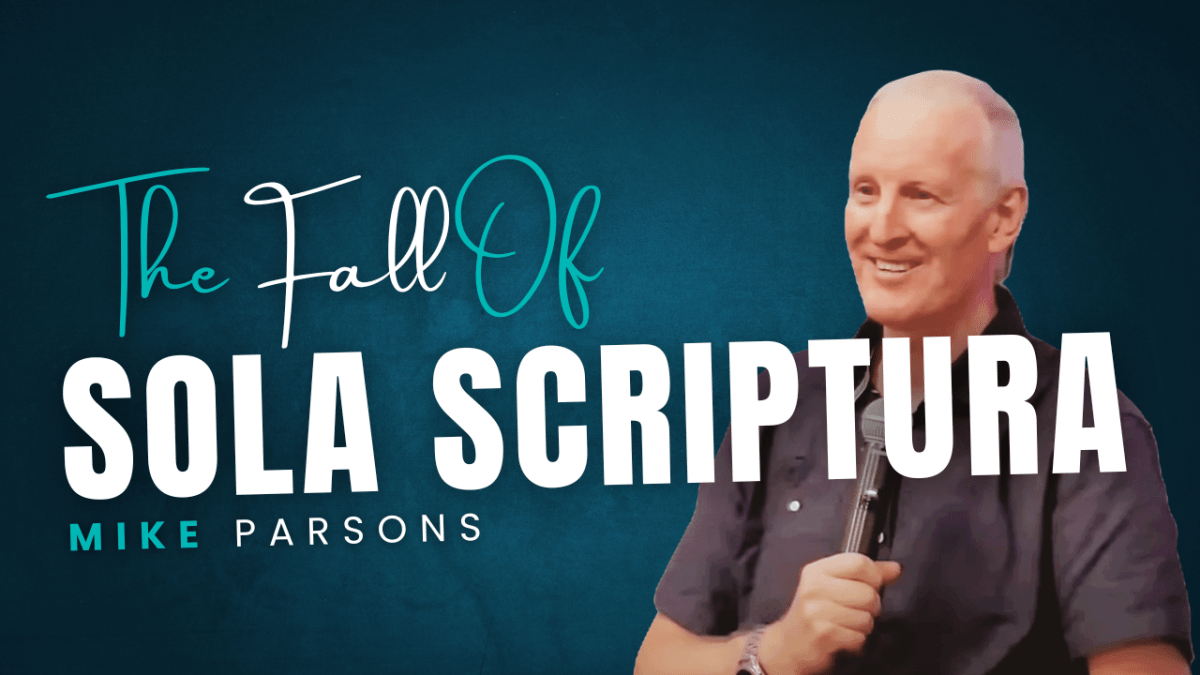
But Protestantism very quickly picked up on penal substitutionary atonement and it became the cornerstone of Calvinism and lots of other streams of thought. When that got removed, and when that evangelical pillar crumbled, all the other pillars started to wobble.
So sola scriptura was the second pillar. Well, without evangelicalism holding it up, that went over, which is why it changed my whole view about the Bible, the way I see the Bible, and the Bible being ‘the word of God’ and all that stuff: “It’s got to be in the Bible!” and all the challenge that came
with that, because God totally took me to task over it.
If you do not see the video above, please click here.
Rethinking How We Use the Bible
Much of the confusion around this topic comes from how we use the Bible—treating everything in it as if it is God speaking directly to us today. The truth is, it is not. If we did not use the Bible that way, and if we did not see it as the primary way God speaks to people today—as “God’s Word”—we might approach it very differently.
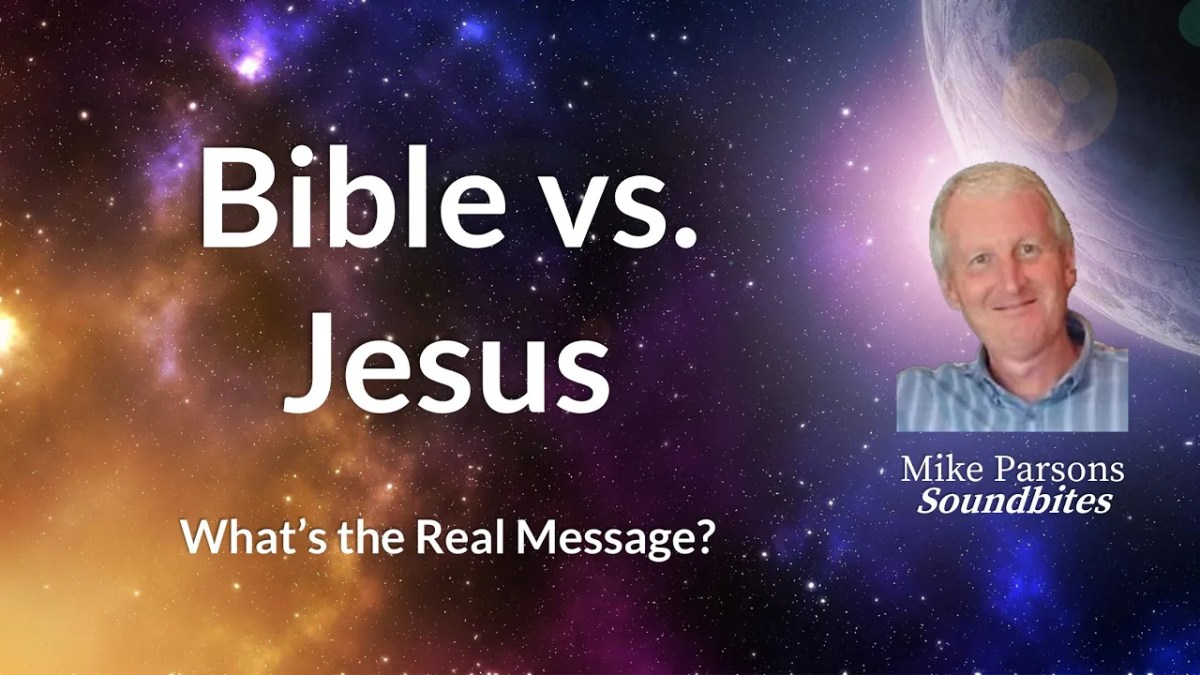
The Bible is not God’s Word. It contains some words that God said, but it is not the Word of God. Jesus is the Word of God. He is the logos—the Word made flesh. He was with God in the beginning. When we understand that Jesus is the Word of God, then when we read “the word” in the Bible, we do not need to assume it is referring to the Bible. It usually is not—especially since the Bible did not exist until about 385 AD.
The Canonisation of Scripture
In 325 AD, at the Council of Nicaea, church leaders selected various writings—those they believed God had spoken through—and labelled them as scripture. Then in 385, they canonised a particular group of those writings and called it the Bible. The implication was: God cannot speak outside of this now. But of course, He still does. He is speaking to us all day, every day.
I spoke to someone recently who insisted that God inspired the selection of the Bible. So I asked him: why, then, did the Protestant version remove thirteen books that were in the original Bible—the ones the Catholic Bible still includes as the Apocrypha? If God inspired the creation of the canon, who had the authority to later remove books from it?
It does not add up. God never required a book. He wanted to speak to us directly—Spirit to spirit. Yes, some of those ancient writings are useful, even valuable. But without them, would we really be worse off? Arguably not. We might not be as divided into denominations, all centred on different interpretations of canonised verses.
Jesus: The Living Word
I believe every generation should have inspired writings that help them understand what God is doing in their generation. But those writings should not be canonised. They should not be seen as a final word that limits how God speaks.
Someone once quoted Revelation to me: “You must not add anything to this book.” But that is referring to that particular book, not the entire Bible—because the Bible did not even exist yet. People assume it means you cannot add anything to the Bible, but that was never the intention.
Similarly, 2 Timothy 3:16 says, “Every inspired writing is useful for doctrine…”—but it does not specify what counts as inspired writing. It could not have meant the Bible as we know it, because that came centuries later. The Greek word used is graphe—it means writings. That verse is often mistranslated or misread to mean “all Scripture”, with a capital S, implying the Bible. But it actually means “every inspired writing”, which is a broader and more flexible idea.
The Bible Contains Words—But Not All Are God’s
God has inspired writings throughout history. I believe there are writings today that help us understand how He is working now. But we should not base our lives on texts written 2,000 years ago as if they are the only things God ever said.
The Bible is a collection of books written by people. It contains words from God, but also words from others—Pontius Pilate, for instance. It contains poetry, history, letters and songs. Some of it is clearly inspired by the writer’s relationship with God. But it is not dictated by God. The Psalms, for example, were David’s personal expression of what he was going through. They were put to music, just like other writers did with their experiences. That does not make them irrelevant—but neither does it mean we must follow them as rules for today.
Should we follow David’s emotional outbursts, or should we listen to what God is saying to us now? I believe we should be listening to the Spirit today. That is the real issue here.
Led by the Spirit, Not the Book
This view can upset evangelical Christians, especially those who hold to sola scriptura—scripture alone—the idea that the Bible is the only authority. But where does that leave the Holy Spirit? If we have to read the Bible every day to know what to do, where is the Spirit’s role in leading us? The Bible itself says, “Those who are led by the Spirit are the children of God.” It does not say, “Those who are led by the Bible are the children of God.”
If you find these videos helpful, would you please take a moment to like, share, comment and subscribe? It really does help. Thank you very much.
Unconditional Love – new book out now Mike Parsons’ new book, Unconditional Love, is out now. Order it from your favourite local or online bookseller today, or get the ebook instantly from our website. More details at eg.freedomarc.org/books.
At that time, the Bible was still the living Word of God for me—not Jesus. I saw the Bible as the Word that washed me, not Jesus. I relied on the Bible to separate my soul and spirit, rather than allowing Jesus to do it. I used the Bible as a mirror to see myself, rather than looking to Jesus or the Father.
Jesus, mediator of a New Covenant
During this process, I was presenting myself in the heavenly tabernacle as a living sahttps://freedomarc.blog/2014/01/21/present-a-living-sacrifice-3-practice/crifice, prepared by me, acting as my own high priest. Now, that might sound bizarre, but when I first received this revelation and began engaging in the heavenly tabernacle, this is what I thought I was doing.
I approached the laver—a basin used for washing—which I understood to have a bronze, mirror-like surface. I used it as a mirror to wash myself through the Bible, performing the role of my own high priest. I consumed the showbread as biblical food, again as my own high priest. I sought wisdom from the light of the menorah, the Bible, instead of Jesus. I engaged the altar, refining myself through the Bible, all the while acting as my own high priest.
In truth, all of this was a self-reliant, religious duty—a “do-it-yourself” form of faith. The reality, as I later came to understand, is that I am not my own high priest—Jesus is. Hebrews 6:20 makes it clear: “Jesus has entered as a forerunner for us, having become a high priest forever, according to the order of Melchizedek.” Jesus is the mediator of the New Covenant, not me. I made no covenant with God—Jesus did.
Deeply ingrained religious mindsets
My deconstruction was revealing God’s grace and the finished work of Jesus, and that was challenging my old covenant thinking. My “do-it-yourself” religious mindset had trapped me and severely limited my ability to truly know God and my original, authentic self.
Now, that might sound really odd to you, and you may never have approached things in this way. I would certainly encourage you not to. However, it shows how deeply ingrained these mindsets can be, distorting our view of God and His work. Only when those limitations and restrictions were removed could I begin to discover my true origin, identity and destiny as a son of God. It was then I began to see how powerful the finished work of Jesus truly is.
Jesus accomplished everything on our behalf so we don’t need to rely on our own efforts. He died for me, and as me, so I died. He was resurrected for me, so I was resurrected. He ascended for me and I ascended. Jesus established the New Covenant for me and included me in it. He is my high priest, he is my mediator—I don’t have to do it myself. Jesus did everything necessary to restore the whole cosmos, reconciling everyone, corporately. We are not required to achieve this individually in our own strength. He has accomplished it on behalf of all mankind; he took away the sin of the entire cosmos.
Renewing the mind
We may need to transition into a renewed mindset because most of us have likely been programmed by some form of works-based mentality. Even if it wasn’t specifically religious works, cultural influences can drive us to succeed and build our identity around what we achieve. Transitioning from an old to a new mindset requires a deep deconstruction—a process of renewing the mind. it is a process, that is the key.
It’s a process that God orchestrates and that he leads us through. It is relational, and through this relationship, our thinking about God—and everything else—begins to change. Old restrictive doctrines and theological mindsets need to be replaced by a relational lifestyle of face-to-face innocence with God. This is the amazing truth of the relationship He has invited us into.
No need to fear deception
Through this, we can learn to trust our Father to father us without fear of deception. Personally, I struggled with a deep fear of “getting it wrong.” This fear was instilled in me through the belief that everything had to be done strictly “by the Bible,” as the Bible was my sole source of security against error and deception.
The reality, however, is that every Christian sect or cult uses the Bible in some way, so relying on it alone for safety didn’t truly protect me from deception. I believed the Bible was God’s Word: all of it was infallible, inspired, and entirely inerrant, and I thought that following it would keep me safe. But whose version was I following? Whose interpretation of the Bible was I basing my life on?
These questions were hard to face because I had been conditioned to think otherwise. In truth, that belief system itself was the deception that was keeping me religiously bound in fear, unable to move beyond the Bible. I was afraid that if I went beyond its pages, I’d fall into some weird error or be led astray. This is a fear shared by many people I have spoken to: their families and friends often worry that they are going off into some error or cult-like movement, because they are no longer going to church or no longer reading their Bible in the same way they once did.
But the fear of deception is itself a powerful form of deception that keeps us locked up. We don’t need to live in fear of deception, because we have the Holy Spirit of Truth within us, guiding us. Jesus, who is the Way, the Truth and the Life, is also in us and with us, discipling us. Our loving Father is within us, fathering us into our true identity as sons and daughters. And if we measure everything against agape love, we won’t stray far. Love is the ultimate standard, and if we root everything in love, we can trust the process.
This video blog is an excerpt from Mike's current teaching series, Restoring First Love. Get the full length videos every month, only at eg.freedomarc.org/first-love
Rest in Love (guided meditation)
Close your eyes, Slow down your thinking, Rest—rest in love. As you are breathing in, And breathing out, The very breath of God.
And as you rest in love, Let the unconditional love of God Rest on you.
Open your heart, Open your mind, Ask the Father to reveal: “Are there any Old Covenant mindsets, Any Old Covenant belief systems, Still operating? Is there any mixture of covenants In your heart?
Open up your heart to listen That the Father could show you.
And if there is anything That’s a mixture of covenants In your experience Just hand it over to him.
Take off those old covenant mindsets And clothes, if you like, And hand them over to the Father.
And let Him clothe you In robes of righteousness, Let Him clothe you In new covenant grace, In mercy, In unconditional love.
I couldn’t move beyond, as long as I was restricted by my mindset and belief system, which was deeply rooted in evangelicalism. For years, I held the absurd notion that certain Bible verses referred to the Bible itself as the “Word of God.” But none of those verses mean the Bible, even though my deceptive sola scriptura programming led me to believe they did. I read the text and interpreted it in the way I had always been taught.
The Bible is a collection of writings, compiled over centuries, that wasn’t formally assembled until around AD 385. It couldn’t possibly refer to itself as the “Word of God” because it didn’t exist in its current form. Those who wrote its books had no idea they would one day be gathered into a single volume called The Holy Bible. That title was given by man—not by the Bible itself, and certainly not by God.
Misunderstood verses
Here are some examples of verses I misunderstood because of my conditioning:
Psalm 119:105: “Your word is a lamp to my feet and a light to my path.” I immediately assumed ‘word’ referred to the Bible.
Ephesians 5:26: “That He might sanctify her, having cleansed her by the washing of water with the word.” Again, I thought ‘word’ meant the Bible—it doesn’t.
Ephesians 6:17: “Take the helmet of salvation and the sword of the Spirit, which is the word of God.” I thought of the Bible as the ‘sword of the Spirit.’ But in reality, Jesus is the Word of God, and the words He speaks are the Word of God. This verse doesn’t refer to the Bible. My children even played a computer game where you would ‘draw your sword,’ which was portrayed as the Bible. You’d take it out from under your arm and use it as the ‘Sword of the Spirit.’ That just reinforced the idea that the Bible itself was the weapon, which was completely inaccurate.
1 Timothy 4:5: “For it is sanctified by means of the word of God and prayer.” To an evangelical, as soon as ‘word of God’ and ‘prayer’ are mentioned in the same sentence, it automatically means the Bible and prayer—because that’s what we were taught.
2 Timothy 2:15: “Be diligent to present yourself approved to God as a worker who does not need to be ashamed, accurately handling the word of truth.” Again, I was conditioned to interpret ‘word of truth’ as the Bible. In the King James Version, it even says ‘study to show thyself approved,’ which led to the belief that studying the Bible was what made you acceptable to God. But that’s not what it means at all.
We need to embrace a deeper understanding. Jesus said, “My sheep hear My voice, and they follow Me.” He didn’t say, “By reading the words in the Bible.” It’s about hearing His voice and following Him. Of course, some of the words Jesus spoke might speak to us today, but not all of them were meant for us. Many were directed to the people He was speaking to at the time.
Hebrews 4:12: “For the word of God is living and active, sharper than any two-edged sword, penetrating as far as the division of soul and spirit.” I thought this meant I had to use the Bible to separate my soul and spirit. When I heard teachings about soul and spirit separation, I believed this was something I had to do. Thankfully, God had a completely different way. Jesus, as the living and active Word of God, was able to separate my soul and spirit and reintegrate me into wholeness.
2 Corinthians 3:18: “But we all, with unveiled faces, look as in a mirror at the glory of the Lord, and are being transformed into the same image from glory to glory, just as from the Lord, the Spirit.” When I read this, I had no idea it meant I could look into God’s face and see Him directly—face to face—and be transformed by the image reflected back to me. I thought it meant looking into the Bible and trying to identify the image of God in it so I could imitate it. I was so caught up in this evangelical belief system.
Hebrews 6:5: “And have tasted the good word of God and the powers of the age to come.” Again, I interpreted ‘word of God’ as the Bible. But I don’t see it that way now.
1 Peter 1:23: “You have been born again, not of seed which is perishable but imperishable, that is, through the living and enduring word of God.” Once more, I could only see this as referring to the Bible, rather than to Jesus—the living and enduring Word of God in me, bringing life.
1 John 2:14 says, “I have written to you, fathers, because you know Him who has been from the beginning. I have written to you, young men, because you are strong, and the word of God remains in you, and you have overcome the evil one.”
When preaching on this, I would have said something like, “You need the Word of God! You need to feed on the Bible! You need to read it daily so that it’s in you, and then you’ll overcome the evil one and grow strong.” But the reality is that the ‘Word of God’ in this verse refers to Jesus, who is in us. He has already overcome the evil one, and we overcome through Him. At the time, I would have thought John’s letters—now included in the Bible—were the key to their strength. However, their strength came not from intellectual knowledge, but from their personal, experiential knowledge of Him.
Titus 2:5, which instructs women “to be sensible, pure, workers at home, kind, and subject to their own husbands, so that the word of God will not be dishonoured,” was another verse I misunderstood. I was taught this meant wives needed to submit to their husbands to avoid bringing dishonour to the Bible. But let’s set the record straight. This isn’t about women submitting to their husbands in some rigid hierarchy. Instead, it’s about being in a mutually respectful and loving relationship. It’s about mutual submission in the context of Christ’s example. The focus is on living in a way that honours God, not enforcing roles for the sake of protecting a book. Jesus is the Living Word of God, and He calls us into relationship with Him.
When we talk about the ‘Word of God,’ it’s essential to recognise that this primarily refers to Jesus, not the Bible. God’s words, whether spoken directly to us today or recorded in Scripture, can be meaningful. But the emphasis must remain on Jesus, the Living Word, who is still speaking and guiding us. He wants us to hear His voice and follow Him.
All God-breathed writings
Now, let’s address 2 Timothy 3:16, a verse often quoted in evangelical circles: “All Scripture is inspired by God and beneficial for teaching, for rebuke, for correction, for training in righteousness.” This verse is frequently used to argue that the entire Bible is inspired, infallible, and inerrant. However, there are several issues with how this verse is traditionally interpreted.
First, the word ‘all’ doesn’t mean everything indiscriminately. Second, the term ‘scripture’ is often mistranslated with a capital ‘S,’ implying it refers to the entire Bible. The original text doesn’t imply this. In fact, when this was written, the Bible as we know it didn’t even exist—it wouldn’t be compiled for another 300 years.
Let me read this verse from Young’s Literal Translation, which translates it as: “Every writing God-breathed is profitable for teaching, for conviction, for setting aright, for instruction that is in righteousness.” Notice the difference? It says every God-breathed writing is useful—not that every part of the Bible is God-breathed, nor that it refers specifically to the Bible at all.
This means that writings inspired by God—whether ancient or modern—are profitable and beneficial. God is still breathing inspiration into people today, and those writings can be just as useful for teaching, guidance and correction as any ancient text. This isn’t about elevating the Bible to an infallible status but recognising the broader scope of God’s inspiration.
God is still breathing inspiration into people today, and those writings can be just as useful for teaching, guidance and correction as any ancient text.
Unfortunately, I was conditioned to believe that this verse proved the Bible was infallible, inerrant and the ultimate authority. The evangelical mantra reinforced this: “The Bible is inerrant, infallible, and inspired.” But when you take a closer look, 2 Timothy 3:16 doesn’t say anything about the Bible being inerrant or infallible. It simply states that inspired writings—those breathed by God—are beneficial.
We must break free from the deception of assuming these verses mean something they don’t. God is still speaking today, and the Living Word—Jesus—continues to guide and transform us through His voice and presence.
This video blog is an excerpt from Mike's current teaching series, Restoring First Love. Get the full length videos every month, only at eg.freedomarc.org/first-love
Activation
So let’s take a few minutes to engage with God, with unconditional love.
Close your eyes, begin to still your heart, and still your mind.
Start to slow down your breathing.
Focus your thinking on God. Focus your thinking on engaging unconditional love.
Breathe in deeply. And as you breathe in, you are breathing in the unconditional love of the Father for you as his child.
Wait in that place. Be still. Let the love of God, that unconditional love, rest on you.
Let Him reveal Himself as pure, unconditional love.
Perhaps now, you want to ask Jesus, as the Truth, to speak something specific to you?
“You have heard it said, But I say unto you.” Maybe some belief system, maybe the way you’ve looked at God, maybe the way you have been programmed with religious thinking, some mindset or belief system.
Open up your heart. Ask Jesus, as the Truth, the Living, Active Word of God, to show you something where is He saying, “You’ve heard it said, you believe this but I am saying unto you… this.”
Listen to His voice, revealing something at this moment that will bring truth to you. Just let that frequency of his voice engage you.


 Unconditional Love – new book out now


 Sons of Issachar