We should weigh both what we feel and what we believe God has said. Does this align with love? If it does, we can wholeheartedly accept it. If it does not, then something has gone wrong in how we’ve understood it. In that case, we can take it back to the Father and ask why we misinterpreted it, recognising that often it is our own mindset that causes misunderstanding.
I had to do that many times when my experiences did not line up with what I thought to be true. When that happened, cognitive dissonance arose, and I was left with a choice: which should I trust—my experience, or my belief system? Over time I came to see that when my experience was aligned with love, that was what I needed to trust. And when it was not aligned with love, it was usually my interpretation of the experience that was the real issue.
We’re all in a process of having our minds renewed so that we won’t be moulded and shaped by the upbringing, conditioning and programming we’ve received. Our minds are renewed so we’re not pressed into that mould, but instead transformed into who He said we were from the beginning.
That process is relational. By experiencing Him, our minds are changed. We can’t make it happen by trying to use the Bible as a tool, since misunderstanding it was what created the problem in the first place. Our minds are changed when we let Him do it, as we submit ourselves to the relationship He gives us—always weighing everything with love as our measuring stick.
We should weigh the things that we feel and what we think God has said. We should weigh them. We shouldn’t just accept them carte blanche. We should weigh it.
What do we weigh it with? How do we measure it? I measure it with love. Is this loving? Is this going to help people experience God and experience His love? So I’m measuring it against that.
So I know that if I thought God told me to do something which was contradictory to love, I know it couldn’t be Him. And people say, but you’re now saying that God can’t do something! Yes, I am. He can’t contradict Himself as being love, and he wouldn’t ask us to contradict himself and contradict what love is either.
So whenever something we think God said is not aligned to true love – true unconditional love – then we’ve got to question it.
We often make assumptions simply because we’ve never thought to question things, or even paused to ask, “Why am I doing this?” It’s so important to consider our motives. I’m not saying that people shouldn’t gather, worship, or take part in services—if that’s how they want to express themselves, that’s perfectly fine. But it’s worth asking ourselves and one another, “What’s at the heart of this? Why am I really doing it?”
A friend of mine, for instance, shared how God told her and her husband not to attend the Sunday meeting anymore. Her husband was delighted—he could use the time for other things—but she was horrified. Every time Sunday rolled around, she felt guilty for not going. It took her six months to work through that guilt. Guilt doesn’t come from God—it stemmed from her conditioning and an internalised mindset of what she thought she ‘should’ be doing. Once she processed those emotions, she found incredible freedom and began enjoying life outside of that obligation. She also found that her relationships changed: there were genuine friends who stuck by her whatever she did, and ‘church friends’ who were only present if she attended church. Real friends are those who stand by you through thick and thin, not just casual acquaintances from shared routines.
Whenever we feel compelled or would feel bad for not doing something, it’s worth asking ourselves: why? What is driving that feeling—guilt, compulsion, or freedom? God never wants us to be in bondage to something because we’ve assumed He desires it when it may not be His intent at all. Asking “Why am I doing this?” is always helpful, and I’ve had to do this myself many times. God has nudged me out of many such patterns. For example, a few years ago—around 2022—He told me to stop doing my annual Vision Destiny teaching series. The idea was that people should discover their own destinies with God and engage in their own conversations with Him, rather than relying on mine.
I realised that, even after stopping public teaching, I was still journaling out of habit. When I asked whether God wanted me to continue, He made it clear that it was up to me—He didn’t require it as a condition for our relationship. It was freeing to realise that my sense of duty was self-imposed, not divinely required. Eventually, I let go of journaling, and even changed how I approached my time with God in the mornings.
This shift wasn’t about having a better or worse relationship with God, just a different one. I learned that intimacy and union with God doesn’t depend on set routines or religious disciplines; it can be experienced just as deeply in everyday life, in the garden, the workshop, or wherever I am. Sometimes that connection comes through a conversation with God, but just as often it’s a felt sense of His presence throughout the day.
Since embracing this freedom and releasing the conditions I thought were required, my experience of God’s unconditional love has grown so much deeper. I realised that the expectations I thought God had of me were really just conditions I’d placed on myself. As I allowed those to fall away, I became freer, more connected, and filled with joy in everyday life, knowing that God’s love is unconditional and not dependent on any ritual or discipline.
If you enjoy these video blogs, please take a moment to like, share, comment, and subscribe—it really does help. Thank you very much.
All Mike’s books, including Into the Dark Cloud and Unconditional Love, are available to order from online and local booksellers; or you can buy them as ebooks and download them instantly from our website.
More info at eg.freedomarc.org/books
If I look at my life personally and reflect on where I have exchanged one thing for another, often these ‘shortcuts’ are presented as opportunities, but there is always a cost involved.
[Questioner: “This question came from your book, Unconditional Love.”]
All Mike’s books, including Unconditional Love, are available to order from online and local booksellers; or you can buy them as ebooks and download them instantly from our website.
Before the fall of the world, Lucifer fell from his position as an angel of light and music bearer of heaven. This fall arose from “I will” statements: “I will ascend,” “I will be like God.” His jealousy stemmed from his understanding of man’s role in creation, particularly as sons of God. He left his appointed role, which was to help mankind ascend. Having walked in the fire of God and the garden of God, he knew his purpose was to reflect God’s glory to mankind. Yet he chose a different path. In effect, he traded his heavenly position for a false aspiration of ascent—resulting in his fall into darkness and deception, losing his rightful role concerning mankind.
When considering trading or exchanging things, I focus on the positive side. Trading can happen in a covenant relationship, such as our covenant with God, where “what is His is ours, and what is ours is His.” If I give myself to God, I receive from Him. However, the negative side appears when we accept shortcuts that lead to harmful consequences. There is always a cost to taking a shortcut, in relationship with God.
One example is when Lucifer tempted Jesus in the wilderness: “You can be above all these things if you bow down to me.” That was a shortcut—a trade for a deceptive, false position that would have cost Jesus His true position and authority. Thankfully, Jesus resisted temptation in a way Eve did not, by quoting God, His Father.
The true cost is hidden
We all have weaknesses and needs in life where trades might function—these are not just spiritual but practical. For example, intimacy is a core human need. Pornography can become a substitute, a shortcut that results in addiction and loss of genuine intimacy. The same dynamic applies to finances, power, or position—“I will give you this if you pay this cost.” Often, the true cost is hidden beneath deception.
I recall early in my ministry when I helped plant a church. The main leader took advantage of my desire to serve full-time and got me to do all sorts of his dirty work. Looking back, I realise I traded my integrity and position for his approval and the prestige of that role. Though it was 30 years ago, I regret doing some of those things—not necessarily bad things, just things he didn’t want to do. I took on roles that weren’t mine, and it ultimately diminished my own value and worth.
There are many such trading floors that people fall into when they don’t know or aren’t secure in their true identity. The enemy exploits our insecurities and needs to trap us in behaviours that contradict who we really are. If you know who you are, you won’t fall for such traps.
If you enjoy these video blogs, please take a moment to like, share, comment, and subscribe—it really does help. Thank you very much.
We can find ourselves really constrained within certain systems and among people who all think the same way—which leaves little room for personal growth or enjoying life. Christians, for example, often end up repeating the same routines—organising potluck meals and eating quiche and such things, which can become a bit staid and, frankly, rather dull and boring. That’s not to say Christians can’t have fun—but generally speaking, the world exists for us to discover, to enjoy, and to bring light into, ideally in a way that’s enjoyable and adventurous.
Sometimes I wonder why anyone would want to become a Christian when, so often, Christians come across as quite miserable. Then there’s the expectation of attending church three times on a Sunday. Why should that be necessary? If I’m enjoying myself by going out, why can’t I worship God in the fresh air? These mindsets persist: we invite people to join us, and then expect them to give up what they find pleasurable in order to join a ‘Christian club.’ In the process, such people often lose touch with real life—and many of the positive experiences they had with God in the past are lost. They end up just becoming ‘church people,’ which really doesn’t attract anyone.
Representatives of God’s love
Instead, we ought to show that life can be enjoyable, that we can have fun, love others, and care for them—that’s the sort of dynamic we should be bringing to the world. We’re meant to be representatives of God’s love, demonstrating care and compassion through what we do. When people hit a crisis, they’ll seek out those who are authentically loving, relatable, and understanding—the kind of people who can help them encounter God through genuine relationships.
I wholeheartedly believe in continuing to enjoy life. Since embracing this perspective, I enjoy life much more as I believe it was intended to be—without imposing a set of rigid rules and obligations that dictate where I should be and what I must do.
Going to church
I go to church meetings with Debbie because she enjoys fellowshipping with others. I like singing too, so I don’t mind joining in, but I doubt I would go if it weren’t for her. I value those friends and connections, but sometimes I do find it a struggle. In the home group, I occasionally bite my tongue to avoid offending others, but now and then God gives me permission to say something a bit provocative, to open up honest discussion. Ultimately, though, if Debbie didn’t attend the group, I wouldn’t go there either. This week, there’s football on—so I’ll watch that, as I’ll probably enjoy it more than wrestling with theological discussions I find hard to connect with. I don’t attend to cause trouble; I simply value the freedom to go or not to go.
No option
Reflecting on my past, especially when I was in church leadership, I remember having no option—I had to be there, unless I was on holiday. It was expected of me as a leader. I was often speaking—which meant there was little choice, and as I was being remunerated, there was a sense of obligation. I would have felt guilty for not going. Although it was genuinely more than just a job for me, there was still a mindset that I needed to “give them their money’s worth.” That way of thinking comes from conditioning: it is certainly not freedom.
If you enjoy these video blogs, please take a moment to like, share, comment, and subscribe—it really does help. Thank you very much.
All Mike’s books, including Into the Dark Cloud and Unconditional Love, are available to order from online and local booksellers; or you can buy them as ebooks and download them instantly from our website.
More info at eg.freedomarc.org/books
If you do not see the video above, please click here.
Buddhism is more a philosophy of life than a religion, really—because essentially, they are not worshipping Buddha. They know Buddha died. It is a teaching philosophy, and actually, it contains a lot of similar teaching to Jesus: love one another, the golden rule, treat people the way you want to be treated.
I was in Cambodia, Vietnam and Thailand in March (2025), and I found it very interesting looking at the Buddhist temples, the philosophy, the culture—looking at how they did things and why they did them. I was not approaching it negatively. I did not go over there with an agenda. I was simply interested: what was this really about?
Seeing truth as truth
Now obviously, Jesus is not at the centre of it. But that does not mean there is no truth contained within it. In terms of meditation—how you focus, how you come to a place of rest—using music, using certain sounds or frequencies, those things can be helpful. But we are not applying Buddhist philosophy as Buddhists. We are seeing truth as truth, and applying that truth as it comes from Jesus through Jesus—not through a Buddhist principle or system. That is the difference.
And I know people will say, “Ah, yes, but if the root of it is evil, then you cannot use it.” But who says the root is evil? Why would it not be possible that Jesus, who is the Truth, might deposit truth in all sorts of places—so people could discover it and ultimately discover Him? There is even a story in Hinduism of a god who was crucified and wore a crown of thorns. Where did that come from? Well, I believe Jesus deposited something there—so that when people in that context later heard the story of His crucifixion, they might be drawn toward Him.
What we are doing is engaging with Jesus, the Truth. We are not embracing the whole of any other philosophy. If there is music that helps us focus or rest, we are engaging it with our own intention. Our use of it can cleanse it. We are choosing it for our good.
Eat the meat
This is not unlike the situation Paul addressed regarding meat sacrificed to idols. Some believers were afraid of being polluted by it. But Paul said, “The idols are nothing—they are just stone and wood.” Maybe there was something demonic behind them—but the meat itself? It was just meat. If you ate the meat, you were not worshipping a false god. You were just eating food. And Paul was trying to help them see—there was no power in it unless you gave it power. If you thought it was wrong and went against your conscience, then it became a problem for you. But the thing itself had no power unless you empowered it.
So Paul was saying, in effect: do not be in bondage to these things. If you want to eat the meat, eat it. If you do not, then do not. But either way, it is not going to harm you—unless you give it that power. The same principle applies to things like frequencies, sound bowls, music, intention. There is a lot of excellent Christian material out there too—music that has embedded intention, that carries a frequency of truth and peace and love.
All Mike’s books, including Into the Dark Cloud and Unconditional Love, are available to order from online and local booksellers; or you can buy them as ebooks and download them instantly from our website.
More info at eg.freedomarc.org/books
Positive intention
I do not really listen to music that way myself, but I know Samuel—who is part of our ministry—writes and composes music with positive intention built in. That is what we often use for activations and meditations. And I know those are good, life-giving pieces of music. So if you are in any doubt, use something you know has come from a good source. If you are concerned, that is the safest thing to do.
But I do not necessarily believe you need to be concerned. Someone might say, “But what if the composer of the music intended something negative?” Well, yes, they might have—but that does not mean you will be affected by it, because you carry a higher truth. You can choose to cleanse something. You can choose a different intention. If the embedded goal of that music was negative, you do not have to receive that. But I would say this: if you are not in a place to know how to handle that—do not listen to it. Do not go there. Choose something else that you know is safe. Find some Christian music you trust. Use what you know carries positive intention. Because for those who are mature, these things may not affect you. But if you feel vulnerable, then avoid it—because your belief about it could actually empower it to affect you negatively.
So it comes down to what you believe. That is the key.
Would I buy into the whole of Buddhist philosophy? No. Because I do not believe in reincarnation. I do not believe we come back in another body to have another go. I believe we get one life—and we should make the most of it. And that life continues beyond death. In fact, I do not believe we even have to die—but that is another topic.
So we just need to take a view of everything through Jesus the Truth. That is our plumb line. Does it carry the right frequency? That is how I always check. Does it carry the frequency of love? If it does, then I know that God is love—and that will be aligned with Him. Whatever the source, if it resonates with God, I do not have a problem with it.
Because truth is truth. Love is love. Not eros or emotional love—but real agape, God love. That is the measure we use to discern what is good, and what is not.
Please remember to like, share, comment and subscribe, either here or on YouTube – it really helps us get the message out!
If you do not see the video above, please click here.
Identifying the Root Causes
Come to a place where God is able to show you what the issues really are. When you describe your brain as a battleground in relation to something like disease or cancer—if you are picturing it—then ask: Where did that come from? Ask the Father to show you. Was this something that runs in your family? Was it linked to a traumatic event? Something that happened in your life?
Most of the time, we are not afraid of things that are not somehow connected to us. So it is important to find the root. Then remember: perfect love casts out fear.
The Power of Perfect Love
Apply the perfect love of God to any fear you may be carrying. In your imagination, if this is something you can picture, or see, or feel—something that causes fear or pain to rise—then allow God to go to the root of that experience.
As I have said previously, you can apply the blood of Jesus. You can apply the love of God. Ask Jesus to remove that image from your imagination—to remove the memory of it from your mind—so that no neural pathway is triggered to lead you back down into that lie. Because disease is not God’s desire for you. God only has blessing for you. He is a good God. He wants the best for you.
Replacing Lies with Truth
So the way forward is not to try and stop picturing it or stop thinking about it. Instead, begin to think on the truth: God is my healer. He wants me to be whole. His desire for me is health and wholeness. Focus your meditation on that truth. If those fearful or negative thoughts return, dismiss those thoughts, take them captive and bring them back to the truth. You might say, This thought of cancer has come again, but it is not mine. God’s desire for me is to live in health—cancer-free, free from disease and sickness.
Each time the memory returns, apply the truth again. In fact, you can take it further: Thank you for this negative thought, because now I can apply the truth and turn this for good. Every time a negative thought comes, I will counter it with a positive one and turn it for good.
Eventually, you will find that external negative thoughts—those not coming from within you—will stop. And if there is anything internal, anything programmed in your subconscious, God can show you. That can then be removed, healed and restored.
Taking Thoughts Captive
Your imagination is neutral. If it is primed for death or destruction, ask why. Have you seen or watched things that lodged fear in your heart and mind? If so, those images can be purged. Your imagination and heart can be purified—by God’s love, by His power, by the blood of Jesus. Imagine it being washed clean, painted over, covered entirely, and removed.
You do not need to try and feel loved. Just relax and allow God to love you. Eventually, you will begin to recognise His love in a way that is meaningful to you. That might be through feeling emotionally close. It might be a sense of peace, blessing or comfort. Whatever that unique language is, God wants to speak it to you.
Unconditional Love – new book out now Mike Parsons’ new book, Unconditional Love, is out now. Order it from your favourite local or online bookseller today, or get the ebook instantly from our website. More details at eg.freedomarc.org/books.
Tune in
Do not assume God is only going to speak with a voice in your head. You need to learn to discern His communication—to tune into it. Think of it like an old radio. At first, all you hear is static. Then you turn the dial and maybe catch a snatch of sound, until suddenly you tune it in and hear clearly.
It is like that with God. There may be lots of noise, lots of interference. But once you find the right frequency, you will begin to hear. Your frequency may be different to someone else’s. That is fine. Just find how you connect. You might feel, or sense, or simply know. It might not be words at all—it could be intuition. All of these are ways God chooses to communicate, and He will tailor it to you.
So just relax. God loves you. He loves you more than you know. He loves you right now—and that is enough. His love will never fail. It will never give up. It will never let you go. He wants you to live in the love, joy and peace of His presence—and enjoy it every single day.
If you enjoy these video blogs, please take a moment to like, share, comment and subscribe- it really does help. Thank you very much.
I think when revelation comes out, people jump on that revelation even if they are not at the level of maturity to be able to operate in it fully. So when benches came out years ago, when governmental authority first emerged, many tried to use it immaturely—confrontationally and law-based—without understanding God’s heart. True government comes from love and maturity, reflecting the Father’s heart. And real authority is restorative, not punitive, focusing on blessing and alignment with God’s purposes rather than opposition or control.
The key is not to get disappointed—maturity takes time and comes from operating in God’s heart, not from rules or protocols. God values relationship and change often happens in transition from the old to the new. Authority depends on jurisdiction; laws only work where God grants authority. It is important to understand those boundaries. And most heavenly laws are permissive: they empower you to do something—they do not restrict you.
A Blue Light Call
[fuller edited transcript]
Questioner: Now I have a question, Mike. I live in the greater Indianapolis area, just outside the city, in a suburb called Fishers. I have done everything I know to try to come into contact with others in the region who are more mystically minded—people who have more of a mystical mindset—and I have got nowhere. I have tried various ways. Just before I came on with you this morning, I was sitting here on the couch, and I remembered the blue light that you have talked about. So, I sent out a blue light. But I am wondering—if you have any record of people in this area, I would be happy to send you my phone number or email. I have no problem with you passing that along to anyone in this region who might want to connect.
I would love to come into fellowship with like-minded people. I have a very good friend who still lives in Florida, where I used to live, and we talk all the time. He is very spiritually compatible, and we bless each other in conversation. But apart from him, he is really the only person I have that kind of direct relationship with.
Any thoughts or suggestions?
Mike: Yes, I would say issuing a call in the spirit is a great starting point—and then being open to how that comes back. That is the key. Because people may pick up on that call. But then, how do they know how to contact you? That is always a bit of a question. So, you have to trust that God can handle how those contacts come together.
There was a group—I have a group that meets tonight actually, here in the UK or Europe in general—and several people in that group asked that exact same question: “Is there anyone else around us we can connect with physically?” I think they lived around the Welsh-English border or somewhere like that. I said to them, “Okay—put out a call. Send out a frequency.” And now, five or six of them have actually connected physically and meet regularly. So yes, it can work. And they were all asking the same thing: “Is there anyone else out there who connects with this in the same way?”
Now, I do not personally know where people are located within the Engaging God programme or Patreon. You would have to look at every individual account to find out their location—if they even included it. I do not have that information. There could well be people in your area. I would suggest putting a message on the Patreon forum or the Engaging God forum: “Hey, I am from this area—is anyone else out there who wants to connect?”
That is one way of doing it. Another would be to post a comment under one of the videos we put out: “Is there anyone from this area who would like to connect?” Or put something out on Facebook. So, there are practical things you can do, as well as what you do in the spirit. But I would say: doing it in the spirit comes first and then those are ways that frequency can actually connect with people in a practical way.
[…]
The Father can give you insight into how to connect. You have a Facebook presence, a GAN presence—use those networks. Post something and ask, “Is there anyone in this location who wants to connect?” and just see what comes back. The same would apply on a Don Keathley post or something like that. Post something like, “Hey, I am really interested in this,” or in one of the forums you are in, or one of the groups—just ask, “Is there anyone in this area who would like to connect physically or online?” Start a conversation that way.
I know it is not always easy when we cannot connect physically with people. I am in quite the opposite situation, in that I am obviously connecting with a lot of people in these sorts of forums. But it is never easy. What I have discovered is that generally, God is at work with people far more than we think. But many are quiet and remain silent because they do not want to get trolled online or abused by those still operating within the church system or other systems. And that does happen.
I had to deal with quite a bit of that when we first started posting things that challenged traditional views of God and the evangelical perspective. There were people who tried to change my thinking, who challenged my views, who wanted me to shift my perspective. Some made accusations against me—and quite honestly, I was happy to accept some of those accusations. Yes, I was moving away from their orthodoxy, but I was moving back towards the original orthodoxy that Jesus promoted. What I did not do was take offence or try to argue with them. At first, I had a few discussions, but I quickly realised they did not lead anywhere because we were simply not on the same page.
There are a lot of people out there, but they are keeping their heads down. Particularly in the US, there is such a strong religious spirit that attacks and undermines anyone with opposing views—whether eschatological, spiritual or related to inclusivism or grace. We saw this when people first started talking about the limitless grace of God. They were accused of promoting ‘greasy grace’ and were disparaged in all sorts of ways. So many people have chosen to remain quiet. They are just getting on with it because they do not want that kind of exposure.
It is hard. I remember God preparing me to handle criticism and negativity without taking offence—and helping me learn to manage it in the right way. There were a few people I had to block, simply because they were not respectful. They did not respect the boundaries we had set on our material. In the end, I just said, “Look, I will have to block you. You are not following the guidelines we have laid out.”
There have only been a few like that, not many. I am sure there are lots of people out there who oppose some of my beliefs or the things we post, but generally, I do not see the negative stuff—and I would rather they not see ours either. I do not want to offend people if they are not ready to explore something more open.
So yes, I would encourage you to stay positive. Send out those blue lights, but also consider the practical things you can do to find out where connections might be made. See how God might bring those connections about. There are far more ways to do that now than there were when I started. Back then, I did not know anyone. I had no idea how to connect with anyone. But God wanted people to connect with me—and they did.
People actually reached out. When I sent out the blue light and other things like that, people found ways of making contact. One of the first people who connected with me when we started putting out blog posts said, “Hey, I have questions I would like to ask. I think there are others who would too. Can I create a forum for you?” I did not even know what a forum was! But I said, “Yes, go ahead.” He said, “I will give you admin access, and you can manage it once it is set up.”
So he started this forum and asked, “What would you like it to be called?” I said, “Preparing for Destiny—let us call it that.” And within a short time, there were ten, twelve, fifteen people regularly posting questions and opening the door for me to respond and connect.
Then God said, “I want you to connect with people online in a more personal way—not just through answering questions.” So I used that forum as a starting point. I posted something like, “I am looking to do an online mentoring session or just a get-together. Who would be interested?” Four people said yes. That is how it started. Once we began posting videos on YouTube, more people started saying, “How can I connect? How can I receive mentoring? How can I join these forums?” And it spiralled from there.
When God said, “I want you to do it,” I had no idea how it would happen. I just said, “I am willing. Let us see how it comes together.” And God engineered it over time. There were lots of occasions where it just happened. People contacted me and said, “You came up on my stream,” or, “You were suggested to me on YouTube,” and then connections were made that way.
If you have an online presence, it is easier to make those connections. But we can also use other people’s forums to connect with like-minded people who are exploring similar things. If you are on Justin’s Patreon group, for instance, there is an opportunity to post and ask, “Is there anyone near this location who would like to meet?” You can try that. If no one responds, then either there is no one there, or they are not ready to connect—and there is not much you can do about that.
America is a big country. It is very spread out. If we optimistically estimate there are 100,000 people in the US who are exploring this area, they are going to be scattered far and wide. Likely, they are concentrated more in larger population centres—California, for example—than in rural areas or large agricultural states. So no, I am not saying it is easy to make these connections. Someone on a previous call asked if I knew anyone in a certain part of Australia. I said, “No, I have never been to Australia in a ministry setting, so I have not made those connections.” Though I have had a few calls with people there, and some are part of the programme. Whether they live in the same city is another matter. I did suggest that Justin has done quite a bit over there in the past, so his team might have some points of contact. I told them, “Email the team and ask if there is a connection in your city.”
There are still not that many physical groups meeting regularly on a larger scale. There is one in California—I will be visiting them for a few days at the end of April, beginning of May. They have a physical group meeting there. I know there was a group that used to meet in the Atlanta area, and one in Toronto. But we are not at the point where you could say there is a network of churches all over the US meeting in this way. Same goes for the UK. People ask me the same thing—“Is there anyone I can connect with physically?” All I can do is point them to people I know, but I do not know what those people are doing now. There is Company of Burning Hearts, Glory Company—so there are a few groups. But not in every area. Not that I am aware of anyway. We are still in the early days of that, I think.
Another questioner: I just want to add a follow-up question to what Dan articulated. I suppose I did not catch what was said about the blue light. Could you define what that is—who it is, what it is, how you engage with it, and so on?
Mike: Right, okay. This probably goes back to 2013 initially. The Father spoke to me and said, “I want you to send out a blue light call.” My initial reaction was, “Okay,” but I had no idea how to do that. So I was sitting in heaven on my throne and I said, “I issue a blue light call.” That was it. I did not know anything more to do than simply that. So I did it.
Then I went back to God and said, “Well, what is it for?” He showed me this picture of arcing connections across the world, where people would be connecting and there would be intersections of those connections. The blue light would call those people, and they would begin to connect.
So I thought, “Oh okay, great,” and I did not think much more of it. A couple of weeks later, I was in a physical meeting with some local church ministers in my area at the time. One of them, whom I was fairly friendly with, said to me afterwards, “Do you know anything about a blue light?” I said, “Well, maybe. What do you mean?” And he said, “Well, every time I have been engaging, praying and so on over the last couple of weeks, these blue lights have been coming around me, dancing around me.”
So I asked, “Do you have time after the meeting?” and we connected. I said, “Yes, I issued this blue light call for people who would come together and form governmental connections around the world.” From there, we started meeting to engage in that sort of thing.
I did not go into more detail, because I had not really done anything beyond releasing it. But I have received testimonies from lots of people over the years. Blue lights have come into their rooms, or they have had dreams with balls of blue light. One lady in New Zealand said blue lights were following her car every night. So there are lots of testimonies. And God has asked me to release that call again. It is still out there. It does not stop.
Questioner: I think I told you this before, but when I first came to see you out in Barnstaple, I saw a blue light in the room—at least once, maybe twice. It was like a ball. I thought, “Oh my goodness.”
Mike: That is essentially the gist of it. Whatever you do in the spirit does not just stop—unless God puts a time limit on something. It carries on in the spiritual realm. So people can still connect with and resonate with that blue light call even now. I have issued it a number of times since, for various specific reasons when God directed me to.
I believe God is still wanting to connect people globally in a way that allows for arcing together—forming significant connections for what He is doing. Later on, I connected with Nancy Coen, and she had a vision of a blue grid around the globe. That was just another way of seeing the same thing, really. You begin to realise that God has probably been doing this with a lot of people for a long time!
[The video continues.]
Mike’s latest book, Unconditional Love, is out now as an ebook on our website and available to order in paperback from your local or online bookseller.
Unconditional love has really been the focus of my life for quite a number of years. The experiences I have had of unconditional love have completely changed my whole belief system—especially concerning who God is, and therefore the reach of His love towards all of creation.
Those experiences of unconditional love have challenged my view of God. They have challenged many things I used to believe: doctrines, traditions and various other ideas. God’s love is unconditional. If it is not unconditional, then it is not love. That, I believe, is the key. If you put a condition on love, it becomes something you have to earn by fulfilling a requirement—and God’s love is not like that. It is unconditional, and that means it cannot be earned. It is love, freely given.
It is unconditional for everyone and for everything. That love knows no boundaries, no limitations, no barriers. I believe God wants everybody to know His love.
But unconditional love has so deeply challenged some of the belief systems I used to hold. I now realise that some of the things I believed were nothing more than religious tradition or myth. Some of the doctrines I held actually kept me in bondage and prevented me from experiencing unconditional love.
Now, it is that same unconditional love which has set me free—as I have experienced it in my relationship with Jesus and the Father through the Spirit. I believe only the experience of unconditional love will bring freedom from the religious deception that most of us have encountered in various forms throughout our lives.
If you have never been brought up in any kind of wrong religious setting, then praise God. But for most of us, there are things we have struggled with, things we have misunderstood, or things we once believed that we now know are not actually true. That is certainly the case for me.
There are so many beliefs I now realise were conditioned into me—programmed into me—by my upbringing, by my religious experiences in church and in other contexts.
The thing that probably challenged me most—and was the most difficult—was what happened when I began to reflect on the power of love and the power of the resurrection, that love overcame death. And that brought me face to face with a huge question: what happens to people after they die?
I began to realise I had been programmed with a religious belief—something I now refer to as the hell myth. I say myth, because the English word “hell” is not actually a biblical word at all. Yet that myth held a lot of sway in my life, even though it was not really something I felt deeply convicted about. It was not something I had arrived at through study or prayer. It was more a kind of unspoken assumption: I suppose that is just how it is. I never liked it. But it seemed unavoidable.
Now, I believe that unconditional love is the very essence of who God is—His character and His nature. It reflects who He is. He does not change depending on the situation. He is not one version of Himself in the Old Testament and another in the New. He is Father, Son and Spirit—and God is love.
God is light.
God is spirit.
God is a consuming fire.
And because of that, there are no situational ethics with God. He is consistent. He is reliable. He does not change. Therefore, we can depend on Him. We do not need to be afraid of Him. He is not going to be pleased with us one day and then grumpy the next—like He got out of bed the wrong side, as it were. Of course, God does not sleep in a bed! But the point is: He does not change. He is the same—and that gives us a deep sense of security. We do not need to worry that He might change His mind about us, or that we might not have done well enough. God is the same yesterday, today and always will be—because He is I Am That I Am.
That is a declaration that He will never be anything other than who He is—and He is love.
A Slur on the Character and Nature of God
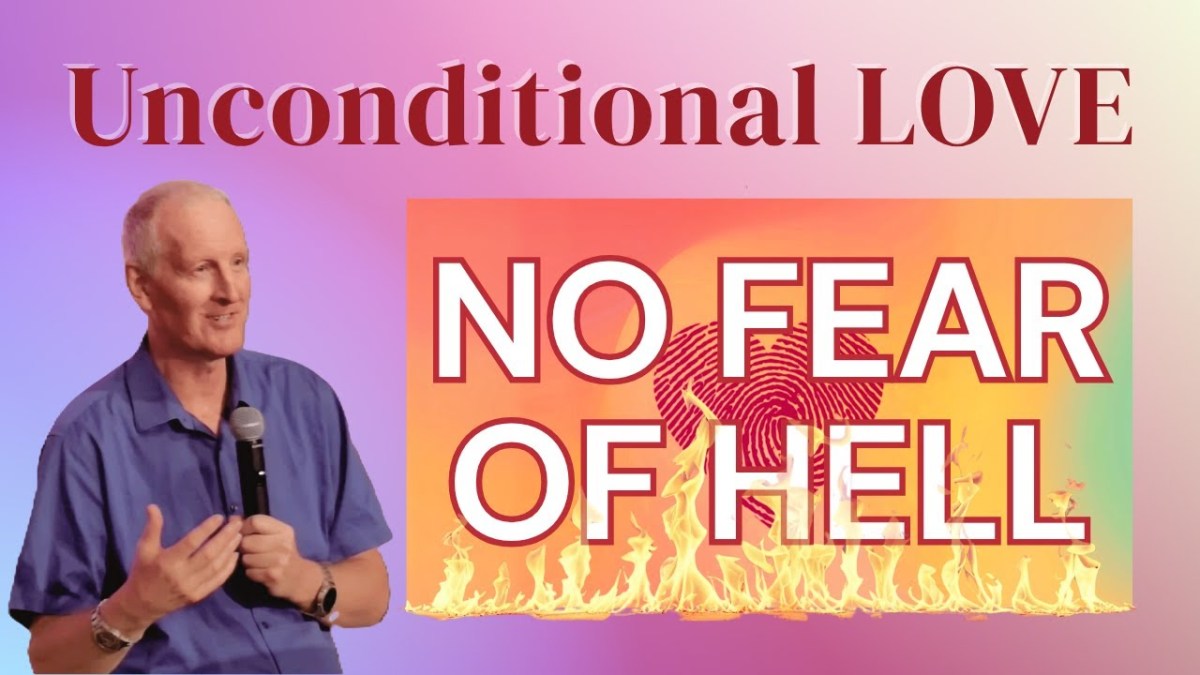
For most Christians, hell and eternal conscious torment are sacred cows—fixed, immutable doctrines. Many people simply cannot imagine there might be another way of understanding them. But I believe the world, in general, has rejected what is, in fact, a slur on the character and nature of God. God is unconditional love. And yet, much of the Church has accepted that slur—the idea that God would torment His children in fire forever. That He would give them a body that never wears out, so that they can be burned for all eternity.
Is that a loving God?
Not from my experience.
That is not what He is like at all.
So then, what does happen to people after they die? It is an important question, because many people are afraid of death—afraid of what comes next. If we know the answers, we can help them make the right choices now, before they die. And even after death, I believe it is not too late.
Is death more powerful than unconditional love? Absolutely not, because unconditional love has overcome death. My own experiences—encounters in which Jesus and the Father have shown me what happens after death—have convinced me completely that people go into the consuming fire of God’s presence, into the fire of His love. And because of that, I am absolutely confident that death is not the end of choice for anyone.
Unconditional love wins in the end—because God is patient. God is kind.
God will never give up. Love will never fail. Therefore, that love will win everyone in the end, so that they too can experience it for themselves.
I did not always believe this. I was conditioned—just like most people—to think that you had to choose Jesus before you died, because after that it would be too late and you would go to hell. But that is not what I now know to be true.
Into the Fire
Jesus and the Father took me into the fire. They showed me that you can preach to people in the fire, and that people in the fire can respond to that preaching. They can be reconciled back into a relationship with God. They can come into His love. They can become part of the cloud of witnesses. They can enter into their eternal destiny.
Now, I understand that many people struggle with this idea. But I have experienced it—over and over and over again. I have been into the consuming fire of God—both with Him, and on my own—many times. I have seen God’s love in action. And I have seen that the fire of God’s love is purifying and refining.
I have seen the power of that love first hand—the power to bring transformation into someone’s life when they accept and realise that God loves them. Even after death. Even after all the things they might have done in life to reject Jesus.
Love wins. The fire of God’s love never fails.
It never gives up. Love wins in the end.
The restoration of all things is founded on this truth:
God’s love will never fail, and He will never stop loving. Not until every person, every created being, comes into the relationship with Him they were made for—because we were created for relationship. He created all of creation for relationship.
Unconditional Love – new book out now Mike Parsons’ new book, Unconditional Love, is out on 20 June 2025. Order it from your favourite local or online bookseller today, or get the ebook instantly from our website. More details at eg.freedomarc.org/books.
References to Gehenna misunderstood
Where does our idea of “hell” come from? In the early Hebrew scriptures, it is not mentioned at all. In the Hebrew context, the concept of hell really only began to appear after the Babylonian exile and was then further shaped by Greek influences.
Jesus’ teaching has often been used to affirm the concept or theology of hell, but I believe that is an eschatological misunderstanding. The teaching Jesus gave about “the end” and what would happen was not referring to the end of time, with a future judgement and resurrection in which some would be punished. When Jesus spoke of the end, he was not referring to the end of the world. He was talking about the end of the old covenant age. There was fire and judgement associated with that, because the system itself was judged—and judged as having failed to produce righteousness.
Jesus used terms and language people would have understood, associated with fire and judgment. But these were generational issues. Jesus said all those things would take place within that generation. They have since been wrongly applied to the end of the world and have become associated with eternal conscious torment in the so-called fire of God’s judgment. In truth, it is not the fire of his judgment. It is the fire of his love.
These are not separate events—what happened at the end of the age and the references to people being thrown into Gehenna, the fiery rubbish dump outside Jerusalem. They refer to the same thing: the end-of-the-age judgment. Not the end of the world, as we have been led to believe. It is an eschatological issue.
If we understand that Jesus’ concept of “the end” was not the end of the world but the end of a particular age, then we can also see that Gehenna— often wrongly translated as “hell”—was not referring to some distant point in the future either. It was about that generation. Jesus’ teaching about the end of the old covenant age and the associated fiery judgment has been used to support an infernalist theology, but again, they refer to the same event. It is not about the end of the world, and it is not about eternal judgment.
In fact, the judgment has already taken place—and we have all been found innocent. That is absolutely essential for us to grasp. We have been judged innocent, not guilty—righteous, justified. There is no need for punishment.
All those Bible verses that have been used to affirm a belief in hell as penal retribution, or eternal conscious torment, are verses that have already been realised and fulfilled. They do not need to apply to anyone today—not to any of God’s children, not to anyone at all. That is really good news. It is not the fear-based, manipulative message that says people who do not know Jesus will go to hell. That is not good news. That is fear, used to control people into accepting Jesus. It is no different from the time of Christendom, when people were told to believe in Jesus or be put to the sword. This is the same idea, simply reworded: believe in Jesus, or go to hell.
When we are willing to look again, with fresh eyes and an open heart, I believe we will discover that death is not the end of choice. People can still accept what Jesus has done while in the refining fire of his loving presence, even after death. I would challenge anyone to produce a single Bible verse that actually states that death is the end of choice. There are none. The only one people sometimes use is the verse that says “after death, the judgment”. But that verse is not talking about physical death. It is not saying what we have been told it says—not in context, that is not what it means.
Ask the Holy Spirit to reveal this to you. Ask for the revelation of the Father’s heart towards what happens after death and for understanding of the concept of his fiery love.
I want everyone to know: you do not need to fear the future. You do not need to live in fear of torment or punishment. And we should never be using those kinds of ideas to scare people into accepting a God who is love. That is utterly inconsistent. God is love. He would not punish someone forever and ever just because they did not believe in him. He believes in you.
He believes in the world. Jesus came to take away the sin of the world. God has reconciled the world to himself in Christ, not counting anyone’s sins against them. Let us do the same. Let us have a ministry of reconciliation—a ministry of power—and let us be ambassadors of unconditional love to a world that so desperately needs it, that desperately needs to know God as love.
Only then can people be free from the destruction that comes from a lost or mistaken identity. God wants them to be whole. He wants all of us to come back into family, back into relationship, back into this amazing relationship with God, who is love.
I want to take us into a short activation. If there is any fear in your life—any doubt about your salvation, or about where you might end up, or even concerns for your loved ones—I invite you to let God, who is love, begin to remove that fear.
And if you have doubts about what I have taught today, you do not have to believe what I say. You have the right to believe whatever you choose. But I do ask you sincerely: ask God about it. Ask him to show you the reality of life, the power of unconditional love, the truth that nothing can separate anyone from it. Ask him to show you what that really means for people’s lives. Ask him to show you personally, so that you can have your own experience—something that affirms to you the truth of who he is: his unconditional love.
Activation: Safe and Secure
I encourage you now to close your eyes.
Begin to meditate.
Allow your breathing to slow down.
And begin to think about God as love.
Just be still.
Come to that place where you can be still and know.
Know that God is love.
Let his love surround you right now.
Let the power of his love flow over your physical body,
flow into your mind, into your heart and your emotions.
Let love, the power of love, overshadow you.
Father, I ask that you would reveal to everyone listening,
the power of your love.
Show anyone now if there is any fear in their lives—
fear of you, fear of punishment, fear of judgment, fear of the future…
Let your perfect love cast out fear.
Love on your children in such a way
that they are safe and secure in your arms of love.
You will never let them go.
You will never let them out of your hands of love.
You are keeping them safe and secure.
Just rest in that love.
Let his love touch you deep within your emotions.
Let it bring healing to anything in your past—
any fear or doubt you have
about where your loved ones are, if they have died physically.
Let the power of God’s love affirm to you
the truth of his consuming fire.
Father, I ask that you would show all who wish to see
what the refining, purifying fire of your love is.
Show them how death is not the end of choice.
Reveal yourself, reveal the truth.
Unveil the truth,
so that we may experience you.
Heaven is open.
Set the desires of your heart on engaging the Father.
Let the Father lead you.
Let him heal you, restore you,
fill you with the power of his love—
overwhelming love,
love that conquers death,
love that is stronger than the grave.
Rest in that love.
Rest in the power of that love.
Truly embrace it,
and for a few moments,
just wait there in the presence of God,
in his love.









 Unconditional Love – new book out now




 Sons of Issachar