427. Align with the Divine!

Mike Parsons

Not seeing the video? Please click here.

The person of God

Going in to meet the person of God—that is an experience beyond any other I’ve ever had. I could never have entered into that in the state I was in, but God began to change me, prepare me, in all those things in the soaking room, so I could get to that place where I was able to meet Him face to face. Now, I’d met God in many different ways, but there’s a difference between engaging the presence of God and engaging the person of God.

Metamorphosis

Metamorphosis is a process that produces transformation. Not only do things get removed, but things also get changed, added, to enable us to go into deeper levels of intimacy. So we have the ability to live in multi-dimensional realms, in the fullness of our eternal nature and identity.

An example in nature of metamorphosis is the transformation of a tadpole into a frog. It hatches from spawn and begins life restricted to water, breathing through gills—but that’s not God’s intention for it, that’s just the beginning. The tadpole eventually loses its gills and tail, develops legs and a new respiratory system, so as a frog it can be free from restrictions and live in both water and on land. A butterfly goes through a similar process—starting as a caterpillar, restricted to crawling on the earth, but changing through the chrysalis into something that is free to fly.

These are symbolic of the change and transformation that’s needed. We also go through a similar transformation that removes, adds, and restores abilities.

Many times in the Bible, you’ll find characters placed in a place of restriction to prepare them for their destiny. Now, sometimes people really struggle with that. They find it really difficult—to be restricted. They think God is putting that restriction on them in a negative way. But it is a positive thing when God places us in a position that brings about the change and transformation needed in our lives.

Some examples of that—Jacob under Laban, where he was looking to receive his wife, and there were all these conditions put on him, and tricks and everything else, but it produced character in him. Moses in the wilderness—he was called, but lived in the wilderness until he was able to take his position, after he had matured. David in Adullam’s cave—called for the kingdom, but in this place with a group of misfits, and God used that. Jeremiah was in anguish of soul, but came out into a place of fulfilling his destiny.

And then Joseph and Esther—they were also prepared. Joseph was prepared in the pit—his brothers threw him into the pit. How difficult must that have been? Then in slavery, in stewardship, and in prison—the prison of obscurity—until the time was right when his dreams and destiny would be fulfilled. Joseph, in his father’s house, was never going to fulfil his destiny. It was Joseph who’d gone through the process of change and transformation, who grew, who matured, who would end up in leadership in Egypt—in a way beyond what we’d have thought possible. But God prepared him, took him through seeming injustice and different situations that so challenged him—and yet he remained humble through those situations.

Esther went through 12 months of preparation before she could come before the king. That was so difficult. I’ve engaged Esther in the spirit—I’ve engaged her in the cloud of witnesses. I asked her, “What was it like?” And she said, “I didn’t want to be prepared to go and see the king.” That was not something a young Jewish girl would ever have wanted—to be a concubine of a king, a foreign king. But God had a purpose for Esther that would bring about the salvation of her people.

So it’s really important we don’t just look at the external circumstances of our life and think, “This is terrible. How can I get out of this?” We need to understand that sometimes, places of restriction are the places of greatest transformation.

For our soul to be prepared, there needs to be an identification of the things in our lives that are hindrances—coping mechanisms, defence mechanisms, trauma—and all of that leads us to a place of surrender. We surrender our independence. We learn to trust the Father for our provision, protection and direction in life. We’re no longer going to do it by the DIY tree path.

This video and blog post are taken from Mike’s current teaching series, Restoring First Love. Get the full-length videos every month, ad-free and with many extras, only at eg.freedomarc.org/first-love


Realign with our divine origin

Our spirits, souls and bodies realign with our divine origin—get realigned and brought into union and oneness with each other and with God. The identification of our false identity and any works- or performance-based orientation gives us the opportunity to find our true origin and redemptive gifts.

There’s preparation for glorious sonship in restored First Love, and creation is longing and waiting for the revealing of the sons of God—for the revealing of our true nature and how that can bring freedom to the whole of creation.

So the soaking room experiences began to engage my body, they began to engage my soul, to prepare my body to radiate glory and my soul to operate in light. This soaking begins to realign the frequencies of our being, to restore resonance with God, with our true identity—harmony and balance to our whole being.

We experience the sound and light frequencies of glory—God’s nature—for transfiguration from one degree of glory to another. We don’t stay the same. We increase in glory. So we increase in the full revelation of who we are, and begin to express that and live from that place.

Now literally, excitation of light waves of specific frequencies causes our DNA photons to be energised and transformed. That light is God Himself. We begin to be transfigured in light by God, who is light. We become sons of light, living in physical and emotional harmony, health and wholeness—and it all happens by the presence of God.

The symbols of the things in soaking are symbols of God’s presence—of God Himself. God as our Father is calling us to embrace the restrictions of transformation, to receive the freedom of our sonship. And it’s so important that we receive that freedom, so we can receive the full revelation of our eternal destiny—to live trans- and multi-dimensional existences, fully embracing all of the eternal characteristics of sonship that are our eternal identity, our true authentic self.

John 3:30 says, “He must increase, but I must decrease.” Now I’ve heard that preached as if it’s something we need to beat ourselves up about—as if we need to put ourselves on the cross every day. It doesn’t mean that. He reveals in me what is like Him—I embrace that. He takes away from me what is not like Him—I embrace that. It’s not something I have to try and do, like “I’ve got to decrease,” as if I’m nobody and nothing and with this sort of false humility. No—this is allowing Him to increase. Therefore, if He increases, then everything that’s not like Him falls away.

So I learn to surrender, where I can present myself to Him—I can be changed, conformed to sonship through this whole process by allowing Him to soak me in His presence.

So, what is soaking? Soaking is to make or allow something to become thoroughly wet by immersing it in liquid—that’s the dictionary definition: to immerse, to steep, to submerge, to submerse, to dip, to sink, to dunk, to bathe, to wet, to rinse, to douse, to marinate, to steep, to pickle. I mean, some of it’s really important.

To baptise in water, to baptise in the Spirit, to baptise in fire—in which we are immersed in those things which bring about the changes. I’ll go into that in more detail in a future session when I look at the heat and how heat transforms us. But the soaking room is the place of preparation that has parallel heavenly encounters in the River of Life, which is a river of energy—of Spirit—and in the river of fire.

God is a consuming fire. His love is a consuming fire. We can be baptised in the River of Life and in the associated waterfalls that cascade down. We can be baptised in the river of fire, engage the altars of fire, engage the process. See, the River of Life is Spirit energy—living water. It’s not H₂O, but the very essence of life, encoded with the frequencies of God—God’s essence. And when we are baptised into it, when we submerge ourselves into it, it begins to change and transform us.

The sound of many waters—it says God’s voice is like the sound of many waters. The sound of many waters are the creational frequencies of God’s voice that will realign us to who God created us to be.

Baptised into Love (meditation excerpt)

I encourage you right now
just to close your eyes.
Get comfortable.
Begin to relax.
To focus your thinking on God.

Focus your thinking
on God’s love, grace, mercy for you.

Focus your breathing by slowing down.

Breathe in more slowly.
Breathe in more deeply.
And as you’re breathing in,
you’re breathing in
the unconditional love of the Father.

You’re breathing in love.
You’re breathing in joy, and peace.

And as you breathe it in, just receive.
Let it flow into your being.
Whether you feel it, or sense it,
just let it flow.

Continue to be still.

Breathe in
and breathe out slowly.
Breathe in slowly
and breathe out slowly.

Slow everything down and totally relax.
Just become mindful
that you’re cocooned
right now
in God’s presence.

As you are still,
He is cocooning you in love.
He’s loving on you.

Consciously invite love,
invite joy,
invite peace,
to come upon you,
to flow in you,
to flow through you—
to create an atmosphere of rest around you
that you are completely submerged in –
baptised into the higher frequency of love.

Vibrating in that energy.
Vibrating in peace and joy.

Overshadowed with the presence of the Holy Spirit,
energising you,
transforming you,
changing you.

Be open to that overshadowing.
For the presence of God
to rest upon you.


Related posts

Into the Dark Cloud

281. Scroll of Destiny: Just Being

399. Become Acquainted With Perfection


414. Living in the Spirit

Mike Parsons –

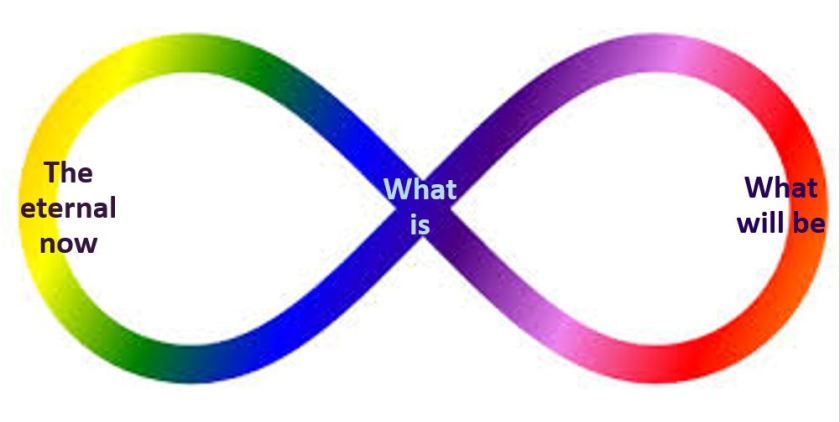
Eternity symbol

I did the same thing when I was on my journey. I found that whenever I was in a setting where I could just let go—usually in a worship setting or something similar at the time—I would notice my hand just drawing this sign. And I remember thinking, “What am I doing?” It felt a bit strange, but I just went with it because I didn’t really care what anyone else thought. I decided to just go with it.

Eventually, God began to show me that I was connecting with something, and He was unveiling an understanding of where I was in the beginning—the origin of my identity in Him—then bringing that into the present and outworking it in the present to create the future. It’s a continual pathway, drawing from where we are in relationship with God in the eternal now, living in intimacy with Him, and outworking that in the present, which then brings the future into place. What I do today becomes history, so today I can establish my future for tomorrow. Tomorrow is going to come, but what I do today can prepare for it out of what was in the eternal now—what was, what is, and what will be.

From doing to being

Sometimes people talk about the end and beginning of a circle, saying the end of one thing is always the beginning of another, which is true in a sense. But actually, God told me, “No, it’s not a circle; it’s this sign, the sign of my eternal covenant with man.” We were predestined to return to face-to-face relationship with Him, and that relationship enables us to outwork who we are in that state of being—what was, what is. I can just be.

I had always been very active because I’m quite an active person. I like to do things. So I was always focused on what I was doing today and how I was outworking things. It became a lot of activity. But God pulled me back from that place and showed me that it’s not about what I’m doing today—it’s about who I am today. My state of being has a greater impact than just what I do. Because what I do can sometimes come from a need, a desire, or something that isn’t necessarily from the heart of God. But if I’m flowing from what was and always is—because God is always in that eternal state—then I can simply be.

I started off doing and eventually became someone who could be. And that was really liberating because it meant I only needed to be in relationship with the Father, connected to His heart. That connection would inspire and motivate me to outwork His heart every day. But I didn’t have to keep asking, “What should I do today?” or “What needs to be done?” I just needed to be me. Because if I am me, that naturally creates space for the outworking of who I am in any situation. I could be more relaxed, at peace, at rest, without always wondering, “What should I be doing?” or “God, what are you doing?” It became a heart-to-heart relationship instead of a list of tasks.

In the beginning, God did give me lists because He met me where I was. But He didn’t leave me there. One day, He just stopped giving me anything to do and simply embraced me. And I remember struggling with that because I thought, “I’m not doing anything!” But He was showing me that being in that oneness was far more important than what I thought I needed to do. Being enabled a flow rather than duty, obligation, or what I thought I should be doing.

Just because I know how to do something doesn’t mean I need to do it.

Just because I know how to do something doesn’t mean I need to do it. And God demonstrated that to me over and over again. There were times when things were happening, and I’d go to God and ask, “Can I do something here?” And He’d say, “No, it’s all right. I’ve got it covered.” Someone else was doing something, and later on, I would find out who those people were. And that was great, because then I realised God was already at work in them. He didn’t need me, but if he did ask me to do something, that would be good. But I knew it would be coming out of a place where I was feeling his heart about it.

Connected in the spirit

And actually, sometimes feeling his heart about a situation but not having any sense that I should do something doesn’t mean I have to be passive, because I can still be encouraging others who God has assigned to do it. In a sense, when we’re connected in the spirit—because we’re all one in the spirit—then my encouragement can help somebody else feel secure in what they’re doing. So my heart wouldn’t be, “Oh, I wish I was doing that,” but rather, “How can I help encourage whoever is doing that so they are able to do it in the way God would want them to?”

My thoughts are always that way—I’m part of the whole, and God has many different ways of doing things. And of course, we can be doing things in the spirit without necessarily needing to know what we’re doing cognitively. I’m doing that all the time. That’s a state of being multi-dimensional, doing things in many different places without needing to be there in a conscious way, because my spirit is there. All our spirits are seated in heavenly places with Christ; we just haven’t mostly learned how to engage with it. But we’re there, so our spirit is active even if we’re not aware of what we’re doing. But we can become more aware as our soul and spirit begin to learn how to engage—until we don’t need to consciously engage because it’s just happening.

I can engage right now with whatever I might be doing in the spirit realm, but most of the time, I don’t need to, because that actually gives me more time to be here in a way that enables me to be at peace and at rest. It allows me to be a demonstration of that and to live it out with a more creational perspective. Before, I was so focused on what I was doing in the spirit realm that the earthly realm almost seemed secondary. But God really showed me the value of this realm—of living here and outworking who we are there, here: “on earth as it is in heaven“—in a way that made me much more connected to creation. I had more time to feel and sense what was going on around me, whereas before, my focus was so much on what I was doing in heaven that earthly things seemed less important. But actually, it’s creation that is waiting for the revealing of the sons of God, longing to be set free.

The groan of creation

There is an aspect of our sonship that is very much about the restoration of how God intended things to be here. And I found that having a more relaxed way of living with creation around me enabled me to tune into that more—to feel that groan and sense what was going on. Sometimes, even the earth groans at what we do to it and what we do to ourselves. You often see physical events happening in the world when significant things happen with people. There’s a kind of disturbance that we can bring peace into. We don’t want so-called natural disasters to follow human disasters—if we can bring peace so that the earth doesn’t react to what’s happening among people.

Reconcile the earth

There’s a lot going on in the world right now—many places where things are unfolding. I believe that, as sons of God, we have the ability to bring peace into these situations. Even if external peace isn’t happening between people, we can still reconcile the earth itself so that there isn’t a reaction from creation to what’s going on. I think that’s really important—that we are peacemakers. It would be great if we could bring peace into every environment; but at the very least we can bring peace between the earth, the creation we are part of, and anything negative that is going on.

If you find these posts helpful, please like, share, comment and subscribe so they reach others who can enjoy them too. Thank you!

Related posts by Mike Parsons

401. Cardiognosis: Expanding Your Heart

Mike Parsons


A deeper knowing

I think cardiognosis is often perceived as being connected to the Father’s heart and, therefore, the knowledge of his heart. That is true, and a heart-to-heart relationship with him will give us an unfolding knowledge of his heart. However, it’s not necessarily a cognitive process where he tells us things directly. Rather, it’s about knowing—a deeper knowing.

To truly feel the heart of God, our own hearts must expand. We cannot contain the fullness of God’s heart if our own is fractured, damaged or broken. Wholeness is essential. Beyond that, our hearts must grow in their capacity for compassion and love as we grow and mature. This level of love requires an expansion of our heart.

We also have a choice—we can open our hearts towards certain things, or we can close them. To open our hearts means giving access to those things God is working with or for. When we feel his heart, God desires that we respond out of his heart, motivated by his compassion, rather than out of duty or obligation. It’s not about thinking, “Oh, God has shown me something, so I suppose I’d better do this.” Instead, it’s about being moved by his desire and compassion as we come to know and discern his heart. This process is an intimate cardiognosis—a heart-to-heart revelation.

Engage with creation

We can also open our hearts towards other things. For example, there have been times when I’ve engaged with creation, and my heart has expanded. I’ve felt the sadness, loneliness and disconnect of creation, which stirred a deeper desire for its restoration and freedom. Engaging with a situation in such a way allows our hearts to expand and to develop a greater love, compassion and connection than we might have experienced before.

As we operate in sonship and the desires that come with it, we begin to see, feel and sense things differently. This awareness prevents us from becoming oblivious to what’s happening around us. Instead, we engage it. I can reach out to creation and engage in cardiognosis with it. I can open my heart to feel what creation is experiencing.

Similarly, I can open my heart towards others. When I speak at conferences, I choose to open my heart and spirit to the people there. I surround the space—wherever it might be—with my spirit to create a safe environment where people could engage with me. In doing so, I become more aware of their needs and am drawn to speak about what is most relevant to them.

In the past, I engaged my spirit to create a safe place, but I’ve since learned to engage my heart as well. It’s not just about creating a safe space but about making it a place of real connection. This requires a willingness to feel.

Open our hearts to experience

Years ago, empathy was often encouraged. Some would intercede for others by empathising with their pain, sometimes expressing this through wailing or outward emotional displays. I don’t think that is really what it is talking about. It is not about feeling someone’s pain and becoming emotionally broken. Instead, I would focus on relating to where someone is and being motivated to engage with them for their good, rather than simply sympathise with them. Some of what I saw in intercession didn’t sit well with me. Perhaps it’s because I’m not mercy-gift oriented, but I felt that all they were doing was wailing without actually achieving anything. Did it achieve anything? Maybe it did. But it didn’t feel like where I was, and I certainly didn’t respond in that way very often.

But I do feel I can choose to open my heart. I can choose to engage my heart and my emotions to feel and sense and be more connected to a
person, or a situation, or creation itself; and this is what I believe cardiognosis to be. It’s not about intellectual knowledge but experiential knowledge—knowing through experience. If we don’t open our hearts to experience something, we won’t truly know it; we’ll only have information about it. True knowledge comes through personal testimony and encounter, not just information.

Engaging heart-to-heart

I believe God calls us to be holistically involved in situations. Sometimes, even our physical bodies can react or sense the dynamics of a situation. It’s about engaging with the whole of who we are—spirit, soul and body. In the past, I relied more on engaging with my spirit because I was more comfortable with that. Over time, however, I’ve allowed my emotions and heart to become more involved, engaging heart-to-heart in a way I hadn’t before.

This change has come as I’ve connected more deeply with the heart of God. That connection inspires and moves me in a way it never did before. I believe this is part of growing in true knowledge.


If you enjoy these video blogs, please take a moment to like, share, comment and subscribe. It really does help. Thank you very much.

260. Coming Back into Alignment

Mike Parsons
with Jeremy Westcott – 

In this series of blog posts we have embarked on a journey to discover the full meaning of ‘the restoration of all things’ (Acts 3:21) and the part we all have to play as sons of God in that restoration.

All things

What are the ‘all things? For me, the phrase ‘the restoration of all things’ refers to all physical and spiritual things that have been lost, distorted, damaged, destroyed, broken or disconnected; everything that God created in line with His original intent and purpose. That would include:

  • Creation and everything in it
  • Everyone, everything, everywhere, throughout all time and all history
  • All relative dimensions of time and space
  • Our eternal memory, wisdom, knowledge, understanding and position as light beings, as we were before we came into this realm
  • All our abilities and powers
  • All dark and light matter and dark and light energy, including the restoration of the speed of light (which has diminished over time1)
  • Access to all places and all realms everywhere, at any time, inside and outside of time and space as we presently know it
  • Our inheritance, identity, position and authority as sons. This is fundamental and impacts the whole of creation because it is as sons that we will play our part in the restoration of all things.

God is looking to see everything restored which was lost when the light of glory was removed. It is in His nature to bring healing, reconciliation, redemption and restoration. Why would He not want all things restored to their original condition and functionality, back to how He always intended them to be? It is not as if He has changed His mind or had a better idea! Restoration for us – and for all creation – is nothing more nor less than coming back into alignment with God’s eternal thoughts about us.

Father and son(s)

For all who are being led by the Spirit of God, these are sons of God… The Spirit Himself testifies with our spirit that we are children of God, and if children, heirs also, heirs of God and fellow heirs with Christ… For the anxious longing of the creation waits eagerly for the revealing of the sons of God… the creation itself also will be set free from its slavery to corruption into the freedom of the glory of the children of God. (Rom 8:14-21).

We are heirs of the Father and co-heirs with Jesus. He has empowered us as sons and given us authority for the created realm, and creation will recognise and respond to us when we are manifested as sons. Therefore whatever is revealed about ‘all things’ in context of the relationship between Father and Son directly relates to our own sonship.

‘All things’ in the Bible

Before we launch into a consideration of ‘all things’ in the Bible, a brief word about how we read our Bibles. As we read, we have a tendency to automatically revert to the familiar assumptions that we (or others) have made, both about what a particular passage is talking about and what it is saying about it. Instead of merely thinking we know what it says, let’s engage with, meditate upon and enter into the scripture and allow God (Father, Son and Holy Spirit) to reveal what He is saying through what we are reading. That takes awareness and practice but it opens up a whole new vista of revelation.

All things in subjection

For He has put all things in subjection under His feet. When all things are subjected to Him, then the Son Himself also will be subjected to the One who subjected all things to Him, so that God may be all in all. (1 Cor 15:27-28).

But what does ‘in subjection’ mean? Who and what is going to be brought into subjection?

If we are ‘in subjection’ to Him, then we acknowledge that we are His subjects. The Greek word hupotasso means ‘to place under’. We are under His protection, under His blessing, under His love, under His covenant.

And not only we but ‘all things’ are to be brought into agreement with God’s plans and purposes. We may look around and wonder how that is ever going to happen. I suggest that it starts with a group of people who say “Yes, God, I want to be in agreement with You. I come into agreement that I am a son, and for my sonship to be revealed to all creation.” That is not what religion has encouraged but Jesus is our example: through His relationship with the Father He only did what He saw the Father doing.

None of this is about theology or doctrine, whether we agree or not with a particular person or teaching. It is all about relationship with God; with the Father, Son and Holy Spirit, and about being willing to maintain a loving relationship with other people with whom we do not necessarily see eye to eye. We can be in relational agreement even if we hold different views. We do not need to be ‘right’ and so reject everyone else as being ‘wrong’. Again, this is not something religion has encouraged or modelled for us.

Some Bible verses

Here are some New Testament verses mentioning ‘all things’. I am not particularly going to explain or teach on them. In line with what I wrote earlier, I would encourage you to take some time to meditate upon them, engage with them – perhaps read them in some other translations – and see what God has to say to you about them.

For from Him and through Him and to Him are all things (Rom 11:36).

…but just as it is written,
“Things which eye has not seen and ear has not heard,
And which have not entered the heart of man,
All that God has prepared for those who love Him.”
For to us God revealed them through the Spirit; for the Spirit searches all things, even the depths of God
(1 Cor 2:9-10).

…yet for us there is but one God, the Father, from whom are all things and we exist for Him; and one Lord, Jesus Christ, by whom are all things, and we exist through Him (1 Cor 8:6).

all things originate from God (1 Cor 11:12).

There are varieties of effects, but the same God who works all things in all [persons] (1 Cor 12:6).

[Love] bears all things, believes all things, hopes all things, endures all things (1 Cor 13:7).

…with a view to an administration suitable to the fullness of the times, that is, the summing up of all things in Christ, things in the heavens and things on the earth (Eph 1:10).

In Him also we have obtained an inheritance, having been predestined according to His purpose who works all things after the counsel of His will (Eph 1:11).

He who descended is Himself also He who ascended far above all the heavens, so that He might fill all things (Eph 4:10).

For by Him all things were created, both in the heavens and on earth, visible and invisible, whether thrones or dominions or rulers or authorities – all things have been created through Him and for Him (Col 1:16).

He is before all things, and in Him all things hold together (Col 1:17).

…and through Him to reconcile all things to Himself, having made peace through the blood of His cross; through Him, I say, whether things on earth or things in heaven… He has now reconciled you in His fleshly body through death, in order to present you before Him holy and blameless and beyond reproach (Col 1:20, 22).

Reflection

In light of what God has shown you in love as you meditated on these verses, do you believe there is potential for all things to be restored to God’s original intent and purpose?

Do you believe that there are some things that could not (or should not) be restored to God’s original intent and purpose? Why not?

The only thing which I consider really cannot be restored is the DIY (do-it-yourself) pathway itself, the pathway of the knowledge of good and evil. That was never part of God’s intent and purpose for creation in the first place.

Reference

A time varying speed of light as a solution to cosmological puzzles – article by Andreas Albrecht and Joao Magueijo (Cornell University, 1999).

Recent posts by FreedomARC
Further resources from FreedomARC

Support Freedom ARC

'Donate to Freedom ARC' button

Our Patreon patrons give a small amount each month and can join us for our monthly group Zooms, get exclusive or early access to Mike’s teaching and enjoy further patron-only benefits. Or you can use the blue button to contact us about making a one-time gift.
Thank you!
*Note Sadly, because of abuse by scammers we can no longer offer a ‘click to donate’ option. However, if you contact us, we will get back to you with a simple means of giving. 

256. The Period of Restoration of All Things

Mike Parsons
with Jeremy Westcott – 

…and that He may send Jesus, the Christ appointed for you, whom heaven must receive until the period of restoration of all things about which God spoke by the mouth of His holy prophets from ancient time (Acts 3:20-21).

We are going to consider a number of questions which come up around what Peter said in this passage. As always, I am not asking you to believe what I say just because I say it, but to take your questions to God with an open heart and mind, and see what He has to say to you about them.

Before, during or after?

Is Jesus coming before, during or after the period of restoration of all things?

All three, I would venture to suggest. He has already come, He is continually coming as He promised, where two or three are gathered, and He is going to come.

So much of Christian expectation has focused on a future event which will change everything in a moment, and that event has usually been called the ‘second coming’ of Jesus. We are waiting for the ‘second coming’, and when that happens, then everything is going to be restored to how God wants it. However, it is not an event that is indicated here, but a period.

When is the period of restoration?

I have heard it suggested that we are in some special season now, in which it is possible for all things to be restored, and that this was not possible before. But there was one significant event in human history which made all kinds of things possible: the cross; the death, resurrection and ascension of Jesus. He took back everything Adam lost and restored it to us. We, though, have been very slow to realise and embrace the full extent of what He accomplished, or its implications.

The early church did a great job of taking this message and filling the known world with it, but then it was hijacked by religion. During the dark ages much truth was forgotten and lost. Everything became a matter of religious observance or duty for most people rather than the relationship of intimacy that God always intended. God has been restoring that, so we can now embrace that truth and continue with the process of restoration which has been going on all that time.

How far back?

How far back does the restoration of all things reach? Back to what?

Some will say, “We need to get back to the New Testament church. We need to get back to this amazing time when people were being added every day.” Others will say, ‘No, I want it to go back further. I want it to go back to the Garden. I want to go back to when Adam and Eve had this wonderful, intimate relationship with God, walking with Him in the cool of the day.” In reality, I believe God wants to go back even further than that, back to His original intent and purpose in creation.

And that is not the end, just the beginning. Think of all that is possible, if we co-operate with God as sons from that point on: it is beyond the scope of our imagination to conceive of, because what we can imagine is restricted and filtered by our pre-existing religious ideas and what we presently see. But when we engage in God’s heart outside of what we can already see, then our minds can be expanded. We are supposed to have the mind of Christ, which certainly contains everything that was God’s original intention. When we start to have that mind, it has the potential to explode the limitations and restrictions on our thinking.

What is restoration?

In English, a dictionary definition of ‘restoration’ is: ‘the action of returning something to a former owner, place, or condition; the act or process of returning something to its earlier good condition or position”. When we read ‘former owner’ we tend to think ‘God’, but actually creation has been given to mankind, to us.

Even the definition of the English word might limit our understanding. The biblical sense is ‘to receive back more than has been lost, to the point where the final state is greater than the original condition’. It means that someone or something is improved beyond their current or previous measure. We derive this from two Hebrew words and one Greek:

The Hebrew word chadash means renew, repair, restore.
Another Hebrew word, arukah, means restoration, recovery, repair, healing, health, perfected.
The Greek word apokatastasis is made up of two parts, apo meaning from and katastasis, meaning first or original order.
Apokatastasis: restoration, restitution, reestablishment, reconstitution. Properly, restore back to original standing, i.e. which existed before a fall; re-establish, returning back to the (ultimate) ideal. Figuratively, restore back to full freedom (the liberty of the original standing); to enjoy again, i.e. what was taken away by a destructive or life-dominating power.

Restoration involves reconciling, renewing, repairing, rebuilding, returning, restitution, resurrecting, relationship, revelation, and even resting. We all need a cosmic makeover of eternal proportions:

  • Restoration of the identity that God intended us to have as sons, and of the revelation that flows from that intimate relationship
  • Recognising that we have a reconciled relationship to God, to each other and to creation
  • Returning to our original position of relationship and authority
  • Repair of everything broken, damaged or fragmented
  • Restitution of everything that has ever been lost or stolen
  • Renewal of our destiny scroll and our minds and thinking to the mind of Christ
  • Resurrecting our lives from all the effects of death
  • Resting in the intimacy of love, joy and peace

What are the ‘all things’?

‘All’ is a big word. The Greek word pas means the whole, every kind of, each and every part that applies; the emphasis is the total picture, made up of each of its elements, one piece at a time, viewing the whole in terms of all the individual parts.

It is a little like making a jigsaw puzzle. You do not make the whole thing in one go, you have to place each piece in the correct position. Normally, people do that by looking at the picture on the box. And if we are to be involved in the restoration of all things, we need to look at ‘the picture on the box’ if you like, at what was God’s original intent and purpose. Then we can realise that God has been at work in this all along, restoring us from the position we have been in (and the image we have had of ourselves) back to the image that He has of us.

And we, mankind, are only a part of the picture. If God is restoring everything back to His original intention, what else might He want restored? We know that all creation is groaning, waiting for the sons of God to be revealed. Are we only talking about the physical realm? Are there things – or creatures – in the heavenly realms which are not as He originally intended, and are they to be restored? Would we have a problem with that?

If the concept of the restoration of all things does not stretch us, I wonder if we have really grasped it!

Recent posts by FreedomARC

Support Freedom ARC

'Donate to Freedom ARC' button

Our Patreon patrons give a small amount each month and can join us for our monthly group Zooms, get exclusive or early access to Mike’s teaching and enjoy further patron-only benefits. Or you can use the blue button to contact us about making a one-time gift.
Thank you!
*Note Sadly, because of abuse by scammers we can no longer offer a ‘click to donate’ option. However, if you contact us, we will get back to you with a simple means of giving. 

217. Redemptive Gifts (1)

Mike Parsons

In this series on ‘destiny’ we have looked at ‘who I am’, and it is time now to move on to our redemptive gifts or ‘how I am made’. After that, we will go on to ‘what I am made for’.

And we know that God causes all things to work together for good to those who love God, to those who are called according to His purpose (Rom 8:28).

If we want things to work together for good (and not just our own good but for the good of everything and everybody), then we really need to know that we are called and that we have a purpose.

  • Do you know His purpose for your life?
  • Have you accepted His call?

His purpose and His call will work together to enable us to see our lives outworked for the glory of God and bring transformation to this earthly realm. If we know His purpose for our lives and know what He has called us to, both in this realm and in heaven, that will enable us to be a gateway of heaven on earth.

Transformed or conformed?

‘A redemptive gift is the grace of God woven into who we are; that when we are made right with God we become able to honour Him with how He has made us to be’.

Sadly there may have been other threads ‘woven into us’ which have affected us negatively.

And do not be conformed to this world, but be transformed by the renewing of your mind, so that you may prove what the will of God is… (Rom 12:2).

God’s will is for an open heaven over us, for us to engage with the Father, Son and Holy Spirit in intimacy, and for that, we need to be transformed (not conformed). The world wants to conform us to a particular pattern and rob us of what God intends us to have and experience.

The world may have masked, damaged or perverted our identity, our gift and our destiny, because of our own experience and that of our generations. If we don’t know who we really are we will forever be asking ‘where do I fit?’ and ‘where do I belong?’

God desires to transform us to outwork who we really are, in His service. In that way, we will be able to fulfil our part in restoring the whole of creation.

Redemptive gifts

Redemptive gifts are different from the spiritual gifts of 1 Corinthians 12 (healing, words of knowledge, wisdom, distinguishing of spirits, tongues etc.), and from the offices appointed for the church in 1 Corinthians 14 (apostle, prophet, teacher, miracle worker etc.), and from the ministry gifts of Ephesians 4 (apostle, prophet, teacher, evangelist, shepherd).

Redemptive gifts are found in Romans 12.

Since we have gifts that differ according to the grace given to us, each of us is to exercise them accordingly: if prophecy , according to the proportion of his faith; if service, in his serving; or he who teaches, in his teaching; or he who exhorts, in his exhortation; he who gives, with liberality; he who rules,  with diligence; he who shows mercy , with cheerfulness (Rom 12:6-8).

There are seven different gifts, and these are given to ‘each of us’, which leaves nobody out. We are to line up with what God has given, rather than what the world has attempted to impose on us. Each of us is to exercise the gift(s) He has given us; as we do we are to be that gift to the rest of the body.

The seven gifts are prophet, servant, teacher, exhorter, giver, ruler and mercy.

Paul writes that faith is intrinsic to being a prophet and that a servant will actually serve (you cannot be a servant in theory). The same with teacher and exhorter – it is only in teaching or exhorting that they express themselves. The next three are interesting. ‘With liberality’ describes how a giver gives. ‘With diligence’ describes how a ruler rules. Finally, mercy operates ‘with cheerfulness’, indicating that the mercy gift may perhaps struggle to be cheerful. We will look at each gift in more detail in coming posts.

Why ‘redemptive’ gifts?

For the anxious longing of the creation waits eagerly for the revealing of the sons of God. For the creation was subjected to futility, not willingly, but because of Him who subjected it, in hope that the creation itself also will be redeemed from its slavery to corruption into the freedom of the glory of the children of God (Rom 8:19-21).

Everything God created, both in the spiritual realm and in the physical realm, is waiting for God’s sons to be revealed, and to bring back to creation what is missing. So ‘creation itself will also be redeemed’, and we are called to be part of God’s plan to do that. That plan includes the gifts God has given us, and when we discover who we are then we can discover how we fit into God’s overall purpose. The way we are wired and designed enables each of us to fulfil our destiny and engage in the process of restoring creation.

Redemptive gifts are dealt to each person in differing measures of faith.
God gives people as the different gifts.
God gives these gifts as necessary to fulfil his redemptive will on earth.
Each of us is a gift, differing according to the grace given to us by God.

Each person is and has a primary gift, but will have others as well, and the mix and degree of the various gifts in each of us is a unique combination.

Received at conception

“Before I formed you in the womb I knew you, And before you were born I consecrated you; I have appointed you a prophet to the nations” (Jeremiah 1:5).

Redemptive gifts are received at conception, rather than salvation. We are born with them and they will influence the course of our lives, regardless of whether we become Christians or not (though they will be more effectively expressed if we do). Psychologists term these differences in people ‘basic temperaments’ or ‘personality types’.

We are designed on (and with) purpose.

Redemptive gifts tend to shape our personality. They also affect the way in which we may receive or express one or more of the spiritual gifts, offices or ministries.

So my redemptive gift is how I am intrinsically made to function, ideally with spirit and soul in harmony. But because of separation from God, my soul or heart personality traits developed independently of my spirit. I need to discover the gift, then purify and refine the heart to define and polish it, so that it begins to shine.

There are some common behavioural characteristics which can help us identify our redemptive gifts (primary and secondary). Compassion, for example, may come more easily to servants and mercies than prophets and rulers. However, we must not use our gift as an excuse for not growing in love! We are all called to walk out the fruit of the Spirit, whether it comes naturally or not.

Arthur Burk has done a great deal of research into redemptive gifts. Here are some of the characteristics he has identified and how he correlates them with other sevens in the Bible (click here or on either image to view or download them both in one PDF file):

slide-1-hd
slide-2-hd

God is your Father and designer, and He desires to call forth your identity as His child. He desires to reveal your redemptive identity. He wants you to know who you are and how you are designed. You are called to be a world-changer.

As you exercise your own gifting you are free of the need to compare yourself (favourably or unfavourably) with anyone else. You can be comfortable in your own skin, not having to try to be like other people.

You are you.

You are unique;
Everyone else is also unique.

You are messed up in some way;
Everyone is messed up in some way.

You are a mixture;
Everyone is a mixture.

Every one of us is in the process of being refined, purified and transformed so that we can be ‘us’ as designed by God.

We must learn to respect and honour the differences and uniqueness in each other. As members of the body we will not all see things the same way, but when we put it all together we (as a body) will see things as Jesus does.

Next time we will begin to look at each of the gifts in more detail.

Related articles from Freedom ARC
Other resources from Freedom ARC
Recommended resources from Arthur Burk

Support Freedom ARC

'Donate to Freedom ARC' button

Our Patreon patrons give a small amount each month and can join us for our monthly group Zooms, get exclusive or early access to Mike’s teaching and enjoy further patron-only benefits. Or you can use the blue button to contact us about making a one-time gift.
Thank you!
*Note Sadly, because of abuse by scammers we can no longer offer a ‘click to donate’ option. However, if you contact us, we will get back to you with a simple means of giving. 

89. Seed Wars

Mike Parsons
with Jeremy Westcott – 

When Satan fell, he was seeking to overturn God’s eternal plan that Man should inherit the heavens. He wanted that place of rulership for himself.

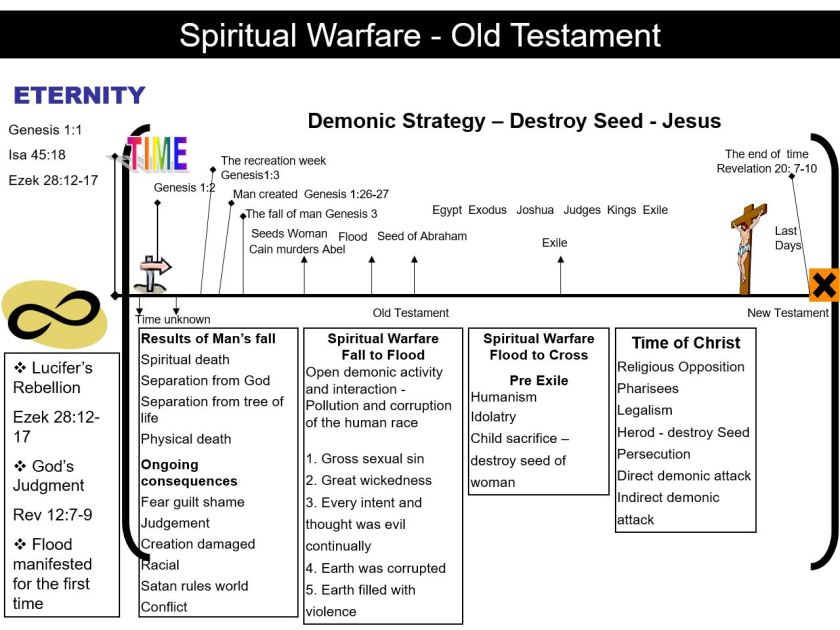
Here is a diagram I used when I taught about spiritual warfare in Freedom Church:
I realise that some of the writing is quite small to read, so you can click on the image above to view or download it as a PDF file, if that helps.

Time and Eternity

On the left you see eternity, the setting for Genesis 1:1. Before time, if you like. God created the earth to be inhabited, but then Lucifer rebelled, as we saw last time, and was cast down to the earth, where he brought down God’s judgment upon it in the first flood.

Moving to the right, you find Genesis 1:2. Inside the bracket of time, now. The earth is without form, and void (that’s really just another word for ’empty’). God begins again, He recreates the earth. How long is the time between verse 1 and verse 2? We have no idea. Nor do we know how long a time elapsed between verses 2 and 3. It could have been microseconds; it could have been 14 billion years. We don’t know.

The Fall of Man

Then comes the week of (re-)creation followed by the story of Adam’s fall, as Satan now engages with Adam and Eve. And what he is offering them is the only thing he has to trade with: information. He offers them the opportunity to become like God, but without God. The opportunity to know, without God. To rule, without God (he would later try the same thing on Jesus in the wilderness). This is the root of humanism.

Trading for Seed

He offers to give them information in return for something. They did not trade by eating a piece of fruit from a tree – that is very symbolic language when you go back into the original language. Satan overshadowed them, and took their DNA. He knew that DNA was the only thing that could inherit the heavens.

Now that he has DNA, he produces a seed. That may be an unfamiliar idea, but it is right there in scripture. In Genesis 3:14-15 we find the first prophecy of the coming of a Messiah, a Redeemer, and in verse 15 we read about Satan’s seed: “And I will put enmity between you and the woman, and between your seed and her seed; He shall bruise you on the head, and you shall bruise him on the heel”. God is talking to Satan, and says, “Your seed and her seed”. It is made really clear that Satan has seed.

Seed Wars

This is how he came to get that seed. Cain and Abel, who were twins, had different fathers. Abel’s father was Adam, and his DNA was to produce what is called ‘the seed of woman’. Except that Cain killed him, and God had to reinstitute that line through Seth. Cain’s father was Satan. Cain was the seed of Satan. So you can view this whole period as one of seed wars, during which Cain’s seed seek to rule.

Polluting the Seed

Then, in Noah’s time, we have fallen watcher angels – Ben Elohim (sons of God) – falling to earth, leaving their proper place (Jude 1:6). They do a similar thing with human women, overshadowing them (this is not sex as we know it, but overshadowing of their DNA) to produce the race of giants called the Nephilim. Spiritual warfare becomes intense, fighting for the purity of the seed. Judgment comes again in the flood, but God preserves the seed of woman.

Jesus the Seed

We know that Jesus was the prophesied seed who was coming, who was to crush Satan’s head (though he would bruise His heel). Satan did not know that, but every scheme and intention of his was to prevent the fulfilment of that prophecy by eliminating or corrupting the seed line before it could happen.

Abraham and his Seed

Remember the covenant God made with Abraham. It was a covenant with Abraham ‘and his seed’ (Gal 3:16). And throughout the Old Testament period, Satan threw everything he had at frustrating God’s plan. From genocide under Pharoah to the massacre of the innocents under Herod, he tried everything to prevent the fulfilment of God’s words in Genesis 3:15. Even when Jesus was ready to enter His ministry, as I mentioned earlier, he attempted to derail His destiny in the wilderness.

The Prophecy Fulfilled

The cross, he thought, was his moment of crowning triumph. Only to find that, despite his best efforts, all he had done was fall in with the eternal purpose of God, and co-operated in bringing down that promised crushing blow upon his own head.

JOIN US IN ENGAGING GOD!

Engaging God on the Heavenly Pathways of Relationship and Responsibility is our online school for equipping a Joshua Generation of supernatural sons of God to live according to the order of Melchizedek.

Your first two weeks free!
Click here to get started today*

To find out more about the Engaging God programme, click here

*Technology permitting: automated process on setup of payment arrangement and completion of online registration form. Terms and conditions apply.