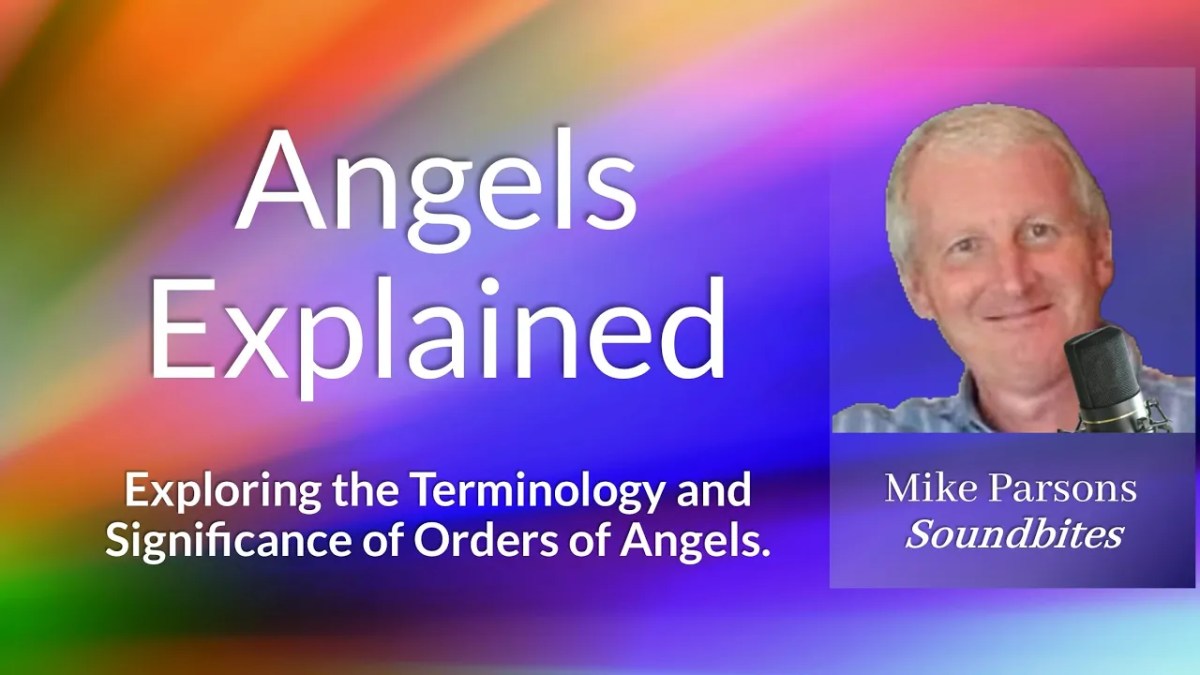
405. Angels Explained | Embracing Our Royal Identity in God

Mike Parsons

Angels

Where you get the terminology often comes from how angels are described in Hebrew. They’re usually called angels, or they might be called seraphim or cherubim, but some of the others aren’t named—they’re just described as angels as a general term— but in reality, they are different orders of angels that people don’t commonly connect with. For instance, there are references to ophanim, chayoth, and others.

The Merkabah

There is an external perspective related to the Throne of God and the Merkabah (divine chariot); however, there’s also an internal aspect which operates within us. The Merkabah represents the core of our being and embodies God’s identity within us. It brings about the focus of spirit, soul and body in union with Father, Son, and Spirit at the core of who we are. And actually, it’s probably more important to grasp that than it is to understand the canopy of angels around the throne of God, the four living creatures and all of those fascinating things, mentioned in Revelation and elsewhere. There is a canopy of angels, and they do have functions, rising up from the throne of God all the way to some of the more unusual ones—the chayoth, which are living creatures that aren’t necessarily humanoid but are living nonetheless. It gets pretty weird. And some of it, does it really matter what all that is about?

God will give us insight when we need it, when we encounter it. Do we need to understand it all? When I first started hearing about the canopy of angels, the ten thousand times ten thousand angels, the myriad of angels, I thought, “What are they all about?” It seemed overwhelming—like, whoa, this is a little more than I can take in. And actually, that’s what God is like in his majesty, the throne of God, and all of that—it’s supposed to be awesome. It’s supposed to be somewhat of a mystery. It’s meant to inspire awe at the amazing things around the throne of God. But it’s also meant to help us engage with the angelic realm ourselves, in our own sonship. When I get to the throne of God, I just want to fall on my face. I want to honour him, to be in awe of him, to totally yield and surrender.

Order of Melchizedek

There are so many different levels of revelation towards each one. Take the four living creatures, for example. They’re connected with what Ezekiel describes as a four-headed being with the cherubic nature of man—reflecting the four living creatures, which, in turn, reflect the order of Melchizedek.

Now, do I literally have the head of an ox, an eagle, and a man? No, I don’t. I have the face of a man. But do I have a cherubic nature, which is how God designed us to function in the order of Melchizedek as a priest, king, oracle and legislator? Yes. There are aspects of who I am that are eagle-like, figuratively speaking. I don’t soar around in the sky, but I carry legislative, governmental authority in terms of my identity. I am an oracle, so I have characteristics of the ox, reflected in being a voice of God—speaking his oracles from his heart. There’s the king, the government, and the priest. So, my nature as a royal priest and an oracle and a legislator is connected to the four living creatures, the cherubic nature, and the cherubim themselves, which carry those characteristics.

I don’t totally need to understand all the symbolism, because some of it is quite weird. I embrace it as part of my identity within the order of Melchizedek. I’ve engaged with the four faces of God, stood in each face, and stood within the name of God. That represents my authority and power of attorney—to use my identity as a son to speak his heart, his intentions, and his purposes, creating reality around my life.

I sort of understand how it relates to those aspects. But do we really need to fully understand how it all relates to the throne of God and the glory and majesty of God? No, because that’s supposed to be an awe-inspiring mystery.

In relation to our sonship

What’s important is how we engage with the angelic realm and the canopy of angels in relation to our sonship. I’ve engaged with the different angelic canopies to see if there was something I need to know to help me in my sonship. That’s how I relate to the angelic canopy—not in terms of their function for God, but their function for me.

If I’m seated on a throne, as we all are in heavenly places, then that canopy comes around me when I’m in that position of identity. They’re designed to help me in my sonship identity, in ruling and reigning from that position. So I engaged with the different angelic beings, to see if there was anything I need to know to help me in my sonship. I have also engaged with the court of angels, participating and sharing there. That drew angels to support, encourage and help, because ‘they are ministering spirits for those who are inheritors of salvation’.

Do I understand all the terminology and functions associated with God’s throne and glory? No, but I do have some insight into how they relate to us, our throne, our position of authority, and our identity. Our glory is our identity, and creation itself will one day be liberated into the freedom of the glory of the children of God. This refers to us, living fully in our identity as sons and daughters of God. There are aspects of these heavenly realities that help us grow into that identity.

Names and functions

Do angelic beings have multiple functions and titles? Perhaps. Some people may relate to them in different ways or use varying names depending on their functions. This is likely where some confusion arises. For instance, who are the twelve ambassadors of the ages? What order of angels are they from, or are they from separate orders? Who are the court of judges or the 24 elders? There are so many questions one could ask that it might seem overwhelming, as though a great deal of knowledge is required. However, I don’t believe such knowledge is essential for day-to-day life. There’s certainly more to discover, but people often describe these realities differently based on their own experiences and where they are in their journey. Just because someone describes it differently doesn’t mean their perspective is definitive or universal—it simply reflects their personal engagement.

For example, have I engaged with cherubim? Yes. Seraphim? Yes. Ophanim, Elohim, and Ben Elohim? To some degree, yes. Each of these has different names in different positions, or functions, and their roles vary. Take the twelve chancellors, for instance—some refer to them as high chancellors, as there are many other chancellors, and we can also function as chancellors ourselves. Wisdom once gave me a seal and staff representing a chancellor’s authority, and I’ve engaged the Chancellors’ Court. I’ve functioned at the bench there to facilitate scrolls and mandates being released and accepted, and other heavenly matters. That said, I’m not someone who pays much attention to details, so I couldn’t describe exactly what the others looked like. My focus was more on their functions and what I could learn to do in cooperation with them. For all I know, each chancellor could be from a different order of angels, and my interactions with them might differ in another type of experience.

Not for intellectual curiosity

It’s not set in stone, a fixed or rigid concept—it’s a dynamic, fluid reality in the heavenly realms. Their roles might vary depending on the situation. For example, the angel who sits behind my throne—though I suspect it might be one of the Ben Elohim—I don’t know for certain, and I haven’t been especially curious to find out. The point is not to engage with these realities for intellectual curiosity or the sake of knowledge but to discern how they relate to our journey, so we can cooperate with them as they help us grow into greater maturity. That’s how I approach these things. They’re about my growth and ascension into deeper levels of maturity, not about creating rigid definitions that apply to everyone universally.

My engagement with cherubim or seraphim has been deeply personal. I’ve encountered seraphim when I was on the altar. I’ve also engaged the seven spirits of God. Are they separate beings? From my perspective, they are. They seem entirely distinct from any other heavenly beings I’ve encountered. To me, they are seven created beings that reflect the fullness of God’s Spirit. Some people might argue they are simply aspects of one Spirit, and while they may reflect aspects of the Spirit, when I engaged them, they were individual personalities—beings embodying specific aspects like wisdom, knowledge, understanding… all seven.

The Spirit of the Fear of the Lord, for example, engaged with my scroll and led me to the Judgment Seat. Each spirit revealed an aspect of my growth in sonship, guiding me in my journey. For me, these encounters aren’t about intellectual pursuits or acquiring knowledge but about learning to cooperate with these heavenly beings in my journey toward maturity.

I agree—it can be confusing to try to understand all the different names, titles and roles of these beings, especially if we attempt to fit them into a fixed, rigid framework—I don’t believe they’re meant to be understood in that way.

If you enjoy this blog and video, please take a moment to like, share, comment and subscribe—it really helps. Thank you!
Related posts by Mike Parsons

389. More Than A Belief

Mike Parsons


Mike: I don’t believe I’m out of the ordinary. I’m a normal sort of person who likes normal, everyday things. You know, I like sports, I like movies, I like normal, everyday stuff. I like making things, I like the garden. I’m not a mystic in a cave somewhere; I have a very normal, everyday life. If I can do it, coming from the background I’ve come from—which didn’t even believe in the gifts of the Spirit or anything, and had no real intimacy with God or any concept of what that might be—if God can do it with me and bring me to a point of dwelling in His presence and living this relationship, then I think that’s possible for everybody.

Mentoring participant: “Listening again to Kay Fairchild, her question this week was, What are we waiting for? She was speaking about Romans and the verse absent from the body, present with the Lord—and how we, as Christians, think we have to die and be absent from our body to actually be with God – and that’s not true. But she said our beliefs are the big picture, and what we believe determines our reality. That’s why people have believed they have to die to go to heaven. She believes we came here upright, that God had finished everything, and we were already upright but simply not aware of it. Because of that belief, these lies have dictated our lives, like penal substitution and other doctrines. She was using Romans 8:19, about the earnest expectation, and explained that our belief about waiting is wrong. There are different meanings of waiting, and essentially, we have to have the maturity to be the sons of God—we already have it.

Mike: Yes, there’s a sense that everything God has done—making us justified, righteous, reconciled, forgiven—all of that is already done from His perspective. But people don’t believe it, and because of that, people don’t experience it. We experience what we believe. So, while it is finished and the work is done, not everyone is living in that finished work because they either don’t believe it’s true or believe a twisted version of it.

Maturity is a measure of growth. You could say, “I’m a child, I’m not mature,” but you could also be an adult and still not mature. It’s not just physical but also about the knowledge of who we are and who God is. Maturity comes when we fully know who we are in the mirror of God’s face. If we have a distorted view of God, we’re not mature in knowing the reality of who we are, and we live in an immature state.

Now, if you think of maturity as growth, you’re not mature until you grow. I can’t say, “I’m 25 years old,” if I’m 3 years old. You have to go through the process of maturity, which is a relational process. In our relationship with God, the truth is unveiled and revealed, so we can then live in that truth. God has done everything for that truth to be outworked, but we don’t just know it as a programmed download.

While the work is finished, we’re not complete in the maturity process until all the things in our lives hindering us from knowing, understanding, and living that truth are removed. That’s a process of maturing, healing, and wholeness. I know some people will say, “Before the foundation of the world, I was perfect.” Yes, your spirit was, but when you came into this realm with a body and a soul, it was a less-than-perfect environment.

Our spirit is disconnected from what we learn in the soul through everyday life. We’re programmed by the life we live, not by what our spirit knows to be true. Until our spirit is reconnected to our soul through reconnecting with God, the spirit can’t bring the soul back into wholeness and agreement with what we always knew in the spirit. Cognitively, our soul doesn’t align with our spirit until this happens.

My soul has never been in the state that my spirit was before the foundation of the world. My soul was born with lost identity. Some say their soul was right, but I’m not talking about original sin or Adam’s loss—it’s lost identity. None of our souls know who we are because we’re born in a disconnected state from God, even though He remains connected to us, loves us, and wants us to know the truth.

That truth has to be relationally outworked on the journey to rediscover who we are from His perspective. Just because God says, “This is how I see you,” it’s not our truth until we mature into it. It is the truth, but it’s not yet true for me. There’s a distinction. What God says about me is absolutely 100% true, but it’s not yet the truth for me until I come into conscious awareness and it is outworked in my life.

This is a relational process that takes time. The time it takes depends on the relationship we establish with God. For some, their relationship with God is the absolute priority, and they spend nearly every day engaging with Him, knowing Him in ways most people don’t. Most people, however, have jobs, families, and responsibilities. These compete with their relationship with God. That’s not wrong. If you have a family, you need to be a good parent; if you have a job, you need to work well.

Still, our relationship with God should be prioritised. A young mother homeschooling four children will have less time than a retired person with no obligations. God understands this. It’s not about how much time you spend, but about the desire and intention. If my desire is for a relationship with God, I will pursue it to the best of my ability.

No one has more time than anyone else—we all have 24 hours in a day. It’s about what we do with that time. A parent may only have half an hour before the children wake up, but they can pursue God in that time.

The waiting isn’t about sitting back and hoping for the best—it’s about pursuing the relationship. It’s not about manipulating God through fasting or prayer. He’s already done the work. He wants us to relationally know the truth so it transforms us, renews our minds, and aligns us with the truth of who He created us to be.

There are various ways of looking at it. Some believe that the finished work of Jesus means everything is done, and therefore, it’s true in them now. However, I think those who teach that can inadvertently cause people to feel condemned when they don’t experience it that way, and many people, of course, don’t. It’s like saying, “I’m saved now because Jesus died for my healing,” and then assuming that everything in your physical body is instantly renewed and healed. But we know that’s not true for most people who have discovered a relationship with God. So, it’s not automatic—because if it were, there would be no relationship.

For me, the danger in allegorising everything in terms of the Bible is that it can make things seem unreal when they are, in fact, real, treating them as merely spiritual. For example, I’ve heard people like K. Fairchild say, “Heaven is in you,” and while there’s a sense in which the kingdom of God is within us, they almost suggest that there is no actual, real heaven to go to. Now, I know the presence of God in us is a manifestation of heaven with us, but it’s not heaven itself. The heavenly realms, the spiritual realms, and angels do not live within me. They exist in a spiritual dimension of a real place. It may not be physical as we know it, but it’s no less real.

The danger in saying that everything is allegorical or spiritual is that it could lead to dismissing literal realities, like angels, fallen angels, or even the devil, treating them as just accusations in our minds that cause us not to believe the truth. People who take that view don’t see angels as personal beings, and they miss out on a lot if they reduce everything to a purely spiritual matter between God and them.

There’s a balance to be struck. Often, when the pendulum swings back towards where it should be, it swings a little too far in the opposite direction before settling in the right place. Some people get caught in that swing, going too far one way. I believe in personal fallen angelic beings and literal angels, and I believe in a real heavenly realm that can be encountered. We are seated with Christ in these heavenly realms, and it’s not just figurative. While it’s true that we rule and reign with God in our lives, the heavenly reality is actual, and we must factor that in.

The reality of our relationship with God has to be balanced. There are extremes on both ends of the spectrum. On one side, there’s the belief that it’s all done, that we just have to believe, and that’s it. But most people who try to embrace that find that it doesn’t quite work that way. They struggle and feel guilty for not having enough faith to just believe that everything is done. On the other end, there’s the idea that it’s all about us, and we have to work out our salvation with fear and trembling, doing it all ourselves. There are extremes on both ends, but the balance is in the middle: God has done it all, and we must come into the reality of that.

Romans speaks of creation longing and waiting for the sons of God to be revealed, not talking about us waiting to be revealed, but creation waiting for us to mature enough that they can recognise our sonship, instead of seeing our childish immaturity. When we fully embrace who we are, creation will be set free into the glorious freedom of the children of God. That freedom is tied to our glory, the fullness of who we are in God’s eyes. If we don’t embrace who we truly are, creation won’t be set free in its entirety, because it’s ultimately down to us, with God, to express the oneness we have with Him. This is what allows creation to recognise our sonship in the union with our Father, not independently of Him.

When people allegorise too much, it’s easy to miss the literal realities, and this can be problematic. There are spiritual stories in the Old Testament, and while they can carry spiritual truth, the people who wrote them often did so from their own understanding, without a full knowledge of God. The Holy Spirit can certainly bring truth out of those stories, but you don’t need to make every story an allegory to understand it. If you have a relationship with the Holy Spirit, Jesus, and the Father, they can reveal truth directly to you. There’s no need to go through a mediator like a book to understand God.

Jesus is the truth, the living Word of God, and I think there’s been too much focus on finding God in the Bible through allegory or stories. Why spend time trying to understand God through these stories when you can meet Him, follow Him, hear His voice, and encounter Him every day? I don’t see the point of spending so much time trying to understand Him through a book when the relationship itself is where the truth is revealed. It’s about understanding God through relationship, not through a book.

Now, if people are used to the Bible and need it as a frame of reference, I understand that. But many teachers don’t have a personal experience of Heaven. They don’t engage with God on the inside in a deep, personal way, and they’re trying to explain the relationship using the allegories and truths found in the Bible. While the finished work of God and His grace are important, the relationship itself is the key. People who miss the mystical dimension of the relationship might use the Bible to explain things, but they’re not sharing their personal experiences of face-to-face encounters with God. They’re still making it about a belief system, not about a lived experience.

Believing what Jesus says is important, but it’s so much more meaningful when you experience Him face to face. It’s vastly different from just believing what the Bible says He said. You can resonate with the love and grace of God, but if you’re not encouraging people to have those real encounters with Him, you’re missing the point. It’s not just about believing a set of doctrines or ideas; it’s about living the experience of truth.


If you enjoy these blog posts, please take a moment to like, share, comment and subscribe—it really helps. Thank you!

385. Understanding Manifestations | From experience to reality

Mike Parsons

When it comes to what God is doing and how that is going to be expressed, I think people see it from different perspectives. Personally, I see it as a process, as relationship, not as an event. Now, I’m not saying there won’t be a vanishing point where people may have incredible experiences, but those experiences alone won’t be enough for them to sustain that way of living unless they come into the revelation and reality of it in their own lives.

Things can happen to you, but that doesn’t mean you can do them yourself until you come into that reality. You have to step into it to make it part of who you are. For instance, if someone like Justin has seen in the spirit that congregations may just vanish into heaven and do amazing things, that’s great. But when those people return, how many will be able to engage in that way on their own? That’s the key: living a life where you’ve learned to develop your spiritual senses through practice, enabling you to live out those experiences yourself.

Now, will there be a wave of new giftings? I don’t think there will be new gifts, but rather a restoration of what God originally intended for humanity. Think about being clothed in glory, having the ability to walk through things, or engaging with quantum realities like translocation and transport. These aren’t new ideas; they’re simply a restoration of what Adam could have done if he had continued walking with God.

Yes, there are levels of ascension God wants to take us through, but I don’t believe these will happen corporately in the sense that everyone in a group will suddenly be able to do all these things. There may be corporate experiences that inspire individuals to pursue these realities for themselves, but it’s still a personal journey of development. The same applies to spiritual gifts: there’s a difference between being given a gift for a moment and developing the ability to express that gift as part of who you are as a son or daughter of God.

There might be manifestations that serve to inspire people to live a lifestyle beyond their current expectations. But these manifestations are not a guarantee of lasting ability—they’re invitations to pursue a deeper life of relationship with God. It all comes back to knowing who you are and stepping into your true identity. Along the way, experiences that inspire or motivate us are wonderful, but the ultimate goal is for each person to grow in their own journey.

Years ago, there was a trend where people would go to conferences to have hands laid on them in the hope of receiving an anointing or impartation. Some may have experienced something profound or even temporarily received a gift, but the reality is that lasting transformation requires more than receiving a gift. It requires living a life shaped by that gift.

Our spirit is capable of doing everything the Holy Spirit enables, but we need to develop discernment and practice. The key is to align with the Father’s heart and only operate out of what he is doing—not just act because we can. There’s a temptation for people to misuse spiritual gifts for personal gain, like fame or fortune, and that’s not what God intends. The glory belongs to God, not us.

One danger with dramatic manifestations is that people can become overly focused on the individual through whom those manifestations occur, or on the organisers of such events. This can lead to disappointment when those people inevitably fail or let others down. It’s a cycle we’ve seen repeated time and again. That’s why it’s so important to develop our own relationship with God and nurture our own giftings. When it’s your gift—something developed through practice, perseverance, and growth—it becomes a part of who you are.

There’s a difference between a temporary ability to do something and living in the reality of that ability every day. The latter requires perseverance, growth, and development—not just in ability but also in character. Immaturity in handling spiritual gifts can lead to misuse or even harm, which is why God prioritises the development of our character alongside our abilities. When love is at the centre, we can use these abilities in a way that doesn’t draw attention to ourselves but instead points back to God for his glory.

If you enjoy these blog posts, please take a moment to like, share, comment and subscribe—it really helps. Thank you!

Recent posts by Freedom Arc


337. Unleashing Joy

Mike Parsons

Video Summary

Laughter was a big thing in the 1990s, especially around 1994 in Toronto. But it was happening before that in places like Vineyard and with Rodney Howard-Browne in Pentecostal circles. Laughter seemed to be something God used to get our attention, bringing joy that made our joy complete. Sometimes, what God is doing in us is so overwhelming that it has to come out, bringing a sense of joy and helping us enjoy life.

Laughter is a joyful thing, especially when you don’t even know why you’re laughing. It feels freeing, especially for us Brits who tend to be quite reserved. I remember during the laughter movement, I was in a men’s worship setting where we were all a bit stiff. This guy said, “God wants to knock the British stuffing out of you,” and he started whacking us with a Union Jack cushion. All our inhibitions just disappeared, and we worshipped in a way we’d never done before. It was life-changing for me, making me feel free to express myself in worship and even dance, something I’d never done before.

Before that experience, I was always worried about what others thought and felt restricted. But once those inhibitions lifted, I felt free to express myself. I think God wants us all to be free, not restricted or inhibited, and laughter helps us let go of our dignity and just enjoy the moment. Laughter is a way to express the joy God has put in us. It can be healing and liberating.

This year, I built birdhouses and we started feeding birds in the garden. Watching the birds has been a lovely experience, seeing how they feed their chicks and care for them. It’s a beautiful picture of how God provides for us and cares for us. Birds sacrifice a lot for their chicks, constantly flying back and forth to feed them. It’s been delightful watching them grow and become independent. Similarly, God wants us to depend on Him as our source of life. Even as we mature, He remains our source, continually feeding and equipping us.

334. Embracing Spiritual Rest

Mike Parsons

When you say you’ve never felt more loved, at peace, and joyful, but it doesn’t seem to go anywhere, that’s not a bad thing! That is the mature state.

In reality, you are probably doing things in your spirit that you don’t necessarily need to know in the soul. Coming to that place where you don’t need to know is probably the process you’re in, because God wants you to get to that place where you can be and not just do. The doing flows out of the being.

I would say in everything that I’ve done in all my journey, I am now in a state of being rather than having to consciously think about doing because my spirit is living in the realms of heaven. I’m functioning in the realms of Heaven all the time, multi-dimensionally, in many different places synchronously, and I don’t need to know what it is most of the time. That, for me, is a state of rest, and I think you’re getting to that place. So don’t try and think you need to understand everything. You’ve surrendered to God. You’re in a place where you’re feeling loved. That’s the place where you’re able to do things in the spirit because you’re letting that happen.

I had to go through that process. My soul had to let go of the need to know and understand and just embrace the reality that sometimes I wouldn’t, but I trusted God anyway. I think you’re probably in that process as well. So just surrender. You don’t need to know. If you did, God would show you, and He will show you if you need to.

So relax. Don’t strive for seeing, engaging or doing things when you are already doing things. God is allowing you to see you can be doing things without necessarily having to be cognitively aware of all those things. The things I’ve done are because I’m a teacher, and my destiny is to equip other people into doing these things. So I do have a record of all the things I’ve done in the past to follow through a linear process to help people understand. But now, I’m in a state of being, which is a state of conscious awareness of just being. Communion to me is now a state of being. I don’t just take communion when I eat or drink; I am in a state of communion. So I’m constantly in communion, fellowship and intimacy. Therefore I’m constantly in that place of the love of God; and the power of God and the grace and mercy of God and the frequency of God’s love are transforming me, transforming my DNA, and cleansing everything in my life that might be a hindrance to me fully entering into everything that God has designed for me.

So, of course, yes, I did apply the blood of Jesus to my DNA. I did apply communion. I did do those things. I did go to my mountain and govern and rule, and I did go to the courts and do various things. I don’t do that consciously anymore. It’s not that I’m not doing it, but I don’t have to be focused on it because my spirit is capable of doing that while I’m functioning here and enjoying life. God wants you to have a place of love, joy and peace here, to enter into rest and enjoy life. Actually, if we are consciously having to do all these things, if I had to consciously do all of the seven or eight places I am in the spiritual realm now and do all the things that I’m doing simultaneously in those realms, it would take up more than 24 hours of my day. My spirit can do it because it’s not functioning in the same time scale.

So that brings you to a place of just coming to a place of rest, just trusting whatever the Father is doing. So many people would be desperate to feel so loved, so at peace and so joyful, because they’re not in that place. You’re in that place. Don’t get out of that place. Just stay in it. Don’t put an agenda on it. Just let God, and you’ll find that anything you need to see, He’ll show you. But don’t assume you’re not doing anything or going anywhere because I guarantee that you are. He is just freeing you to realise you don’t have to know everything about it all in that way.

Support us

'Donate to Freedom ARC' button


Our Patreon patrons give a small amount each month and can join us for our monthly group Zooms, get exclusive or early access to Mike’s teaching and enjoy further patron-only benefits. Or you can use the blue button to support our work with 
one-time gift*.

Thank you!

Note: This donation is securely handled through PayPal but you do not need to have a PayPal account yourself to make a one-time donation.
For repeating donations, if you do not have (or want) a PayPal account please support us through Patreon instead.

Mike’s YouTube Channel

These blog posts are based on videos posted on Mike’s YouTube channel. Want to see the latest ones as soon as they are published?
Subscribe at youtube.com

298. Revealing the Function of the Earth Shield

Mike Parsons

The Earth Shield, as I have encountered it during meetings with other leaders around the world, serves the primary function of shielding the Earth from external influences, including dimensional forces; it aims to safeguard God’s work on Earth. Participating in the Earth Shield involves collaboration with others, including Quantum Lumens and the angelic realm.

The Earth Shield may have existed in different forms over time. It could have initially been a shield of Glory around the Earth when the Everlasting doors opened. While its exact nature is uncertain, it seems to have always been present in some way.

I have had the opportunity to work with various groups within the Engaging God program participating in the Earth Shield. This involves both shielding the Earth from external influences and legislating the Father’s desires into the Earth. It is a collaborative effort, requiring union and oneness of heart.

A person’s involvement with the Earth Shield is based on what the Father assigns. Although it is not an elitist concept, spiritual maturity is a vital aspect. I advise anyone to seek permission to engage in the shield from the Father, based on their calling and leading.

Participation in the Earth Shield has expanded our reach, allowing engagement with the solar system and opening avenues to other realms. It has facilitated access to the Everlasting Doors and various gates. Whilst I am happy to share my experiences, I am not an expert, and there is much more to be experienced and learned about the Earth Shield.

Key takeaway

Any involvement with the Earth Shield is based on what the Father assigns, so seek permission to engage in it from Him.

Recent posts from Freedom ARC

297. Most people don’t want to know God – and I wouldn’t either!
296. A New Perspective on the Millennium (2)
295. A New Perspective on the Millennium (1)
290. Discovering the Reality of Salvation

'Donate to Freedom ARC' button
Our Patreon patrons give a small amount each month and can join us for our monthly group Zooms, get exclusive or early access to Mike’s teaching and enjoy further patron-only benefits. Or you can use the blue button to support our work with one-time gift*.
Thank you!Note: This donation is securely handled through PayPal but you do not need to have a PayPal account yourself to make a one-time donation.
For repeating donations, if you do not have (or want) a PayPal account please support us through Patreon instead.

229. No-One Said It Would Be Easy

Mike Parsons
with Jeremy Westcott – 

Subdue

No-one said it would be easy (or if they did, they lied).

God blessed them; and God said to them, “Be fruitful and multiply, and fill the earth, and subdue it” (Gen 1:28).

So apparently there was something in their destiny that Adam and Eve would need to subdue. And it is always that way:

Consider it all joy, my brethren, when you encounter various trials, knowing that the testing of your faith produces endurance. And let endurance have its perfect result, so that you may be mature and complete, lacking in nothing (James 1:2-4).

Most of us are familiar with that scripture, but how many of us really do consider it joy when we encounter difficult situations? Yet we would probably all say we want to be mature, complete and lacking in nothing. Do we see every obstacle as an obstruction and a barrier, or as an opportunity to overcome and grow in faith? That is what will make the difference in our experience.

Every battle on the pathway of our destiny is intended to create dependence on and intimacy with God. We are not supposed to overcome it alone, independent of Him, but to learn that we need Him. When we come up against something that seems impossible, if we keep looking at the obstacle it gets bigger and bigger until we end up in despair. If we look instead at God (who is God of the impossible), we get hope. Faith can arise and then nothing is impossible.

Jesus said we could speak to obstacles and tell them to move, but only if we have hope and faith in our hearts. He has been there and knows what it is like to face obstacles. If we try to avoid the battles, conflicts, trials and tribulations then we are cheating ourselves of experiential intimacy, growth and transformation. That will actually hinder our development into maturity. Sadly, the kind of gospel preaching many people have responded to has completely failed to prepare them for the battles they will face.

The first step

When God gives us a vision, usually we do not immediately get to see the whole of His purposes in it. Often, we only get the first step or two, like Abraham did: ‘Leave everything behind and I will show you where to go’. This encourages us to pursue Him for further revelation, and we then find that this only comes by first pursuing relationship with Him.

He uses that initial encounter or vision to get us started on the pathway. Sooner or later we will meet opposition which we need to press through to overcome, often from well-meaning believers, friends or family who try to put us off doing what God is asking us to do. Other people’s negative words have hindered many from fulfilling their destiny.

Fight for it

“And I will put enmity
Between you and the woman,
And between your seed and her seed;
He shall bruise you on the head,
And you shall bruise him on the heel” (Gen 3:15).

Adam lost his inheritance but God’s ultimate plan did not change. He promised restoration through conflict. There is conflict, enmity, between the path of the tree of life and the path of the tree of knowledge of good and evil.

We have to be willing to fight for our destiny. Jesus himself overcame the circumstances of His illegitimate birth and an early attempt on His life. Later on, He faced temptation and opposition from all kinds of people, from his own family and disciples through to the religious and political leaders. He persevered even to sweating drops of blood in Gethsemane and willingly giving up His life on the cross.

Abraham

Many other people we read about in the Bible experienced the same thing. Abraham did not just get the Promised Land handed to him. God took him (and his descendants) on a journey in which they could learn to trust Him and be obedient, with varying degrees of success. When the people of Israel came out of Egypt they crossed the wilderness to the Promised Land only to find it full of giants needing to be conquered. But God gave them divine strategy to overcome the opposition they faced.

So where are you? Are you in slavery in Egypt, wandering around in the wilderness, or are you in your own Promised Land, fighting to take possession of your inheritance?

Joseph

Joseph had wonderful visions, but his family reacted badly. He had a coat of many colours, favour, a double portion… and it seemed he had lost it all. He was betrayed by his brothers, thrown into a pit, and sold into slavery in Egypt. He suffered false accusation and imprisonment. He was forgotten and let down by other people time and again.

Most people would have given up, thinking ‘those dreams must not have been from God’. Not Joseph. He continued to believe that God’s plan was alive and well. The reality is that he started out somewhat naïve, and his destiny for ruling could never have been learned in his father’s house, so God removed him. His experience of exile and prison taught him about people: through encountering animosity and jealousy he became streetwise.

Instead of being deflected from our purpose by treating everything we face as misfortune, how about we call it ‘refining’, and allow it to transform and change us?

David

David eventually became the great king he was destined to be, but not without first facing family opposition, killing a giant, surviving the previous king’s attempts to assassinate him, living in a cave with a bunch of oddballs (which sounds a lot like ‘church’ to me) and fighting off Philistines trying to rob him of his family and possessions. Only when he had overcome all that could he fulfil the purpose of God in his generation.

Esther

Esther was seemingly on a fast track to nowhere. Orphaned, kidnapped to a harem, separated from her remaining family, not allowed to speak to anyone, she went through a whole year of purification in order to spend the rest of her life in futile servitude at the whim of the king. God had other ideas. As her uncle Mordecai asked her, ‘What if you have come to your royal position for such a time as this?’ God is saying the same thing to each of us today.

She saved a whole nation by taking her life in her hands, stepping out of cultural expectations and going to see the king uninvited. You may not know the significance of your destiny, what its consequences might be in the plans and purposes of God for yourself, your family, your nation, your world. God has a purpose for you. Be an agent for change. Be a world-changer.

Let’s be willing to be transformed, to come into maturity. Let’s embrace the fullness of who we are and fulfil every part of the destiny God has for us. We sing,

I am royalty
I have destiny
I have been set free
I’m gonna shape history
I’m gonna change the world
(Jake Hamilton – The Anthem).

It’s great to sing that we are going to change the world – but it will only happen if we believe that, because of who we are in God, we really can.

SoundTrack: Jake Hamilton – The Anthem

Related resources from Freedom ARC
Other resources from Freedom ARC

Support Freedom ARC

'Donate to Freedom ARC' button

Our Patreon patrons give a small amount each month and can join us for our monthly group Zooms, get exclusive or early access to Mike’s teaching and enjoy further patron-only benefits. Or you can use the blue button to contact us about making a one-time gift.
Thank you!
*Note Sadly, because of abuse by scammers we can no longer offer a ‘click to donate’ option. However, if you contact us, we will get back to you with a simple means of giving. 

219. Redemptive Gifts (3) and Other Influences

Mike Parsons – 

Since we have gifts that differ according to the grace given to us, each of us is to exercise them accordingly: if prophecy, according to the proportion of his faith; if service, in his serving; or he who teaches, in his teaching; or he who exhorts, in his exhortation; he who gives, with liberality; he who rules, with diligence; he who shows mercy, with cheerfulness (Rom 12:6-8).

We are continuing to look at the seven redemptive gifts mentioned in these verses: Prophet, Servant, Teacher, Exhorter, Giver, Ruler and Mercy. We receive those gifts at conception, and they affect the course of our lives. But there are other contributing factors that will also influence how the redemptive gifts are expressed in a person’s life.

Parenting

Every child’s parents have their own redemptive gifts, which impact how they view the world and how they raise their children. So the parents’ gifts will leave a very significant imprint on the children, independent of what the child’s own gifts are. Any potential character weaknesses of a parent’s gifting can shape the child as well.

If a child’s parents are servant and exhorter, for example, the child may grow up in a home where the exhorter is financially irresponsible and is living in denial. The servant parent will try to help meet the child’s need, and the child may grow up lacking the knowledge needed to be financially responsible and a good steward of resources, which will be a particular problem if their own gifting is giver!

On the positive side, a child who has the redemptive gift of prophet and is raised by an exhorter will most likely be much more relationally oriented than others with the gift of prophet.

Birth Order

Firstborn children tend to be more driven and perfectionist by nature. Second-born can be competitive or very passive, and the baby of the family is often much more relational and horizontally focused. Being firstborn can intensify all the strengths and weaknesses of any gift (perhaps double the benefit, but also double the challenges).

Maturity

A person’s level of maturity will colour how they live out the characteristics of their redemptive gift at different times in their life. Those who are immature (or those who are not seeking to live in the fruit of the Spirit) will exhibit the weaknesses of their gifts more than the strengths. Whilst none of us has reached perfection, we should all be working on our character issues to grow up to maturity. The recognised weaknesses of our gifting are not an excuse for immature behaviour.

Gender

It is easy to stereotype certain gifts such as prophet, ruler and teacher as being more masculine and servant and mercy more feminine, so that men often reject the idea of being a mercy or servant because they perceive it as being weak. In fact, the gifts of servant and mercy have some of the strongest spiritual authority.

Women with the gifts of prophet and ruler often find it hard to be accepted, validated, and nurtured in a church setting, since the natural boldness and strength of their gifts can intimidate some men who traditionally occupy those roles.

Both men and women need to see the beauty of God’s design, instead of trying to be something other than who God made them to be.

Woundedness

Everyone has experienced painful situations and relationships that have left them wounded. Wounds can change our perception of ourselves and of God.

For example, someone who grew up with an abusive authority figure may become very self-sufficient and independent because they believe they have to make it through life on their own. If they are an exhorter, servant or mercy gift, this will seriously conflict with how God designed them to function.

How we are broken, the pain in our soul, our wrong response to pain, the coping mechanisms, and how we compensate for those wounds will influence how our gift is expressed. Any walls of self-protection we build as a way of surviving painful circumstances may hinder the proper expression of our gifting.

Left-Brain vs. Right-Brain

Whether a person is right-brained or left-brained is an organic issue.

Right-brained people tend to see the whole picture. They are generally more creative and emotional because emotional concepts and messages operate in the right half of the brain. Left-brained people see the various parts, process logically and in a linear fashion, and think more strategically.

Some people have a fairly effective blend between the two sides of the brain and can transition between them with ease, whilst others may be dominated by one side or the other.

Each of the gifts will be expressed differently, depending on whether the person is right-brained or left-brained. For example, a left-brained teacher will look different from a right-brained teacher. Left-brained teachers will enjoy spending hours researching in the lab or in the library, whereas right-brained teachers will flourish in the classroom and light up when their students “get it”.

Prophet and ruler tend more toward being left-brained in their basic God-given essence and expression, whilst the servant and mercy gifts are more right-brained and therefore may tend to be more emotional and expressive through actions, rather than vocally.

Culture and Time Frame

The family, community and time in history in which a person lives can have a radical impact on how they perceive themselves and express their gift.

A woman with a gift of ruler who lives in a culture where women are subservient will likely have a large reservoir of untapped potential if she is not given an opportunity to shine.

Your nation and family of origin also have an impact.

Your family and your community or country have influenced you because of what they needed or what was expected. If you were raised in a nation with a redemptive gift of prophet (such as the United States or Germany), you will have a natural affinity for more of the characteristics of prophet, because it is what your culture affirms and cultivates. But this does not mean that your redemptive gift is prophet.

While we are on that subject, notice that redemptive gifts are not restricted to individuals. Nations, regions, cities and churches have them too. Here are some more examples of the gifts of nations, as identified by Arthur Burk:

England – Ruler
Wales – Exhorter
Scotland – Prophet
Ireland – Teacher
Brazil – Giver
Canada – Mercy
France – Exhorter
Germany – Prophet
India – Servant
Italy – Exhorter
Netherlands – Giver
Norway – Mercy
Spain – Prophet
USA – Prophet

In summary, then, we may not know a particular individual’s redemptive gift, but we can observe the external behavioural characteristics of the seven gifts. We can observe whether someone is quiet or verbally expressive, whether they prefer to work alone or to be in a group, or whether they are task-oriented or relational-oriented. But we need to bear in mind that we cannot always tell just from observation whether what we see is a true expression of their redemptive gift or is being affected by one or more of the influences we have mentioned.

Here again are the links we gave last time, to questionnaires which can help you identify your own primary and secondary redemptive gifts. But before you jump into them, you might like to read what Arthur Burk thinks of tests such as these!

[Please remember that all of these are only indicators which may give different results, and that those results may be skewed because of the ‘other factors’ we have looked at in this post].

Related articles from Freedom ARC
Other resources from Freedom ARC
Recommended resources from Arthur Burk

Support Freedom ARC

'Donate to Freedom ARC' button

Our Patreon patrons give a small amount each month and can join us for our monthly group Zooms, get exclusive or early access to Mike’s teaching and enjoy further patron-only benefits. Or you can use the blue button to contact us about making a one-time gift.
Thank you!
*Note Sadly, because of abuse by scammers we can no longer offer a ‘click to donate’ option. However, if you contact us, we will get back to you with a simple means of giving.