If you are operating from the Father’s heart, doing only what the Father’s intentions are, then you can take the promise that all these things will be added to you and then outwork that promise. When it says, “take no thought,” it does not mean trying to live in denial or suppressing what might be the truth. Rather, it means not worrying about it, as your trust is in God’s provision.
God’s provision can come in many different ways—sometimes through work, sometimes through people blessing us, or in other ways. The phrase “take no thought” does not mean to avoid thinking about a situation but instead to avoid worry. It encourages us to bring the situation to the Father. Scripture says, “Come boldly to the throne of grace when you have a time of need to find grace and mercy.” There is nothing wrong with coming to the Father, saying, “I am running out of money for the end of the month,” and seeing what the Father’s heart is on the matter. Yet, you do not come from a place of worry or lack, but rather with a heart that shares your needs and life with the Father. Sharing your life with the Father is good and healthy. “Take no thought” does not mean you cannot think about it; it simply means not to dwell on it in a negative way based on worry, anxiety, or fear.
When you seek first the kingdom of God, all these things will be added, but that does not mean we are not involved in the “adding.” For instance, we may, as the Father directs us, call for things that are not as though they are. We can call for finance to manifest in our lives or for the manifestation of other things we need. We do not have to be negative or passive about it; we can be active and seek the Father’s heart for any guidance He would provide. We might be involved in that manifestation spiritually, by establishing things in heaven so they can be manifested on earth, or physically and practically, such as by taking up a job or something similar. But that involvement is as the Father directs us. The key is to seek first the kingdom, meaning to seek first God’s rule and His way of life.
The kingdom should not be thought of as a vast realm encompassing the universe; rather, consider the rule of God in and through your life. Ask yourself: what is God calling you to establish on earth as it is in heaven? Break it down to the basics and assess whether what you are doing aligns with God’s purpose for you. Are your actions consistent with who He made you to be? It is good to take time to reflect—are you in the right place, doing the right things and walking in line with the Father’s Heart?
Remember, your destiny is not a list of tasks but the person you are meant to be. It is about who you are, and once you understand that, it will naturally shape what you do. Sometimes, reflection with the Father reveals that you are on the right path, and you can continue looking for daily opportunities to outwork that. Other times, He might signal that it is time for a change—a new season, place or direction. Make changes only if you are led by the Father to do so, but remember that asking Him is always welcome. The Father wants us to ask. Scripture reminds us, “You do not have because you do not ask.” This is not about pleading but sharing your current state with Him so He can guide you, bring you peace and rest, and help you outwork these truths in your life and heart.
If you enjoy these videos, please consider taking a moment to like, share, comment and subscribe; it really helps. Thank you very much.
Changing your state of consciousness is less about actively doing something and more about entering into the reality that already exists. It’s coming into agreement with the truth of who you are as a son or daughter of God and embracing your identity in Him. This means realising that you live in an interactive relationship with God, where He is in you, and you are in Him – abiding in His presence as He abides in you. Connecting relationally with that truth changes your state of consciousness and your state of mind.
I would say this change begins with peace, a place of rest where you accept the reality of who you are in God – that you are forgiven, made righteous, justified, accepted and included. These truths bring you into a state of love, joy and peace. You are loved unconditionally, filled with joy, and live in gratitude for the life you have. You find peace that surpasses understanding. Jesus said, “My joy is in you so your joy can be full; love one another as I have loved you.” He left us His peace – not as the world gives, but a deeper peace of being loved, accepted and brought into a relationship with the Father.
This awareness shifts your consciousness from a focus on doing to a focus on being.
In this state of being, I live in unconditional love, grace and mercy. That is the state I live in. I am in rest; I don’t strive or struggle. I simply enjoy. A key to this shift in consciousness is understanding that you don’t have to do anything to maintain your relationship with God – it is freely given by His grace and love. You don’t earn it, work for it or need to do anything to sustain it. Instead, you enjoy it. You enjoy being loved, the joy of relationship with God, and a state of peace, free from duty, obligation or fear.
This means you can enjoy each day, knowing He is with you, and you are with Him. You don’t have to try to connect with God because He is already in you. Communication becomes continuous, as you are constantly face-to-face with Him in the light of His presence. He is connected to the core of your being, so you live in a state of oneness with Him. “Whoever is joined to the Lord is one spirit.” This oneness becomes a background awareness of His presence and your presence in Him, allowing you to live in love, joy and peace.
Communication with God becomes more of an inner knowing, where He shares His heart with you, filling you with peace. You are inspired by His intentions, which brings a sense of authority into your everyday life. Resting in Him means that you don’t approach Him with an agenda. You don’t seek to encounter or communicate with Him for specific goals; instead, you simply want to know His heart and walk in fellowship, intimacy and relationship with Him. As you rest in this relationship, He begins to reshape your understanding of yourself and your connection to Him, naturally transforming your consciousness into a state of rest.
From this place, communication with God becomes instinctive, an inner knowing of His heart. Yes, you may talk with Him, and He with you, but it becomes more about sharing hearts and living out of a state of union and oneness. As you do this, everything you are doing in the realms of Heaven connects with what you are doing here on earth, creating a seamless flow between both realms. You live in a state of peace and rest, enjoying life more fully, as life is meant to be enjoyed.
Living in intimacy with God, knowing that He is your Father who loves you, fills you with a sense of peace and purpose. In that state of love, He desires the best for you and wants you to live out that relationship daily, grounded in love, joy, peace and rest.
Thank you to our Patreon patrons – you help make these videos possible! Join them at https://patreon.com/freedomarc and partner with us in taking the good news of unconditional love to all creation.
As we have been created in the image of God, sonship is the key. Father, Son and Spirit exist in an eternal circle of relationship, a mutual exchange of love. This dynamic love is central, and although the Spirit represents a spiritual reality, God has also created the natural realm to interact with us as His children. This allows us to reflect, receive and extend that love to one another. Love is always key with God – He has created us both to be loved and to love.
We are included in the circle of relationship between Father, Son and Spirit. He has placed eternity in our hearts, so we are drawn back to that relationship, even if we are not fully aware of it. This pull towards worship and connection with God is by His design. In the realm of creation, God has created us as sons to operate in sonship towards creation, as creation was made for us, not primarily for Him. Creation exists so that, as His children and co-heirs and co-creators, we might mature, come into an ascended state and, like Him, become creative.
There are things God has chosen only us to do, as we carry His DNA signature. We are made in His image and likeness, and this distinguishes us as a race. Angels, for instance, are created as individual beings with unique purposes. Other dimensions contain races as well, but they are all connected to this dimension, as we are the reference point for them. This calling is not about arrogance or claiming superiority; rather, we have been chosen as His children to steward creation with Him, moving forward into ages to come. There is a joy in God’s heart for us, and He wants this joy to be in us so our joy may be complete.
This co-heirship leads to co-creatorship, and as sons and daughters, we become creative. We express this creativity in our daily lives, but there is also the potential to create as God creates, calling things into existence as if they are. This starts with choosing realities that align with the Father’s heart and His intentions for our lives. Creation responds to us, forming that reality as we collapse quantum possibilities into being. However, to understand His intentions, we need intimacy with the Father’s heart. Jesus only did what He saw the Father doing, and that is what God desires from us – a relationship that is face to face, heart to heart, mind to mind, in the light of His presence. As His children, we then work in collaboration with Him to realise His intentions, choosing realities aligned with His purposes willingly and cooperatively within this co-creatorship.
Of course, I do not have all the answers because I am not God. There may be many other reasons for God creating us in this way and for creating the physical, spiritual and dimensional realms. God is a creative being, but I know with certainty that His purpose in creating is rooted in love. The whole of creation is meant to experience His love. This is why creation is waiting and longing for the revealing of the sons of God so it may be set free from corruption into the freedom of the glory of God’s children. He has given us a glorious image, clothing us in sonship so creation can respond to us. When we speak with His voice, carrying out His intentions, creation responds.
Therefore, it is essential to know His heart and to carry out His purposes with love. We love because He first loved us, and we love one another as He has loved us. This also means we should respond to creation lovingly, bringing God’s kingdom – His rulership and dominion – through love and not through any other way.
I hope this provides a little more insight into who we are and our image. We can only truly see ourselves by looking into the mirror of His face and seeing what is reflected back, listening to the vast sum of His thoughts about us. God has made each of us with a particular purpose, both individually and collectively as His children.
If you enjoy these videos, please take a moment to like, share, comment and subscribe – it really does help. Thank you very much!
When it comes to the fear of God, I think we need to move beyond the word “fear” as something associated with being afraid – being afraid of someone or being afraid of God. Instead, think of awe and respect, a deep sense of reverence for who God really is. In this way, there is no need to reconcile fear with love. Perfect love casts out fear, so it cannot mean being afraid of God in the sense of fearing what He might do or fearing punishment.
God didn’t kill Ananias and Sapphira
In the story of Ananias and Sapphira, it was not actually God who killed them. What happened was that, rather than administering God’s love and forgiveness, Peter spoke death over them, and the power of his words caused their deaths. Nowhere in the story does it say God killed them or took any direct action against them. It was the guilt they felt, combined with Peter’s lack of forgiveness, that caused this. God did not intend for this; His mercy would overcome anything we do. So, God does not kill people, nor does He punish. Perfect love is an expression of God’s best for people, and God wants to bring good out of every situation. When you read the story of Ananias and Sapphira, you see that it was Peter who cursed them, not God. This highlights the power of words and the authority Peter had, but he was acting out of the wrong spirit. He should have forgiven them, said, “God forgives you, let us restore you.” We are meant to carry one another’s burdens, not to punish each other.
Reverence, Respect and Honour
So, what is a practical example of the fear of God in action, when you understand it as reverence, respect and honour? It would be me going before the throne of God, falling on my face and casting my crowns before him in awe. There’s that sense of “Wow, you are so awesome, so wonderful.” There’s a weight to his presence that is amazing. But in another instance, I might sit on the Father’s lap on the throne of grace, feeling nothing but His pleasure and desire for me, simply enjoying His presence – which I do often. So, do not assume that just because the Bible says “the fear of God is the beginning of wisdom,” that it means being afraid of him. Honouring God for who He is as the source of all wisdom and knowledge is the beginning of wisdom. The evangelical Christian world often programmes us to fear God to keep us in line. But, in reality, it is His love, His joy, and the wonderful peace and rest I have in Him that keep me following Him – not a fear of punishment. I do not worry that if I get something wrong, He will punish me or that something bad will happen to me. In fact, if I fear that something bad will happen, that fear could invite it into my life. Fear is like negative faith, generating a negative force in my life if I believe it. But God is never going to do that to me.
Rob, Kill and Destroy
Who does function in fear? The enemy seeks to rob, kill and destroy, and he will use our fear against us. This is what happened with Ananias and Sapphira: their guilt and Peter’s words allowed life to be taken from them. They lost their future because they were not restored. But as soon as they entered the realms of heaven as part of the cloud of witnesses, which they now are, every tear and regret would have been washed away. They would hold no negative memory of what they did, having been made whole. Now, they are part of the cloud of witnesses, fully restored, having forgiven Peter, who also realises that his actions were not good. Hopefully, God would have shown him this when he entered that realm, so he would not carry any regret, fear, or negativity with him either.
Unconditional Love of God
God is unconditionally loving towards us, though there are consequences to what we do. These consequences can bring about certain outcomes, but God’s mercy seeks to overcome them. So do not feel guilt, shame or condemnation – those feelings never come from God. Always receive forgiveness, reconciliation and restoration, for those are what God brings. God wants to love you so deeply that you know you are unconditionally loved and can come to know who you truly are. From that place, you can enjoy life, resting in His goodness, mercy, and love.
If you enjoy these blogs and videos, please like, share, comment and subscribe. It really does help. Thank you very much!
Your spirit is active all the time. What God wants most people to realise is that their spirit is always doing the Heavenly work, allowing us to handle the earthly things without needing to think about it, plan it, or programme it. Living in that state of rest is the key to everything. When Jesus walked the earth, he existed in a state of rest with the Father, knowing the Father’s heart. The Father did not have to tell him to “do this” or “do that”; Jesus simply knew the Father’s heart through relationship and intimacy. When Jesus came across the Widow of Nain’s son, he was moved by the compassion of the Father’s heart to raise that person from the dead. He did not need a predetermined list of things to do; he simply followed life.
Being and Doing
You do not have to be doing nothing in order to “be.” Being is a state of consciousness and awareness; it does not reflect what you are physically doing. You could be taking a long walk, working in the garden, or doing practical things. I love gardening, and when I am tending to the garden, I feel close to the Father, who planted gardens. I enjoy being actively engaged in gardening and feel the pleasure of the Father’s heart while doing it. It is not that I am doing nothing; rather, I am simply not driven to perform an action for spiritual reasons. Meditating and engaging with the Father’s heart can happen while I am in the workshop, making something from wood, or on a walk in the countryside, or even lying in the sun and resting.
Gratitude and Thanksgiving
Rejoicing, gratitude, and thanksgiving express one’s attitude towards God simply for who He is. I love to thank Him—for all the wonderful things in my life, for the garden I tend, for the sunshine, and even for the rain that waters the ground. Such an attitude fosters fellowship and a sense of peace. I am at peace with myself and enjoy life. If the Father desires to show me something or guide me, I am available; He can do so whenever He wishes. Even while physically resting or sleeping, my spirit remains active, contributing to the present moment. God is present in everything, wherever I am or whatever I am doing. He wants us to enjoy life, not out of obligation or duty, but in gratitude and celebration of His creation. The joy of our spirit actively brings forth an appreciation of life in all its moments, allowing us to live with peace and purpose.
If you enjoy these videos, please consider taking a moment to like, comment, and subscribe. Your support means so much—thank you!
Isaiah 53 is a widely misunderstood and mistranslated passage. Often, the concept of the “suffering servant” has been used to support the idea of penal substitutionary atonement, suggesting that God punished Jesus. However, that was not the case; it was people who inflicted that suffering. Jesus frequently referenced the Septuagint, the Greek version of the Old Testament, which presents these scriptures differently. For example, in Isaiah 53:10, the traditional Hebrew text states it was the Lord’s will to “crush him with pain” by making his life a reparation offering. But in the Septuagint, it reads that it was the Lord’s will to “purify him” or “heal him of pain”—the pain we placed upon him. Therefore, Jesus did not die for our sins but rather because of our sins. The wages of sin led to death, and Jesus took on death to overcome it and bring life.
In the New Testament, Peter affirms that Jesus carried our sicknesses and went to the cross not only for our lost identity but also to deal with sickness. He addressed the consequences of sin that resulted in death, as “the wages of sin is death,” not punishment. This is relevant to the passage in Isaiah, which states that “by his scourging we are healed.” The scourging, or whipping, was not inflicted by God, but by people. This suffering enables us to be fully restored and healed. Reading Isaiah 52 alongside chapter 53 highlights the travesty of justice that Jesus endured, a profound injustice as an innocent person was punished by human hands, not by God. This passage, misinterpreted through the lens of penal substitution, truly reveals that God was not inflicting punishment on the suffering servant; rather, Jesus’ suffering was an act of injustice inflicted by others.
Continual communion with God
Years ago, I explored the Bible to understand its teachings on healing and health. I discovered that God is my healer, and Jesus’ actions on the cross made healing possible, allowing me to experience health and wholeness. Over time, I have come to see that I can be healed, live in health, and even transcend death itself. Jesus’ work on the cross means I am not just spiritually saved to reach heaven but can also live free from physical death. This realisation shapes my daily practice: I take communion, symbolically taking on the life of God, and receiving it as a cleansing and transformation. By living in communion, I partake in this life continually. Rivers of living water flow within me, providing health and wholeness from the Tree of Life.
I draw from this life force, a quantum field that God has created to sustain the entire universe, which in turn sustains me. I could see this as rivers of living water, light energy or spirit, reflecting my existence within an environment meant to be self-healing, self-restoring, and self-repairing. This aligns with God’s original design for the body, which should be able to restore and repair itself. However, because of death’s presence in the body, ageing results, disrupting its natural function. Ideally, the body would communicate within itself, signalling the immune system to identify areas needing repair, restoration, or replacement. This process operates within the mitochondria of the cells, yet that communication apparently slows down or fails to work as we get older. So, we need to make sure that our cells are communicating. I can communicate that to my body, and I can communicate with the cells of my body and remind my body of its immortal state. I can speak to my body in that way, live in that communion and fellowship of life and immortality, and live in that atmosphere. That will be my thoughts, my intentions aligned to God’s thoughts and intentions.
Transition
There are also things you can do to help with that. There is a liquid you can drink called ASEA, which actually restores the cell’s ability to repair themselves. You can also get a gel called Renew, which I have seen miraculously restore burns and do things very quickly, because it is designed to cause the body to self-repair and self-heal efficiently and effectively. Now, that is a transitionary thing until we can begin to think and function in health and immortality in our own thinking and begin to live in that environment where health, wholeness, life, and immortality are the norm.
Breathing in life
So, you know, I have had various stages along the way of realising that God desires me to live in health, that God desires me to be immortal, and to have that function. Therefore, I take on that life, so now every time I breathe, communion for me has gone from something I did to something that I now am. So I am in communion with life; I am partaking in life. When I breathe in, I am breathing in life, just as God breathed into Adam, and he became a living being. I am breathing in the life of God. I am living in rarefied air, if you like; I am breathing in life, breathing in energy, breathing in wholeness. That is the fellowship I live in—that is, in a sense, where I live in communion with life, and I have no communion or agreement with death, sickness, or disease. I know it takes time for this to become something we live in and not try to attain. This is my reality; this is the reality I live in.
Accidents
Now, of course, at times I have to focus that intention in my body, like when you mentioned accidents. I have had accidents. In fact, I had an accident this week in which I slipped on a slippery paving stone, went up in the air, came down, and my whole side landed on the edge of a railway sleeper and really hurt. Therefore, I am having to focus on basically apologising to my body for that accident. Although I could not say it was my fault, and I was not in any way careless, it was just slippery, and I did not realise. But I still engaged my body. Now, I am communicating with my body for the removal of the pain.
Now, pain, in a sense, is something that says something is wrong. So, at the moment, my ribs and all the way down my back are—well, my ribs are very, very sore, but I am working with my body for its restoration. But I have to be sensible. There are some things that I think, okay, I am going to push through this, and I am just going to ignore it, and I am going to get on with it. Then, there are times where I think, no, I need to rest now, I need to give my body time to repair and to restore itself and to repair the damage done to my ribs, intercostal muscles, and all around that area. So, I focus my intention on that area, and I begin to choose the reality that my body will come into a restored, repaired, healthy state. Sometimes it takes time; you can have a miracle in which all of the pain goes and all of the problem goes, or you can work with your body in your thinking and in your positive mental attitude in choosing restoration and choosing health and wholeness, and choosing the reality that you will come into a whole state.
Jesus healed in different ways
Jesus healed people in different ways. One of the words used for healing was “therapeuo,” which is where we get “therapy” from, and that indicates a process. So, sometimes there is a process, sometimes it is instant. Obviously, we would all prefer it to be instant, but sometimes we have to work through the process, coming to agreement. Yes, I have done court cases and things with my body years ago, apologised, and did all that, so that my body would have no offence against me, and therefore, my body would be working in cooperation with me because I am one—body, soul, and spirit. I am one, you know.
Abundant life
But it is a process and a matter of thinking and realising that what he did on the cross was to bring me into the wholeness of life. What happened on the cross was an injustice because he did not deserve to go to the cross, and God did not do any of that to him on the cross; man did. But he was representing man and taking man’s desire for punishment, and thereby brought about the resurrection and overcame death. Therefore, to overcome death, you have to overcome sickness, and he overcame sickness so that we could live in the abundance of life.
So, I would encourage you to continue with communion. See communion as a state of being, so that with every breath you take, you are receiving life, energy, health, and wholeness. Just see that begin to bring about the changes in your physical body to align with the truth of Him actually taking on all the associations of death and giving us abundant life.
If you enjoy these videos, would you please take a moment to like, comment, and subscribe? It really does help. Thank you very much.
I want to share some insights into our core or innermost being, known as the Merkabah, and delve deeper into its significance. The Merkabah serves as a focal point for the “rivers of living water”—the flow of abundant, immortal life and spiritual energy distributed within us. It grants us access to limitless grace and living light energy. But what is the Merkabah, and how can we activate and use it practically?
You may encounter many interpretations of the Merkabah online, some of which might seem weird or mystical. If you decide to research further, please use discernment, as there is a lot of misleading information about it. You’ll likely come across mystical and New Age concepts that use similar terminology but may obscure the truth with layers of deception. The words may sound the same, but the truth can be hidden, which is why spiritual discernment is essential.
I would not recommend delving into Jewish mystical texts like the Kabbalah for the truth. Jesus is the Truth, and we do not need to seek it in old religions that ceased with the destruction of the temple. You might find terms like “sacred geometry,” “Sephiroth,” or “Metatron’s Cube,” which may be confusing or even enticing. I encourage you to focus on God, Jesus the Truth, and the Holy Spirit as our guide on this journey of discovery.
Please do not just accept what I am saying. Take it back to the Father and get first-hand revelation (not information) so that you can embrace it for yourselves.
Merkabah, which you may sometimes see spelt “Merkabah” or “Merkaba,” is actually three words combined: “Mer,” meaning a light rotating within itself; “Ka,” which refers to the human spirit; and “Ba,” signifying the physical body or the reality that the spirit holds. In the Bible, “Merkabah” is translated as “chariot” and appears 44 times, often a vehicle of light or a chariot of divine power.
In Ezekiel, for instance, the throne of God is described as the Merkabah, represented by a four-wheel chariot driven by four living creatures, the Chayoth,—each having four wings and four faces (man, lion, ox and eagle). These figures symbolise aspects of our nature aligned with the order of Melchizedek, a topic for further exploration. In other texts like Jeremiah and Isaiah, Merkabah is associated with chariots in a whirlwind, underscoring its connection to divine movement and power.
In Ezekiel, three angelic types are linked to the Merkabah: the Chayoth (living creatures), the Ophanim (wheels within wheels), and the Seraphim (burning ones). These beings often connect to humanity’s cherubic nature, carrying God’s image through the four faces of the order of Melchizedek: Lion, Ox, Eagle and Man; or King, Prophet/Oracle, Legislator and Priest. In 1 Chronicles 28, the instructions given to build the temple link the chariot (merkabah) with the Cherubim and the Ark of the Covenant.
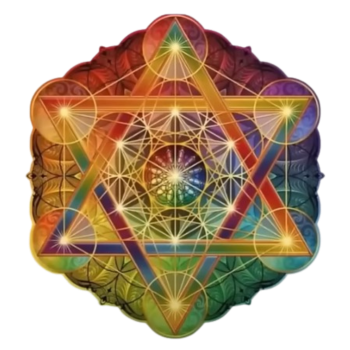
The Merkabah is described as a spirit body surrounded by counter-rotating fields of light, the “wheels within wheels,” spirals of energy that allow the spirit body to transcend dimensions: the “chariot of ascension”. In ancient Egyptian thought it was rotating light that would transport the spirit and body from one realm to another. It is often represented by two interconnected tetrahedrons of light, forming a “stellar octangular” or a star tetrahedron—a symmetrical geometric shape where one tetrahedron points upwards and the other downwards. Other sacred geometrical shapes are contained within it, such as the seed of life and Metatron’s cube. It represents heaven and earth, connected through our spiritual and physical positions.
However, our focus is not on its appearance but on how it functions and how we can engage with it practically in our lives. The Merkabah connects to our energy field and operates as a transducer of zero-point energy—a limitless source of life-giving energy, essential for health and wholeness. This energy field can fluctuate between low frequencies, which might bring imbalance or illness, and higher frequencies that foster abundant life and unity. The Merkabah is woven into our genetic code, our eternal identity, and the merging of the eternal with the physical. It reveals the true essence of who we are in God and in union of spirit, soul and body.
According to Ecclesiastes, eternity has been set in our hearts, and I believe this eternity is the Merkabah, where time and eternity converge within us. Here, our innermost being resonates with our original identity in God. Our existence is designed to be at rest, balanced in love, joy, and peace—a harmonious state that releases the energy of immortality. This requires integration of spirit, soul and body, a unity that releases abundant life and limitless energy. Immortality is challenging when we’re fragmented or divided; it requires transformation, a surrender of the soul to let divine energy flow from within.
The Merkabah is composed of intertwining layers of living light, quantum or “zero-point” energy, creating a tight matrix at our core that, when activated, begins to spin and grow. This spinning light appears spherical and acts as a conduit, interfacing with the unified quantum field around us. It allows us to connect with everything, as it ties into the divine fabric, the ether, in which all creation is held together.
The Merkabah acts as a conduit for zero-point energy, drawing limitless energy into the body. As the sons of God, we may soon understand how to tap into this energy source, enabling us to function independently of earthly power grids. Imagine the potential—one sugar cube of zero-point energy could power 400 billion galaxies!
Uses of the Merkabah
Safety
One of the Merkabah’s purposes is safety, or protection. The Merkabah is an energy field—a generator, really. Now, I know this may sound like science fiction, but it’s actually something that science is beginning to uncover. This energy generates a protective field around us that shields us from all sorts of harmful forces—whether entities, physical attacks, or even negative electromagnetic fields. All those things that can impact us physically, the Merkabah can help shield us from by creating a protective barrier from within.
Travel
Another powerful use of the Merkabah is travel. The Merkabah can transport us—body, soul and spirit—from one place to another. This means it can enable translation, transrelocation, and even trans-dimensional movement, all powered by the energy within.
Healing and Regeneration
The Merkabah is also instrumental in healing and regeneration. It can help rejuvenate our soul and physical body by generating abundant life energy within. This energy works with our subtle energy fields, interacting with the natural flows within us. Many years ago, concepts like energy meridians might have been dismissed as quack medicine, but they are now being recognised scientifically. More and more, people are using these insights to generate healing frequencies that support wholeness. As we connect with the unified field, this energy flows in, raising our frequency and helping us live in the fullness of life, health and even immortality.
This healing energy from the Merkabah is not just about extending life—it is about living with abundance and vitality. We don’t just want to ‘not die’; we want to thrive and be who we are meant to be in relationship with God. And this energy flows through frequencies of intention—love, joy, and peace—bringing us into rest and helping us access the life force of God within. In my own meditations around rest, I have learned to draw on this flow of love, joy and peace. I have experienced that deep stillness, learning how this energy flows and works within, and have trained my senses, as described in John 4 and John 7, where rivers of living water can flow from our being, energising our core and distributing life through the seven gates, or chakras.
The Seven Energy Gates (Chakras)
These energy gates are also known as seals or chakras. ‘Chakra’ is just a Sanskrit term meaning “disc of energy.” There are seven primary gates: the crown, third eye, throat, heart, solar plexus, sacral, and root. Each has its own function:
– Crown: Connects us to the heavenly realm
– Heart: Grounds us in the realm we live in
– Root: Links us to the rest of creation
These three are foundational; the other chakras come into play when we function in insight, communication, creativity, or feeling. All seven gates work together to generate the energy we need to fulfil our calling and purpose on a daily basis.
The Merkabah can be activated and developed through intentional practice, meditation, and by focusing our consciousness. From a place of rest, energy flows more powerfully, energising spirit, soul and body, creating an energy field around us. This is like the story of the temple described in Ezekiel, from which living water flows outward, becoming ankle-deep, knee-deep, waist-deep and so on, bringing life wherever it goes.
The Merkabah can be developed or enhanced by drawing energy down from heaven to earth through our body as a gateway; through our first love gate, through the very presence of Father, Son and Spirit in us. Conscious intentional grounding allows flowing of spiritual energy from
the River of Life into and through the body, and it is both cleansing and
energising. it is a flow of Living Water which is designed to bring about the
abundance that God intends us to live in.
Signalling and Communication
The Merkabah also connects us to the grace of God and the living light within everything, enabling us to communicate with others, angelic beings, and all of creation, even across dimensions. Using the principle of quantum entanglement, our spirit can reach anywhere within the universe, instantly connecting us to that reality. This allows us to connect with and engage across realms in a way that transcends both distance and time.
Sensitivity
Through practice, using the Merkabah increases our sensitivity to physical and spiritual sensations. We learn to tune into energy fields, sensing the atmospheres in different spaces. Hebrews 5:14 talks about training our senses to discern between good and evil, which is achievable through intentional practice.
Joy Joy, too, is associated with the Merkabah; as Jesus said, His joy is within us so our joy may be complete. When we are filled with energy and health, we are naturally more joyful and grateful, and that overflows as positive, life-giving energy toward others and creation.
Abilities
With the Merkabah, we also have the potential to unlock spiritual abilities such as telepathy, telekinesis, pre- and post-cognition, and enhanced creativity. These gifts, aligned with our identity in God, are part of how we were originally created.
Broadcasting
The Merkabah lets us broadcast energy—reaching others, in this and other realms and even in other dimensions. Through focused, intentional energy, we connect and make these connections with people, realms and more. I have done this many times; to begin with I did not know how to do it, other than just do it! But then God then showed me that this is what the energy in me enabled me to do; when I released it from my innermost being, it was energised within the Merkabah and connected me to other realms, dimensions, and particularly to people I was trying to reach and connect with in this realm.
The frequency of our sonship is broadcast through the Merkabah within us, which contains multiple portals designed to connect with various dimensions of heaven and other dimensional realities. These dimensions are tuning into our frequency, seeking connection and help. Our responsibility is to ensure we broadcast love, joy, peace and rest, intentionally focusing positive energy across these portals. This is how I engage effortlessly—by choosing to connect through my innermost being, not my mind, but through a union of thought and being, aligned with the Father’s heart and intentions as He reveals them to me.
Convergence and Coherence
The Merkabah serves as a hub that connects us to God’s heart and our heavenly identity and position of government in Christ, bringing heaven to earth. We are intended to be a point of convergence between time and eternity, heaven and earth. When we are in this state, there is a coherence—a rhythm of the heart, mind and spirit working in unity. We are designed to operate in harmony, without discord, which is when our spirit, soul and body are truly in union and oneness. This is the ideal state for living in health, wholeness, and even immortality.
Non-linear, multidimensional lifestyle
When the heart, mind and emotions align, we find ourselves in harmony with God, with each other and with creation. Everything was made to be in union, to be one. As we grow into our identity as sons of God, we mature into a non-linear, multidimensional way of life, much like Adam would have if he had continued along the path of the Tree of Life toward an ascended state. Through this journey, we discover how to reconnect to the Eternal Now—outside the realms of time and space. Unconditional love will gradually transform us, transfiguring our bodies and renewing our minds into a fully expanded state of consciousness. This is not just knowledge; it is a deep awareness of who we truly are. We will live in complete knowledge of our identity as sons of God, rooted in rest—a state of being rather than doing. Everything flows naturally from this place of rest. We no longer need to “do” to find our identity.
We can start by visualising the Gateway of First Love opening within us, connecting with the life energy of love, joy and peace as a river of living water. This living water flows in us, fills us, and then flows through us, allowing a stream of spiritual energy to circulate within and around us. By consciously surrendering to this flow, instead of resisting or trying to control it, we we consciously choose to be in harmony—spirit, soul and body united and whole. When we are in sync, we can intentionally activate our energy gates, visualising the “wheels within wheels” spinning and generating a powerful flow of life force energy. This flow energises the Merkabah, creating a kind of hydroelectric turbine effect that powers our abilities, enabling us to operate at our full potential, beyond the limitations we have been used to.
At this level, we become co-creators with God. We are not just observers but participants in the creative process, able to engage frequencies of light, sound and intention to manifest our choices and bring new realities into being. For example, the first time I created something, it was at the Father’s prompting. Without fully understanding how, I trusted His guidance and released a creative energy from within my innermost being, which took form as a galaxy. Over time, I learned to do this intentionally, responding to the Father’s call by focusing my energy and intention. In another instance, I released a blue light, calling people to arise in their sonship. Now, I understand how this energy flows from within me, and I have repeated it numerous times.
On one more recent occasion, I was asked by Guardians in a heavenly courtroom to create more Guardians, as they were needed. At first, I hesitated and checked it out with the Father, as He had not asked me directly. He reassured me, reminding me that I knew how to release creative energy, just as I had done before. So, aligning my intention with the Father’s heart, I created the Guardians and assigned them to the Council, who then placed them to dimensional portals in constellations across the cosmos. I shared this experience with others; some asked, “Can we do that?”—and they did. They approached it with their own (perhaps more creative) style, coming up with descriptions of what the Guardians looked like, their colours, and all the details. For me, it was more about just releasing that creative energy from within. All of us can do that. We each have the Father, Son and Spirit’s creative force within us; we just need to focus it with intention and a willing “yes.”
When we pray for someone or lay hands on them for healing, the energy we draw on is the life of God flowing through us. It is not from us independently; it is the river of life within, redirected to a specific need—someone’s DNA, heart or body. Sometimes healing happens even when we are not fully aware of what we are doing, but as we grow in understanding, we become more intentional, seeking alignment with the Father’s heart. Jesus did only what He saw the Father doing, and this is how we are called to operate as well: in love, rest, humility, and from the Father’s heart. This way, we avoid drawing attention to ourselves or taking any glory. Living this way, we become vessels of God’s love and creative energy, bringing freedom, restoration and healing.
This may all sound rather technical, and it can be complex, but for me it’s simply the life I live. I have practised and developed these ways of operating until they have become second nature. Now, I no longer have to think about activating gateways or focusing on specific aspects of my identity. Instead, I am constantly connected with the Father’s heart and receiving whatever knowledge I need from Him. As I walk in my identity as a son, all I require to fulfil my purpose flows to me naturally.
For the most part, this means I just enjoy everyday life. I live each day in love, joy and peace. I live loved, I love living and I live loving. Admittedly, it’s not always easy, and there are people we are called to love who may not “deserve” it (by our standards). But if Jesus could forgive those who hurt Him, then we too can extend unconditional love. By embodying this love, we become a channel for living energy in the world, bringing life wherever we go and contributing to the restoration of all things.
Our destiny as sons of God is to release this love and creative power in everyday life, transforming and renewing the world around us simply by being who we are. When we allow God’s life and energy to flow through us, we create a field of love that touches and changes lives. Just by ‘being’, we can bring about transformation and let the reality of God’s love impact everyone we encounter.
Activation: Energise the Merkabah
Close your eyes.
Start breathing slowly.
breathe in slowly;
hold it,
and breathe out slowly,
breathing in
the very breath of God,
the life of God,
focusing your thinking on God who is love.
And as you’re breathing in,
let love flow, flow and flow into you,
flow around you, flow into you,
and let it rest upon you so you can be still.
Let God love you,
And feel and sense
the unconditional nature of that love,
where you can be still and know that He is love.
You can be still and know that He is love.
Be still and know that He is joy.
Be still and know that He is peace.
Be still and know that He is truth,
and light, and life,
and limitless grace and triumphant mercy.
It may take a little bit of time sometimes
to slow down your thinking and focus on love.
Come to that place of love.
[And as you’re doing that,
I’m just going to release some sounds,
and these frequencies.
I want to encourage you
to let the frequency and sound
of the intention of love
touch your physical,
emotional,
and spiritual being.
Let this sound go around you,
and in you and through you
generating energy, frequency.]
Jesus is knocking on that door within your first love gate,
you can picture that door, picture Him knocking.
Beyond that door is a well;
choose to open the door
and drink from the well, from the fountain.
It’s living water.
It’s flowing as a frequency and an energy of life.
And as it begins to flow,
flow with it as it forms a river.
Choose to flow with it
as these waves of energy,
begin to flow within your innermost being;
that river flowing through the gateways of your spirit,
flowing through your soul,
just beginning to converge in the core of your being,
the Merkabah
which begins to energise –
energy forming, spinning, increasing.
Flowing from you,
as rivers of living water
energising each gate.
Energising your crown,
your ability to connect to heaven.
Energising your spiritual insight,
knowing truth and revelation;
Energising what you think and what you say,
when you speak,
speaking with the energy
of the voice of God as an oracle,
Energising your heart,
feeling and releasing love,
unconditional love.
Each of those seven gates,
the creativity, feelings
deep within your innermost being,
the gut instincts, the knowing,
energised, connecting you to creation, the root
grounded with that unified quantum field.
You are connected,
you can become spaghettified,
every atom of your being can be connected to creation.
Feel and sense creation.
Feel and sense your sonship touching creation – broadcasting, communicating, beyond yourself,
through those portals within your innermost being.
You may want to travel along that portal,
you may want to send a message,
an intention of love to someone in particular.
Focus that intention of love
and let it travel through that entanglement you have
with someone that you carry in your heart,
to touch them with love.
Limitless energy
generated from your innermost being,
flowing around you,
creating an energy field –
a field of light,
a field of love.
You can choose to stay in that place.
If you’re engaged, just feel free to stay there.
This is not something that is just a one-off, but something that we need to develop. We need to practise day after day,
practise generating flow; so that we can learn to become sensitive, and learn to focus these things in our lives, and through our lives to others and out into creation itself.
When it comes to framing or co-creating, the key is aligning yourself with God’s heart and purpose. This is not something you can do by your own strength or for your own ends; it must be rooted in God’s intentions. Intimacy with the Father is essential. Understanding the Father’s heart—whether through personal direction or what you might call a ‘heart-to-heart’ infusion—enables you to align yourself with His will. Once you know you are in sync with God’s heart, you can then begin to frame your life accordingly.
Framing your life involves nurturing or ‘brooding’ over what you want to bring into existence. Just as a hen sits on her eggs until they hatch, you must incubate your intentions. If you are double-minded, it will not work. You are effectively creating a reality where light and the enabling power of God respond to your expectations, collapsing a wave function to bring that reality into being. It is crucial that you observe and speak as though this reality has already occurred. As God calls things into existence, so too must you align your words and authority with His, speaking with conviction and faith.
Brooding
The process of framing often starts with God’s promises. If you are seeking first the Kingdom, you can confidently expect those promises to be fulfilled. This means framing your life around expectation, calling forth God’s protection, provision, and direction for each day. You are not merely wishing for things; you are living from the expectation that you will have everything you need, with an abundance for every good work.
This framing process creates an atmosphere around your life that draws in the reality of God’s promises. However, it cannot be done out of anxiety, fear, or worry. You must be in a state of rest, characterised by contentment, peace, and joy, with an attitude of thanksgiving and gratitude. Even before you receive what you are calling into existence, you must live as if it is already yours. Gratitude and thanksgiving are vital components of this process because they reinforce your faith that what you are framing is already a reality.
Speaking with Authority
When co-creating, whether calling forth new realities or framing promises around your life, you need clarity. You cannot randomly decide to create something—like calling 15 angels into being—without knowing that you have permission to do so. As a son of God, once you know you have that permission, you can call things into existence that did not previously exist. For example, I have created guardians after receiving permission from the Father, brooding over the intention until I knew it was aligned with God’s heart. Once I had that assurance, I spoke with the voice of God and the guardians manifested. There was no doubt or double-mindedness, just a clear understanding that I was acting with God’s authority.
Intimacy and Rest
Framing your life around God’s promises begins with intimacy and rest. Jesus only did what He saw the Father doing, and we are called to operate in the same way. This is not about manipulation or control; it is about aligning your life with God’s purposes and seeking to bless others. You cannot use this process to manipulate people or situations to your advantage. Instead, you can call forth opportunities to bless others or to meet people you can help. It is a process rooted in love, aimed at bringing out the best for yourself and others.
Expect that there will be a process involved. Jesus said that when you pray, believe you have received, and you will receive. This means living in an attitude of thanksgiving, gratitude, and contentment, trusting that what you are framing will manifest in time. Some things may happen instantly, while others may take longer. It is important to avoid negative thoughts or speech that could undermine what you are working towards. Stay positive, remain at rest, and keep your focus on your intimacy with the Father.
Ultimately, you can frame your life according to your destiny and identity as a son of God. This involves calling forth the wisdom, insight, resources, and everything else you need to fulfil your God-given purpose. By framing your life in this way, you can live with the expectation that everything necessary for your journey will be available to you.
If you enjoy these videos, would you please take a moment to like, share, comment and subscribe? It really does help. Thank you very much.
Salvation is not about “going to heaven after death.” Surprisingly, the words “saved” and “heaven” never appear together in the Bible. Salvation means restoration to wholeness in the present, not something that happens after death. The idea of being “promoted to heaven” or “crossing the Jordan” is part of a religious system that has promoted a mistaken tradition.
Salvation is about experiencing wholeness here and now, bringing us into the true identity of who we are. If you have been indoctrinated to think that your salvation depends on your efforts in any way, you will remain stuck in trying to secure it. This was my experience, coming from an evangelical background, where salvation seemed to depend on my ability to trust God, my faith, or what I did in asking God into my life.
Rather than realising what had already been accomplished, I viewed salvation as an ongoing effort—trying to be good enough and acceptable to God through practices like reading the Bible, praying every day, witnessing, and fulfilling the perceived requirements of being a “good Christian.” But who said we were supposed to do those things? Jesus did not—the church did. Deconstruction is the process of removing that indoctrination and replacing it with truth, renewing and transforming our minds.
All of humanity is included
Even if someone does not believe they are saved, they still are; they just do not believe it yet. This is the truth: all of humanity is included in what the Father already accomplished through Jesus to forgive, redeem, and reconcile us to himself. The work is finished, and everyone has been declared righteous, justified, and forgiven. Whether or not someone believes this truth, it remains the truth.
The New Covenant was made between the Father and the Son and included all of humanity. Teaching that we must make a free will decision to be included is ‘a church-invented heresy’, as Don Keithley says. “Our free will decision is simply to accept what has already happened, to realise that we are already included—not to make it happen. If Jesus included the doubter, Thomas, the denier, Peter, and the traitor, Judas, I seriously doubt anyone is excluded from his work today.”
No one is excluded from what Jesus came to do and to finish. He came to take away the sin—the lost identity—of the world, not just a few people but the whole world, and every person in it. What we believe about God does not define him, and our doctrines do not even define us, though they often label us. Many of us have been labelled by what we believe, whether Baptist, Charismatic, Pentecostal, Anglican, or any other denomination. But God knows the truth about us, and what he knows, demonstrated in Christ, is what defines us.
Equal Value
Jesus is what God believes about us. The love God has for his Son, Jesus, is the same love He has for us. When we are reconciled to God, it is important to understand that God was in Christ, reconciling the world to himself. The term ‘world’ here is the Greek word kosmos, and ‘reconciliation’ in this sense is an accounting term. The debit and credit must balance.
The value we hold for God is the same value God holds for Jesus. This is a profound truth: we are of equal value to God as Jesus. Understanding this is key to grasping the fullness of our identity and value in the eyes of God.
The truth that sets us free
Adam’s choice to walk independently of God did not change the nature of God the Father. God still desires a relationship with us, just as he did with Adam. The Father still longs to walk with us in the garden, to restore that relationship. We need to see that this relationship can be restored, and this realisation is an essential part of our journey.
Deconstruction takes different forms. Some people reject the conditional love taught by religion and walk away from organised faith, while others discover unconditional love outside of religion. God is love, and this is a fundamental truth. However, God does not deconstruct us by focusing on the lies we believe, but by revealing the truth that sets us free. This process renews our minds to the truth, and in doing so, those false beliefs naturally fall away.
The truth we know through experience will set us free. So let us focus on positive solutions, not negative problems. Do not try to deconstruct your beliefs with the same thinking that created them. Instead, allow God to encounter you in such a way that it changes what you believe, leading to a transformation based on truth, not on doctrine.
The ‘Second Coming’
Many Christians are still waiting for the second coming of Jesus. However, as I have discussed before, the ‘second coming’ already happened, in AD 70. This means that many are looking for the wrong event. Creation does not recognise Christians waiting to be rescued; it recognises sons and daughters who are living out the truth. Religion has deeply ingrained in us a fear of the future—the fear of tribulation, of the rapture, of trouble to come.
But we do not not need to fear the future. The Spirit of Truth was given so that we, as sons and daughters, might shape the future. Fear never comes from God, and perfect love casts out fear. Therefore, let’s ensure we are not operating out of fear, worrying about what might happen tomorrow, but instead live in the blessing and provision of today. There is no ‘Great Tribulation’ on the horizon. There may be personal tribulations, but God will be with us through them. The biblical ‘Great Tribulation’ was the end of the old age, the age of the old covenant, and it has already passed.
If you enjoy these teachings, please take a moment to like, comment, and subscribe, whether here or on YouTube—it really helps. Thank you very much!
There are various levels of understanding and experience that take us deeper into what it means to be in unity, union, and ultimately, oneness with God. In earlier teachings, unity was often understood in terms of shared beliefs. If people agreed on doctrines or beliefs, they were considered to be in unity. However, this kind of unity was superficial because it excluded others who did not share the same beliefs. In reality, true unity has little to do with agreement on beliefs.
Unity Based on Beliefs vs. True Union
Union, on the other hand, is about a deeper relational connection. It’s similar to the union between husband and wife, where two people come together in an intimate relationship that goes beyond mere agreement. Union is more about connection and relational closeness than about aligning beliefs. It involves a joining together at a deeper level, reflecting a more intimate connection than unity of the mind or beliefs alone.
However, there is an even deeper level: **oneness**. When we enter oneness, there is no separation between us and God. This doesn’t mean we become God, but we become one with Him in spirit. In this state of oneness, we have access to His heart, His mind, and there is a profound connection that transcends separation. While we remain distinct, oneness allows us to experience God’s presence and intimacy in a way that feels inseparable.
Union and Oneness: A Personal Journey
My personal journey involved discovering what it means to be in oneness with God. It was not just a theological understanding but an experiential one. The feeling of oneness was different from the experience of union, where intimacy was deep, but there was still a sense of individuality. In oneness, I felt an abiding presence in God that made it impossible to feel separate from Him. It became clear that this relationship was not about doing or achieving, but about realizing and experiencing what was always true—that I am made in His image and likeness, and that this reality transcends any works or protocols.
We are all on a journey to discover who we truly are as sons and daughters of God. Being made in His image and likeness means more than we often understand. It means that our very essence reflects His original intention for us. As we go deeper into this relationship, our DNA is transformed, and we are restored to God’s original purpose.
Experiencing Truth Beyond Protocols
In the past, much of the spiritual journey was about protocols—if you do this or that, you would get closer to God. There were steps to follow: salvation, baptism, receiving the Spirit, and so on, which often felt like climbing a ladder. However, the deeper understanding is that we don’t need to earn or work for these experiences. The truth has always been there; we just need to have it revealed to us. Once it is unveiled, we come into agreement with it, realizing that God has always seen us this way.
Evangelical Christianity has often taught that God’s view of humanity changed after the Fall, but in reality, **God never changed His view of us**—we changed our view of ourselves. His thoughts towards us have always been rooted in love and truth, and He is revealing this so we can see ourselves as He does.
Agreeing with God’s Reality
This process of revelation is about agreeing with God’s perspective. It’s not about reconciling our limited human thinking with God’s, but about transforming our thinking to align with His. This transformation is key to entering into the reality of who we truly are. It’s not about doing works or following steps to ascend spiritually. Instead, it’s about embracing the truth that has always been there and allowing it to transform us.
Ultimately, this journey is about living in a relational reality with God that unveils the depth of who we are. It’s not about striving or achieving through works but about receiving the revelation of our identity in God and living in agreement with that truth.














 Sons of Issachar