
77. Characteristics of the Joshua Generation (#1-5)

Mike Parsons
with Jeremy Westcott 

We have seen that in our time God is raising up a Joshua generation, who will enter into their inheritance and enable others to do the same. This is what that generation will be like:

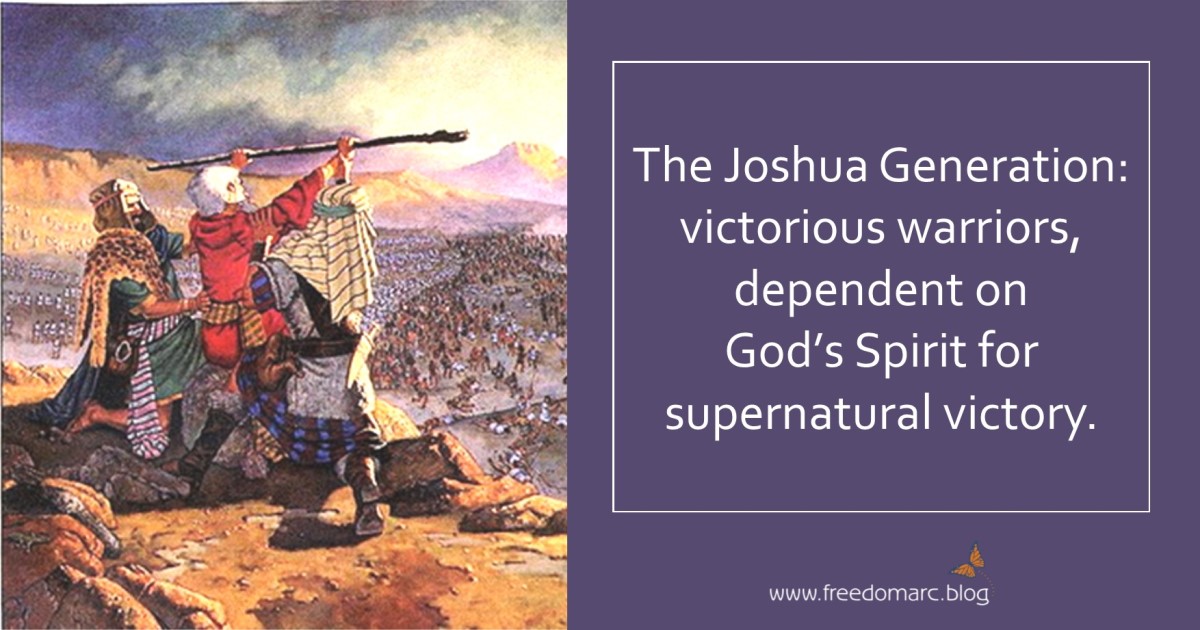
1. The Joshua Generation will be victorious warriors, dependent on God’s Spirit for supernatural victory.

Do you remember the story in Exodus, when Moses was standing and needed support for his hands, because as long as his hands were raised, Israel was winning the battle? Even at that point, Joshua was being prepared to succeed Moses, and there was a supernatural dimension to what was happening:

‘Then the LORD said to Moses, “Write this in a book as a memorial and recite it to Joshua, that I will utterly blot out the memory of Amalek from under heaven.” Moses built an altar and named it The LORD is My Banner; and he said, “The LORD has sworn; the LORD will have war against Amalek from generation to generation”’ (Ex 17:14-16).

We need to know the Name of God, Jehovah-Nissi:  the Lord our banner or victory. ‘The Lord is my banner’. There is something here that we need to get hold of in our spirit. We use banners in this dimension of warfare, and that banner of victory is what will enable us to overcome. This battle will be in every generation. This is something which God wants to equip us for, to see Amalek destroyed.

There is a reason God wants it destroyed. The Amalekites were descended from Esau – they personified evil, and were inheritance robbers. They were those who competed for the Promised Land. For us they represent the tares, the leaven of the Pharisees and of Herod, who seek to rob us of our inheritance. We need to destroy them; and there is going to be a battle in our generation. We need to know the Name of God, Jehovah-Nissi, because of the level of warfare which is going to come. When the world is falling apart, we have to be able to be overcomers in the midst of everything that is going on around us.

2. The Joshua Generation will have a servant heart.

“Come to Me, all who are weary and heavy-laden, and I will give you rest. Take My yoke upon you and learn from Me, for I am gentle and humble in heart, and you will find rest for your souls. For My yoke is easy and My burden is light” (Matt 11:28-30).

This is a key scripture to understand about being servant-hearted. It is about not doing things in your own strength but in knowing your identity and being of gentle and humble heart. That’s what Jesus said, “if you take My yoke upon you, learn from me, because I am gentle and humble in heart”. A servant generation will know true authority and true identity through submitting it all to God.

We need to understand that Joshua had a call, and yet he was Moses’ servant: ‘So Moses arose with Joshua his servant, and Moses went up to the mountain of God’ (Ex 24:13).

3. The Joshua Generation will know the glory of God as a consuming fire.

We are already beginning to experience this in the heavenly realms, but there is so much more of it still to come.
On Mount Sinai, when God gave the commandments to Moses, Joshua also went up with him to the mountain top. Most people don’t read that or realise it, but that is what it says. And what happened there was that ‘the glory of the LORD rested on Mount Sinai, and the cloud covered it for six days. .. And to the eyes of the sons of Israel the appearance of the glory of the LORD was like a consuming fire on the mountain top’ (Ex 24:16-17).

God is inviting everyone to come to the mountain top, to come into the fiery smoke, and to meet Him face to face. It is an awesome thing to look into His eyes. Face-to-face encounters with God will characterise the Joshua generation.

4. The Joshua Generation will be hungry and thirsty for the intimacy of God’s Presence.

We will not be satisfied with anything less. We need the intimacy of God’s presence. We need to press into it. We need to be so hungry and thirsty for righteousness, and for the presence of God, that it is going to transform our lives. And God is going to start stirring that hunger, by giving you experiences that make you crave and hunger for more. Don’t be satisfied with just an experience: it needs to become a lifestyle. We need to live in the presence of God in the dual realms of heaven and earth. We need to press in.

‘Thus the LORD used to speak to Moses face to face, just as a man speaks to his friend. When Moses returned to the camp, his servant Joshua, the son of Nun, a young man, would not depart from the tent’ (Ex 33:11).

Joshua stayed in God’s presence even after Moses left, and that will be a characteristic of the Joshua generation. When some people give up, when they have had enough, the Joshua generation will press in for more. You are not going to be satisfied until you have received the fullness of your inheritance.

5. The Joshua Generation will be chosen as forerunners to enter the Promised Land.

Some of you are going to have experiences that go beyond, and you are going to help other people to come into it. When I went on the fast two years ago, and began to enter into heavenly encounters, my desire was to facilitate others coming in. Our intention is always to open the door for others. We are not exclusive. The purpose of being  forerunners is not to keep others out, but to encourage everyone to come in.

Joshua and Caleb were sent out as spies: they saw the promises – and they saw the giants – first hand. But they had a different attitude to the others: they were willing to press in.

…and they spoke to all the congregation of the sons of Israel, saying, “The land through which we passed as spies is an exceedingly good land. If the Lord delights in us, then He will bring us into this land and give it to us, a land which flows with milk and honey. Only do not rebel against the Lord; and do not fear the people of the land, for they will be our prey. Their protection has been removed from them, and the Lord is with us. Do not fear them.” But all the congregation said to stone Joshua and Caleb with stones (Numbers 14:7-10a).

These are just the first 5 of 40 characteristics of this generation which I believe God has shown me. Do you recognise these things in you? Is this a generation of which you are called to be a part?

We will look at some more next time.

Available in other languages
  • Este artigo também está disponível em Português (do Brasil)
  • Este artículo también se encuentra disponible en Español
Related articles from Freedom ARC

Are you part of the Joshua Generation?

We developed this just for you:
 

Engaging God on the Heavenly Pathways of Relationship and Responsibility
Equipping a Joshua Generation of supernatural sons of God to live according to the order of Melchizedek

Get started today!*

To find out more about the Engaging God programme, click here…

*Technology permitting: automated process on receipt of payment and completion of online registration form. Terms and conditions apply.

76. A Generation Of Forerunners

Mike Parsons
with Jeremy Westcott –

As we saw last time, God will have His way: His will is going to be done, and our choice is whether we want to be part of it or not. All the earth will be filled with the glory of the Lord.

The Moses generation

Moses’ generation came to the borders of the land… and chose not to go in. As a result, God told them, “your corpses will fall in this wilderness, even all your numbered men, according to your complete number from twenty years old and upward, who have grumbled against Me. Surely you shall not come into the land in which I swore to settle you, except Caleb… and Joshua” (Num 14:29-30).

Those aged 20 years and up were responsible. There were a whole lot of people under the age of 20 who wandered round in the wilderness with their elders; but when their time came to make a choice, they chose to embrace their destiny. God is calling that people forth today. Caleb and Joshua were of the older generation; but how they lived, how they believed, how they acted, what they did – that was what set them apart from their contemporaries and inspired the younger generation. They are a key to understanding what it takes to inherit, what it takes to become a Joshua generation.

A billion labourers

The Moses generation failed to receive their inheritance, and died in the wilderness. The Joshua generation, I believe, are going to equip a harvest of a billion labourers in the supernatural. I say ‘in the supernatural’ because we cannot succeed by natural means in all that lies in store for us; it is going to have to be achieved by supernatural means, and by a people equipped to operate in the fullness of God’s kingdom power.

That is why we have to take back ground that has been given to the enemy. Occult and New Age people are operating in spiritual power and doing things most of the church would not begin to know how to do, but they are occupying ground in the counterfeit that we should be ruling in the authentic if only we were operating in the true power of God.

We need to stand up and be counted. We need to take back that territory, in the face of intense opposition (and most of that opposition will come from within the church). If we are to see this next generation raised up, we need to begin to operate in the realm of the supernatural beyond what any of us have experienced so far. We have to make ourselves ready for a whole new revelation of the supernatural, and when we are ready God will lead us into it.

We need to equip a generation who will see Jesus return. To see a final harvest in which everybody who is going to be saved will be saved. The Joshua generation will be forerunners who have spied out the land. Many of us have already been forerunners. We have experienced a foretaste of some of the things which are going to take place. We have glimpsed it. In our spirit and in our heart we know there is more. We have been hungry for more, some of us have been that way all our lives. And there are more forerunner experiences still to come. It will be like spying out the land. We will not yet have received the complete fulfilment of all that God intends, but we will have glimpses of it, get a taste for it, begin to realise what it is going to be like.

Crossing the Jordan

The Church is crossing the Jordan, and it has been happening for a while. I look back into the eighties and I can see the beginnings of it. I remember some of the things that were prophesied then (and people didn’t really know what they were prophesying): about Joel’s army; a whole different breed; a nameless, faceless army of God’s people who were going to be raised up; no superstars, just ordinary people, operating in the supernatural power of God. They were prophesying some of the very things we are now beginning to see take place.

This generation has been entering in over that whole period of time, but we have not progressed far beyond the other side of the Jordan. The church is still at that place called Gilgal. For Israel that was where the reproach of the past was removed, where they were all circumcised again, where they took the Passover again: the things which were necessary for them to do as preparation to going in to fight the giants and take the whole land. I believe that this is where the church is in these days, days of preparation.

We have experienced the Wine, Fire and Wind of God, but there is more coming. We have to be able to lead and equip the Jesus generation to possess – the Hebrew word means ‘to inherit by seizing, dispossessing, and become heirs of’ – the land of promise. This is about the violent taking the kingdom by force. The Joshua generation is a warrior generation who will fight on behalf of others and bring them into the land. They will bring God’s kingdom on earth as it is in heaven: fulfilling Adam’s mandate in both realms. They will rule in the spirit realm and influence in the natural realm, to see God’s glory fill the earth (Num 14:21).

The Joshua generation will experience the land for themselves, but will also equip others to be able to live in the Promised Land and to fully possess it. It will mean living in a completely different dimension in terms of the supernatural.

We are all called to enter: some of us are called to go before, and to equip, but all of us are called to enter. Or you can choose to be like those who turned down God’s invitation and died in the wilderness. Everyone has that choice, but God is inviting people to enter in. Even in Joshua’s day, there were people who crossed the Jordan, were part of fighting the battles, and yet they chose to go back and live on the other side. Two and a half tribes, or nearly a quarter of them.

There are some ministries who have been forerunner ministries, who have been in the forefront of what God is doing, but who will choose to go back, and as a result will miss out on the fullness of their inheritance. I do not want to be one of those. I want to be part of a generation who enter in, possess, and enjoy the land; and who equip others to come in and do the same.

Available in other languages
Related articles from Freedom ARC
Related articles from others

75. Lessons From The Moses Generation

Mike Parsons – 

Preparing the next generation

In closing this series on the Prophetic Timetable, I am going to be talking about three generations. There is the Moses generation, and you don’t want to be part of that, as we will see. There is the Joshua generation, which I am going to focus on over the next few posts. And finally there is another generation, the Jesus generation, who will see Jesus return.

God is releasing a generation to prepare others. This word really got to me when I was on the fast a few years ago: I saw in the spirit a whole generation passing away and a whole new generation being raised up, and I knew God was saying something significant.

Moses’ generation an example

It is important for us to understand what the Moses generation is all about:

For I do not want you to be unaware, brethren, that our fathers were all under the cloud and all passed through the sea; and all were baptized into Moses in the cloud and in the sea; and all ate the same spiritual food; and all drank the same spiritual drink, for they were drinking from a spiritual rock which followed them; and the rock was Christ. Nevertheless, with most of them God was not well-pleased; for they were laid low in the wilderness.  Now these things happened as examples for us, so that we would not crave evil things as they also craved. Do not be idolaters, as some of them were; as it is written, “THE PEOPLE SAT DOWN TO EAT AND DRINK, AND STOOD UP TO PLAY.” Nor let us act immorally, as some of them did, and twenty-three thousand fell in one day. Nor let us try the Lord, as some of them did, and were destroyed by the serpents. Nor grumble, as some of them did, and were destroyed by the destroyer. Now these things happened to them as an example, and they were written for our instruction, upon whom the ends of the ages have come. (1 Cor 10:1-11).

Although God showed them all the promise, and the Promised Land, they actually refused to go in and wanted to carry on operating in the place they had become accustomed to, and in the strength of their own understanding. ‘Now these things happened to them as an example, and they were written for our instruction’, so that is an indication that this is really important. We don’t want to miss what God is doing, and we need to be aware of things which could cause us to miss it. We are experiencing a time when the fire of God’s Presence is here to refine and cleanse us, to prepare us for what is to come.

An opportunity to choose

We don’t want to operate in idolatry. We know that idolatry is about putting other things before God. Our idols are stumbling blocks in our hearts, and God is gathering those up and removing them from us. God is giving our generation an opportunity to choose.

There are some obvious parallels in this story:

Coming out of Egypt’s bondage – Salvation
Crossing the Red Sea – Baptism in water
The pillar of cloud and fire – Baptism in the Holy Spirit
The wilderness – Testing, preparation, transformation
Crossing the Jordan – Embracing destiny
Promised Land – Kingdom inheritance (but that involves giant-killing)

God has called us to be giant-killers. Our Promised Land is not just physical. It is true that there is a physical aspect to it: ‘Your kingdom come, Your will be done on earth just as in heaven’, just as Adam and Eve were given the mandate to bring God’s kingdom onto earth and to subdue and overcome and rule. But there is also a dimension that God is bringing His people into which goes beyond the physical here on earth, and into the realms of heaven. So the ‘Promised Land’ for us is not just a matter of embracing all the good things which are ours on earth, but of being seated in heavenly places with Christ and bringing that authority to bear in the atmosphere of the earth. We have thrones of authority as a church – and other churches and other people of God have thrones of authority. But most people have no understanding of these whatsoever: they have never been there, have never sat upon them. Going to the courts of heaven, obtaining judgments there that will affect what goes on in the atmosphere of the earth and in this physical realm, all these things we are going to really have to get hold of and embrace, because it is all part of our inheritance, part of our ‘Promised Land’.

Failed to inherit

Let’s see what happened when the children of Israel were brought to the borders of the land:

Then Caleb quieted the people before Moses and said, “We should by all means go up and take possession of it, for we will surely overcome it.” But the men who had gone up with him said, “We are not able to go up against the people, for they are too strong for us.” So they gave out to the sons of Israel a bad report of the land which they had spied out, saying, “The land through which we have gone, in spying it out, is a land that devours its inhabitants; and all the people whom we saw in it are men of great size. There also we saw the Nephilim (the sons of Anak are part of the Nephilim); and we became like grasshoppers in our own sight, and so we were in their sight” (Num 13:30-33).

Now this is what caused them to fail to inherit, when they were given the choice. Joshua and Caleb brought a positive report; the others saw the obstacles, including the giants, and the Nephilim; they saw them and they backed off. They were not prepared to go in, fight the fight and take possession of the land. And as a result, that whole generation missed out on what God wanted them to do.

Nevertheless, in spite of that generation saying ‘no’ to Him, God’s response was: “but indeed, as I live, all the earth will be filled with the glory of the LORD” (Num 14:21). He would raise up another generation, because He was going to have His way.

And that is still the case today. God’s will is going to be done one way or another: our choice is whether we want to be part of it or not.

Available in other languages
Related articles from Freedom ARC

74. God’s Kingdom Fills the Earth

Mike Parsons
with Jeremy Westcott

Resurrection

We have been looking at the Millennium, or thousand years, and I just want to clear up one more point from that passage in Revelation, and then sum up what we have said.

Then I saw thrones, and they sat on them, and judgment was given to them. And I saw the souls of those who had been beheaded because of their testimony of Jesus and because of the word of God, and those who had not worshiped the beast or his image, and had not received the mark on their forehead and on their hand; and they came to life and reigned with Christ for a thousand years. The rest of the dead did not come to life until the thousand years were completed. This is the first resurrection. Blessed and holy is the one who has a part in the first resurrection; over these the second death has no power, but they will be priests of God and of Christ and will reign with Him for a thousand years (Rev 20:4-6).

What is this ‘first resurrection’? Well we know Jesus was resurrected, and His was a physical resurrection. As a result of the fall there was spiritual death and physical death. The consequence of Jesus’ physical resurrection was a spiritual resurrection for us. We have been resurrected spiritually, and that spiritual resurrection deals with the spiritual death.

It is signified in our baptism: …having been buried with Him in baptism, in which you were also raised up with Him through faith in the working of God, who raised Him from the dead (Col 2:12).

Even when we were dead in our transgressions, [God] made us alive together with Christ (by grace you have been saved), and raised us up with Him, and seated us with Him in the heavenly places in Christ Jesus (Eph 2:5). We have been made alive with Christ: a spiritual resurrection.

That is the ‘first resurrection’. It deals with the spiritual death, so we can be born again, and come back into life; the second resurrection (when everybody gets resurrected) deals with physical death, which also came as a result of the fall.

And here is an interesting passage. It is only a couple of sentences in the Gospel narrative, but it must have caused quite a stir:

The tombs were opened, and many bodies of the saints who had fallen asleep were raised; and coming out of the tombs after His resurrection they entered the holy city and appeared to many. (Matt 27:52)

So at that time there was an actual physical resurrection of all those Old Testament saints who came back to life.And don’t imagine that they then died again – what happened was that Jesus led them into heaven, and that is where they are now. They ‘came to life and reigned with Christ for a thousand years’.

The rule of Christ is now

Let’s wrap this up. We are a kingdom of priests, and the millennial rule is now. In heaven, and on earth – because we can live in both places, as we have begun to understand. We bring heaven to earth through our lives and the kingdom of God is manifested on the earth through us.

But you are A CHOSEN RACE, A royal PRIESTHOOD (1 Peter 2:9).

… And from Jesus Christ, the faithful witness, the firstborn of the dead, and the ruler of the kings of the earth. To Him who loves us and released us from our sins by His blood and He has made us to be a kingdom, priests to His God and Father—to Him be the glory and the dominion forever and ever. Amen. (Rev 1:5-6).

The reign of Christ began at His ascension, and continues until all things are subdued under his feet. The return of Christ and the bodily resurrection of all men will occur after (or post-) the millennium: that is to say it will happen after the period in which we now live, the period in which Jesus rules in heaven and on earth through His people.

This is really what we need to have faith in. We need to be expecting these things to take place, and expecting ourselves to be part of the process of bringing them about. “But indeed, as I live, all the earth will be filled with the glory of the LORD” (Num 14:21). That is what we want – and how will the earth be filled? Through us.

For the earth will be filled With the knowledge of the glory of the LORD, As the waters cover the sea (Hab 2:14). People will know about the glory. It will not just be a few people going around glowing a bit. God’s glory will be clearly demonstrated for all to see.

Remember how in Daniel 2:35 the Stone [Jesus] that struck the statue [the kingdoms of the world] became a great mountain [God’s kingdom] and filled the whole earth. The earth will be filled with glory, and that will happen before Jesus will return:

…That He may send Jesus, the Christ appointed for you, whom heaven must receive until the period of restoration of all things about which God spoke by the mouth of His holy prophets from ancient time (Act 3:20-21)

mount-everest-276995_640Now it will come about that
In the last days
The mountain of the house of the LORD
Will be established as the chief of the mountains,
And will be raised above the hills;
And all the nations will stream to it.
(Isa 2:2).

These are the last days (and have been ever since Jesus first came). God’s kingdom is already established as the chief kingdom, because we know that Jesus is above all rule.  His kingdom is already above every other kingdom. The nations have been streaming to it throughout church history, and we want to see that prophecy completely and finally fulfilled.

I believe we are called to be a Joshua generation. The Joshua generation will raise up and prepare the following (and final) generation to receive their full inheritance and to usher in the end time harvest, ready for Jesus’ return.

We are fast approaching the end of this series on God’s Prophetic Timetable. It is based around the series I taught in Freedom Church during the spring and summer of 2011, and lays the groundwork for some of our more recent teaching both on this blog and elsewhere. The audio of those original sessions is available on our Apostolic Resources website. As we have noted elsewhere, some of the views we held at the time have been challenged by God in the intervening period but these blog posts (particularly #64-67) have been updated to reflect those changes (the audio recordings, of course, have not).

In the closing posts of this series I want to look at 40 characteristics that mark out that Joshua generation, because many of us will be part of it.

Related articles from others

73. A literal 1000 years?

Mike Parsons
with Jeremy Westcott

Scripture teaches us that Satan is bound for a thousand years. In this short post I just want to look more closely at that figure and consider whether it is literal or symbolic.

cattle-20527_1280To do that, let’s look at some examples of how the Bible uses it in other places.

For every beast of the forest is Mine, the cattle on a thousand hills (Ps 50:10).

So are the cattle on the 1001st hill not His? Clearly this is not a literal 1000 hills, it is just a big number – in fact it means all of them.

For a thousand years in Your sight are like yesterday when it passes by, or as a watch in the night (Ps 90:4).

Are a literal thousand years exactly like a day to God in heaven, or is it really saying that heavenly things are eternal whilst earthly things are temporal (and temporary)?

And it is the same with this scripture: He has remembered His covenant forever, the word which He commanded to a thousand generations (Ps 105:8). If that is literal, you are in trouble if you are part of the 1001st generation! Will the 1001st generation miss out on His covenant blessings? Will His word no longer be operating? That is not what it means at all.

You might think I am deliberately picking references to the number 1000 and 1000 years which are not literal. But I cannot find even one Old Testament reference to a literal 1000 years, nor did Jesus ever teach about it or even mention it. There is nothing in the epistles to indicate that there would be a significant period of a literal 1000 years. We have one short passage in Revelation 20, and people have built up a massive theology around it being a literal 1000 years when there is nothing else in scripture to back it up.

The conclusion has to be that the number 1000 is symbolic. It is made up of 10x10x10, and 10 is the number of fullness. The ‘thousand years’ is the whole of this period we are living in. And when everything is fulfilled, Jesus will return.

Related article from Jonathan Welton: A literal new heaven and new earth

72. Bound For A Thousand Years

Mike Parsons
with Jeremy Westcott 

We saw last time how important it is that our faith is in victory, in overcoming, in seeing God’s kingdom fill the earth.

A theology of victory

Kingdom and Covenant theology is a theology of victory. More and more people are starting to realise this because of the nature of what God is saying prophetically in these days. If you are someone who believes Jesus is going to come and rescue us, you are going to struggle to reconcile what God is saying with that belief. How does it fit? It doesn’t: Jesus is not going to come and rescue us: we are going to be victorious.

In succeeding periods of church history, people tended to hold different views on the book of Revelation. I want briefly to make it clear how we see things.

Firstly, Revelation is a  historical book which deals with God’s covenant judgment on Israel and Jerusalem.

Also, Revelation illustrates the triumph of the church through history, overcoming all persecution.

Soon… the time is near… quickly

The Revelation of Jesus Christ, which God gave Him to show to His bond-servants, the things which must soon take place (Rev 1:1).

I’m sorry, 2000 years later is not ‘soon’. Now I know that for God, everything can be now. Bur this was not written for God, it was written for people to read and be encouraged and comforted in the midst of the persecution they were facing. It would have been very poor comfort to say that judgment was coming soon, if in fact it was going to take centuries. The book of Revelation was written before AD 70 to servants of God who were alive at the time. It was written about events which would soon take place. And what soon took place was the destruction of Jerusalem. John repeats it, so there can be no mistake: ‘the time is near’.

‘Blessed is he who reads and those who hear the words of the prophecy, and heed the things which are written in it; for the time is near’ (Rev 1:3).

Again, at the end of the book, Jesus says:

“And behold, I am coming quickly. Blessed is he who heeds the words of the prophecy of this book… Yes, I am coming quickly” (Rev 22:7, 20). And Jesus came quickly: within a few years of this being written, He came in judgment upon Jerusalem and it was destroyed.

Bound for a thousand years

While we are considering Revelation, I also just want to look at the only scriptures in the Bible which actually mention a thousand-year reign.

dragon-253540_640Then I saw an angel coming down from heaven, holding the key of the abyss and a great chain in his hand. And he laid hold of the dragon, the serpent of old, who is the devil and Satan, and bound him for a thousand years; and he threw him into the abyss, and shut it and sealed it over him, so that he would not deceive the nations any longer, until the thousand years were completed; after these things he must be released for a short time (Rev 20:1-3).

So here we see that for a thousand years Satan is bound and not able to deceive, and then is released. It continues:

Then I saw thrones, and they sat on them, and judgment was given to them. And I saw the souls of those who had been beheaded because of their testimony of Jesus and because of the word of God, and those who had not worshiped the beast or his image, and had not received the mark on their forehead and on their hand; and they came to life and reigned with Christ for a thousand years. The rest of the dead did not come to life until the thousand years were completed. This is the first resurrection. Blessed and holy is the one who has a part in the first resurrection; over these the second death has no power, but they will be priests of God and of Christ and will reign with Him for a thousand years’ (Rev 20:4-6).

When we read ‘the beast and his image’ we immediately think it must be future. But if you think about the beast and his image in terms of the Roman destruction of Jerusalem, you will read this in a different light. It has already happened. And this is not a bodily resurrection – the scripture specifically says it was the souls of people which came alive. So this has happened before a bodily resurrection, not after. If Jesus had already returned, there would already have been a bodily resurrection, and that is not the case.

‘Priests of God… will reign with Him for a thousand years’: we know the language about being a royal priesthood belongs to us. So this is talking about us, and it is talking about something which happens on the earth.

We have already seen that Satan was bound (Rev 20:2). When is or was that? Look at Matt 12:28-29: ‘But if I cast out demons by the Spirit of God, then the kingdom of God has come upon you. Or how can anyone enter the strong man’s house and carry off his property, unless he first binds the strong man? And then he will plunder his house’. All deliverance that we see today is on the basis that the strong man is already bound. Otherwise we would not be able to cast demons out.

If Satan were not bound, we would not be able to do what we are doing right now. If he were deceiving the nations, no-one would be getting saved. Remember the Great Commission: Jesus sent his followers out into the whole world to disciple the nations. It is possible for us to do that because Satan is bound and not able to deceive them. His power is limited.

In John 12:31 Jesus said Now judgment is upon this world; now the ruler of this world will be cast out” (my emphasis). And in Luke 10:17-18, ‘The seventy returned with joy, saying, “Lord, even the demons are subject to us in Your name.” And He said to them, “I was watching Satan fall from heaven like lightning”’. It already happened.

Jesus first bound Satan in the wilderness, when He did what Adam had failed to do in overcoming temptation. Then He went further, in releasing authority on His disciples to go out and minister because of that. The fact that the disciples were ministering in kingdom power showed that Satan had no authority any longer. But then Jesus went on to actually conquer death: the wilderness had dealt with spiritual death, the cross dealt with physical death.

‘When He had disarmed the rulers and authorities, He made a public display of them, having triumphed over them through Him’ (Col 2:15).

And if Satan is bound now, then the thousand years, the Millennium, must also be now. That is what the scripture says: he is bound, and remains bound for a thousand years. So we are living in the time right now when God’s kingdom is active on earth, because Satan is bound. It is not an exact, literal 1000 years.

Satan will be loosed. That will be just before the end. I believe there will then be an increase in Satan’s power, because we are going to have to overcome him. Warfare will be much more open, but God’s church will be raised up in light, as the mountain of the house of the Lord.

And that church will be victorious.

Related articles from others

71. Defeat? Or Victory?

Mike Parsons
with Jeremy Westcott 

In the past couple of posts we have briefly sketched some of the widely-held views about the Millennium. So what did the early church believe about the scriptures we have been considering? And what has the church believed through the centuries?

Persecution

Up to AD 70 most of the focus of teaching was preparing believers to live in that persecution leading up to Jesus’ coming in judgment upon Jerusalem. Initially, then, the prevailing conditions were persecution by Jews. After AD 70 persecution continued, but it was persecution by the Romans. The church took on a Jewish apocalyptical view of a literal kingdom on earth. Some thought that the kingdom might be before Jesus returned; some thought it might be after. It was still a very difficult time, and they were looking for Jesus to come and do something.

Political control

KONICA MINOLTA DIGITAL CAMERA
“Rome-Capitole-StatueConstantin” by I, Jean-Christophe BENOIST. Licensed under CC BY 2.5 via Wikimedia Commons (see below)

A major change happened for the church with the conversion of the Roman Emperor Constantine in 310 AD – and not all of it good. The church was now accepted by the political authorities, and it was OK to be a Christian. But the church was also controlled by those political authorities, so that Greek thinking and Greek influence began to pervade it. At this time the prevailing view was amillennial: the old interpretation (which had made a lot of sense under persecution) seemed not to relate so well to the changed conditions, so people began to interpret things in a less literal way, and say it must all be spiritual. You can see the Greek mindset having its influence in that distinction.

Political control continued into the medieval period, 596-1517 AD, as church and state started to mix together. Politically motivated and powerful popes, the crusades, the Holy Roman Empire, the whole idea of Christendom: all these arose during this time. The church was used by those in power to exercise control. Hardly anybody could read the Bible for themselves because it was available only in a not-very-accurate Latin translation, and that meant the priests had control of the whole system. Postmillennial theology became the norm. Their expectation was that things would get better, that the church would increase to fill the world  – but to achieve that they expected to use the sword, and to compel people to become Christians by killing those who would not comply. The preaching of the gospel was certainly not done in a way we would recognise today.

Reformation and revivals

After that came the Reformation (1517-1648). The truth began to be restored to the church and people began to question both the spiritual and the political authority of the Roman establishment. They continued to hold a postmillennial view, still expected things to get better, and saw the restoration of truth as part of that process.

Charles_g_finneyThen we come to a period where the Holy Spirit was poured out in revivals in both England and America: Wesley and Whitfield and so on in the UK; the First and Second Great Awakenings in the USA with Jonathan Edwards, Charles Finney (photo) and others. Those revivalists were predominantly postmillennialists: they believed that Jesus would be coming back after the church had succeeded in its mission. Maybe that was because they saw the church actually succeeding; they saw revivals in which many thousands were saved and the work of the Holy Spirit was very obvious.

Tares sown in

But from 1826-50, so much that was negative began to be sown in, as we have seen. The tares were sown into the world, with the rise of cults and so on; and in the church the leaven of dispensational teaching and false doctrine began to spread and permeate everything.

From 1909, when the Scofield Bible was published and so many people read it and adopted the dispensational premillennialist views it reflected, the predominant mindset became very pessimistic. There was a great deal of scientific and philosophical attack on Christian belief, Darwinism began to become generally accepted, and two World Wars seemed to indicate that far from getting better, things were getting much worse.

A whole generation which had been impacted by the Welsh revival saw its young men wiped out in the First World War. And even after the Second World War, the pessimism continued into Cold War, a period of intense uncertainty in which nuclear destruction looked to be a distinct possibility. So much went into print at that time identifying Russia as the Beast or the Antichrist or whatever – and now those books are completely obsolete.

It didn’t stop the same thing happening with the Common Market in Europe, which was supposed to be the twelve heads of the Beast coming out of the sea in Revelation – and how many nations are there in the EU now? Then it was going to be Saddam Hussein. Well, he is no longer around either. North Korea next…?

All this material was written by authors looking at the prevailing conditions and trying to interpret them using biblical prophecy; looking at events in the world and imposing that onto Scripture, instead of the other way around. When we read biblical prophecy, we want to allow it to tell us what is (or was) going to happen. We do not want to interpret it from looking at the newspapers or the television news.

Renewal

Around 1960 there was a turning point, the charismatic renewal movement, when the Holy Spirit was poured out across the churches. That has led on to the whole prophetic movement, and the restoration of prophetic and apostolic ministry. With that has come fresh revelation – and a fresh challenge. It has caused warfare within the church, because when you challenge a status quo which is dominated by the enemy you get Jezebel spirits and all kinds of demonic activity being stirred up. They do not like the truth being preached when they have had things their own way for so long.

We need to preach the truth. The truth is that the kingdom of God is going to fill the earth. The truth is that Jesus is going to come back for a victorious church. The devil would just love us to believe that we are going to be defeated, because then our faith would be in that defeat.

But our faith is in victory, in overcoming, in seeing God’s kingdom fill the earth.

Related articles from others

Image of the Emperor Constantine
Attribution: “Rome-Capitole-StatueConstantin” by I, Jean-Christophe BENOIST.
Licensed under CC BY 2.5 via Wikimedia Commons – http://commons.wikimedia.org/wiki/File:Rome-Capitole-StatueConstantin.jpg#mediaviewer/File:Rome-Capitole-StatueConstantin.jpg

70. Millennium? What Millennium? (Part 2)

Mike Parsons
with Jeremy Westcott

Last time, we saw how important it is to know what we are expecting when Jesus returns. In light of that, we began looking at the Millennium, the thousand-year reign of Christ on the earth (or not). In this post I want to give you a little more understanding of the three main views people hold on this, and next time we can go on to look at what the church has believed over the centuries.

Premillennialism

Jesus will return to set up a literal 1000-year kingdom on earth, in Jerusalem – and re-establish the whole Old Covenant sacrificial system. My immediate question is: why? Why would He want to set up sacrifices again when He is the sacrifice? Once and for all, it says (1 Pet 3:18, Heb 9:28). So to me that now seems like a really strange way of thinking – but I used to think that way, because that is what I was taught. I didn’t even know there was any other way. Every book I ever read said that was the way. Until God started to speak to me about the kingdom, and how the kingdom needed to come; until I began to look for it myself; and that is what really changed things for me.

Premillennialists teach that there will be a series of key events that occur before the millennial rule of Christ on earth. These events include the secret rapture of the church and a seven-year time of tribulation. They hold various opinions about when the rapture will occur, and these can be summed up as pre-tribulation, post-tribulation, or mid-tribulation. Whereas we have seen that the Great Tribulation has already occurred, and that Jesus said there would never be another one like it. We have also seen that the rapture was not at all what we thought it was. newspaper-412441_640One of the problems with the premillenialist position is that there is a tendency to interpret things not in light of what the Bible says, but in light of history, current events, and the news on TV and in the papers. They contend that they hold to a literal interpretation of prophecy and scripture, whereas in fact they are very selective in what they believe literally, and actually have a very symbolic interpretation of what they see as things to come.

For them, the kingdom is future, and a literal 1000 years on earth with Christ. The book of Revelation is seen as also mostly future.

Amillennialism

Amillennialism is the belief that there is no literal millennium.

It teaches that there is no future millennial earthly rule of Christ. Amillennialists tend to have an allegorical interpretation and non-literal approach to prophecy. For them, the events mentioned in the book of Revelation reveal that the situation in the world will continue to worsen before Christ returns. Christ will one day return to rescue the church. He will not be coming to establish a millennial rule on earth but to usher in the age to come. This view can often seem very pessimistic, because it does not see prophecy being literally fulfilled on earth, so all the promises of God are just spiritualised, and do not actually relate to our present reality.

For them, the kingdom is present now – but only in heaven. The book of Revelation is being played out presently in the church age, and the events it portrays happen in every age, throughout history.

Postmillennialism

Jesus returns after His people rule spiritually on earth. The 1000 years is not a literal figure, it simply represents a long period of time.

Postmillennial theology teaches that the Church will be triumphant as a result of the gospel impacting the world. After this, Christ will return, and believers will then enter the eternal state, or the age to come. When the church has finished its task, to see God’s kingdom come and fill the earth, then Jesus will return and we will enter the age to come.

In this view, the kingdom is present and will expand to fill the earth before Christ’s return. The prophetic promises of God are expected to have all been fulfilled by then.

The book of Revelation is mostly historical – talking about the destruction of Jerusalem – but continues to be applicable to the church triumphing over persecution, and overcoming, throughout history.

This view seems to me to be in line with what Jesus taught. As we have seen, He said He was coming on the Last Day, the day of resurrection and judgment – and our guiding principle must be to interpret everything through what Jesus said.

[Editor’s note: if you are looking for a fuller discussion of pre-, a- and post-millenialism, there is probably none better than Martin Scott’s series of podcasts and accompanying notes which you can find here (though we don’t see totally eye-to-eye with him on everything). And if you are planning a long journey or otherwise have a couple of hours to spare, you might be interested to download, listen to or watch this roundtable discussion between leading American exponents of each of these views, hosted by John Piper’s Desiring God Ministries.]

69. Millennium? What Millennium?

Mike Parsons
with Jeremy Westcott – 

Faith

Now faith is the assurance of things hoped for, the conviction of things not seen (Heb 11:1 NASB).

Now faith is the substance of things hoped for, the evidence of things not seen (NKJV).

It is really important for us to know what is to come, because if we do not know we cannot have faith in it. Everything we do, we need to do by faith.

For whatever is born of God overcomes the world; and this is the victory that has overcome the world—our faith (1 John 5:4).

The mandate we have is to bring God’s kingdom rule from heaven to earth. It is the same mandate as when Jesus came ‘to destroy the works of the evil one’ (1 John 3:8).  We are overcomers; we are conquerors, because we have the authority of God’s kingdom. So in everything that we are going to have to face; in whatever spiritual warfare that is going to take place; in every arena in which we are going to have to defeat the enemy; in all that battle we have an overcomer’s mantle, because we are born again. Our identity is that of an overcomer. But how is that victory going to be won? It is won through our faith.

That means it is really important that we know what our prophetic expectation is, that we know what we believe God is going to do in the future. If we believe it is going to be defeat, then our faith is going to be in seeing and experiencing defeat. If we believe it is going to be victory, then our faith will be in that victory; and it will be possible for that victory to be outworked in us. Our faith is the substance of that victory; our faith is what will bring it into reality.

Victory consists in fulfilling God’s original intention, which is to see His kingdom filling the earth (Gen 1:28). For man to subdue and rule over it, and bring God’s kingdom: as it is in heaven, so it is on earth. That is quite an expectation, and if that is what we actually are to expect, then we really do need to know.

Pre-, A-, Post- or Pan-?

That brings me to the question of the Millennium, the thousand-year reign of Christ.

Now there is a good deal of confusion over this in the body of Christ, many different teachings going around, many different ideas we are likely to hear. If we can get some clarity on it, we will be able to have faith in what is coming. So let me just sum up for you the main strands of teaching and then in coming posts we will begin to look at them in a little more detail:

  • Pre-millennial – ‘before’. Jesus is going to return before a period of time called a millennium (which the Latin word for 1000 years).
  • A-millennial – ‘non-’. There isn’t actually a millennium at all, and the term is normally understood by those who hold this view to be symbolic of the church age.
  • Post-millennial – ‘after’. Jesus is going to come back after a period of His kingdom being on earth.
  • Pan-millennial – ‘all’. Or, “Who cares? It will all work out in the end”. This seems to be the camp of those who are unwilling to nail their colours to the mast. Some are unsure, but maybe some are just unwilling to be honest, because they know that if they come out and say what they really believe about this, they are likely get a lot of flak.

In the USA especially, if church leaders and prominent Christian people come out and say that they don’t actually believe in a premillennial return of Jesus, they are likely to find themselves under attack from other Christians. The internet is full of articles and comments from ‘heresy-hunters’ basically just running them down because they have dared to say what they believe. As we have seen before, that premillennial view has pervaded the church like leaven, and a lot of the church don’t even know there is another way of seeing things, or if they do, they don’t understand how that other way could possibly make any sense.

Whereas in fact the church believed something quite different for centuries. And some of us do so today.

Related articles from others

68. As He Is, So Are We

Mike Parsons
with Jeremy Westcott –

When Jesus comes back, He is coming for His bride, the church. So this scripture is talking about us:

That He might present to Himself the church in all her glory, having no spot or wrinkle or any such thing; but that she would be holy and blameless (Eph 5:27).

And since each of us are part of that bride, we have to be ready. That is why we are experiencing a season of purification and refining in our lives. For some of us, we may well have been here before. But we have a sense that God is doing something at a deeper level this time. God is removing stumbling blocks, He is removing all the idols we have in our lives. We are praying Psalm 139, ‘Search me O God, and know my heart’. And it is so that He can make us into that holy church that Jesus can inhabit in fullness, releasing His power onto the earth.

Confidence

Now, what does it take to be ready? There are some scriptures in the first letter of John that I want to look at:

By this, love is perfected with us, so that we may have confidence in the day of judgment; because as He is, so also are we in this world (1 John 4:17).

So we can have confidence, because ‘as He is, so also are we in this world’. As Jesus is: not as He was, but as He is now. He is enthroned in heaven: and we are outworking that kingdom, that enthronement, here on the earth. Our confidence comes from knowing that He is on the throne. His position as King is what gives us the confidence to outwork that kingdom, here in our lives, on earth.

‘Now, little children, abide in Him, so that when He appears, we may have confidence and not shrink away from Him in shame at His coming’ (1 John 2:28).

There is a relationship here: we abide in Him and He in us. It is an intimate relationship. And when He appears, as long as we are remaining in that relationship of intimacy, hearing and obeying His voice daily, doing the things we see the Father doing, then of course we will greet Him with confidence. It would be terrible to flinch away from Him when He comes in glory, not to be able to look at Him because we are ashamed of the way we have been living. If we stay close to Him now, we can have confidence when He comes.

Like Him

‘Beloved, now we are children of God, and it has not appeared as yet what we will be. We know that when He appears, we will be like Him, because we will see Him just as He is. And everyone who has this hope fixed on Him purifies himself, just as He is pure’ (1 John 3:2-3).

So when Jesus actually appears, we will be like Him. We will be transformed. We will have a new resurrection body, and be transformed into an eternal being. In His resurrection body Jesus was able to appear to His disciples, walk through walls, eat a fish supper. We will be just like that: ‘we will be like Him, because we will see Him just as He is.’ But because we have this hope, we also need to purify ourselves, just as He is pure. So we do have some work to do.

Baggage

When we see Him, we do not want to be carrying all the baggage that we might presently be going around with. We have an opportunity, right now, to be purified. We can allow Jesus to refine us, to prepare us to meet Him. All that holds us back and weighs us down, we have an opportunity to get it sorted out ahead of time.

I want to be properly prepared to meet Him face to face. I have my life here and now to work on that. And how do I make myself ready? I just surrender to Him. I allow Him to do whatever he wants to do in me. It is not something I have to somehow try to rack my brains and get all figured out. I just have to give Him my life on a daily basis. I need to present myself as a living sacrifice. I need to reckon myself dead to sin and alive to Him. I need to be crucified with Christ so that I no longer live, but Christ lives in me. My flesh no longer determines what I do.

Anointed One

‘Christ’ is not Jesus’ surname, remember. Whenever the word ‘Christ’ is used in scripture it refers to the anointing he carries. When it says ‘Jesus’, it is referring to the person of Jesus; when it says ‘the Lord Jesus Christ’, it is giving Him His full title and emphasising His lordship. So each time we read about Jesus in scripture, the name(s) used to describe Him emphasise what aspect we particularly need to understand about Him.

So it is Christ, the Anointed One and His anointing, who lives in me. I have been crucified – past tense – but I need to outwork that in a daily relationship, by presenting myself as a living sacrifice before God. I have written about how we do that in an earlier post. This may be stating the obvious, but the thing about a living sacrifice is that it is actually alive. I present myself on a daily basis, so that my life can be used for His kingdom purposes, so that I can be pure as He is pure.

That is how He would like me to be; how He would like all of us to be. How we need to be, because He is coming.

Related articles from Freedom ARC