The book of Revelation was written to support those who found themselves in challenging times leading up to the end of the temple system—the old “heavens and earth,” or old covenant. As Jesus foretold, the end of the age (completion of that era) would take place within a generation, and indeed, it occurred between AD66 and AD70, when the temple was destroyed. Despite claims that Revelation was written much later, the evidence points to its composition while the temple still stood, specifically to help those who would soon experience the events described. The entire book addresses things “shortly to take place,” in the words of its opening chapter.
Symbolism and the End of the Old Covenant
Revelation is highly symbolic and apocalyptic in style, drawing heavily on imagery from Old Testament sources such as Daniel and Ezekiel. Without an understanding of this symbolism and Jewish apocalyptic language, it is easy to misconstrue its meaning—leading some to interpret its symbols, such as “666” or the “mark of the beast,” as predictions of future global events, tribulation, and so forth. However, this “great tribulation” was a unique event, as Jesus stated. It was fulfilled in that generation, and never to be repeated in the same way. Both Matthew 24 and Luke 21 detail the armies surrounding Jerusalem and the destruction of the temple, marking the end of the old covenant.
The text’s references to the heavens and the earth passing away signal the temple’s destruction—the ultimate fulfilment of that age. The period described was truly “the end of days,” a time when resurrection and judgment marked the transition from the old covenant to the new. It was not about individual resurrection, but the spiritual shift described also in Daniel 12, moving from the end of the old to the birth of something new, as Jesus called it “birth pangs”—the end was the beginning.
Misinterpretations and the True Message
Revelation includes figurative language; concepts like a “thousand years’ reign” or millennium do not appear elsewhere in the Bible and were intended as rich symbols, not literal predictions of future historical events. Arguments claiming that Revelation predicts future disasters often rely on literal readings or contemporary events, but the book itself insists its prophecies would happen soon. Much modern speculation—such as equating trumpets and judgments in Revelation with ballistic missiles or helicopters—is nothing more than popular fiction.
At heart, Revelation is about the ending of the old covenant and the temple’s destruction, written for those suffering persecution at the time—particularly under Nero Caesar. The infamous “666” is the numerical value for Nero Caesar in Hebrew, while some early Latin versions read “616” (the Latin equivalent). Early Christians wrote in code since openly denouncing Nero was dangerously subversive. The persecution by Nero included the dreadful burning of Christians as Roman candles, highlighting the harsh circumstances faced by those to whom Revelation was addressed.
Ultimately, Revelation was not written as a roadmap for the distant future, but for events soon to take place and as a comfort for its original audience. It is a book filled with encoded references, rich Jewish symbolism, and apocalyptic promise.
If you enjoy these video blogs, please take a moment to like, share, comment, and subscribe—it really does help. Thank you very much.
All Mike’s books, including Into the Dark Cloud and Unconditional Love, are available to order from online and local booksellers; or you can buy them as ebooks and download them instantly from our website.
More info at eg.freedomarc.org/books
If you do not see the video above, please click here.
Hebrews for the Hebrews
Hebrews was written to the Hebrews, which is evident from its content and the mindsets and beliefs the writer was addressing. The aim was to help them understand that the old covenant had ended and a new covenant had begun. Much of the letter was therefore written in that context. When we read passages such as, “If we go on sinning wilfully after receiving the truth, there no longer remains a sacrifice for sins,” some read this with a predisposed theological lens—for example, evangelicals might interpret this as a threat, but the reality is that there is only one sacrifice for sins, and it has already been made. If you sin, there isn’t another sacrifice—you’re already forgiven through Jesus. It’s not about going back to animal sacrifices or Christ’s work being insufficient because someone continues to struggle independently.
The following phrase, “a terrifying expectation of judgment and the fury of a fire that will consume the adversaries,” raises the question: who are the adversaries? It’s not people, but rather those things that cause us to operate in lost identity, leading us to act in ways contrary to our true nature. A judgment is a verdict—God declares, “That’s not good.” God is a consuming fire; He consumes everything opposed to the truth so you don’t have to live that way any longer.
The writer refers to those who ignored the law of Moses being put to death without mercy by the witness of two or three people. He’s speaking to Jewish believers, helping them understand their historical context and system. Just because something is said to this specific group doesn’t mean it universally applies today. This is a common issue—we don’t always consider audience relevance, asking who the letter was written to, why, and when. Hebrews was written before the destruction of the temple; these were covenantal issues. The writer is essentially saying, “Jesus has come; those following Judaism are trampling underfoot the Son of God, not accepting Him as Messiah, so your old system is coming to an end.”
Hebrews with a modern Western mindset
Much Christian theology reads Hebrews with a modern Western mindset, not recognising the original audience or situation. The statement, “It’s a terrifying thing to fall into the hands of the living God,” is terrifying for those living by the old covenant, as there is no grace for those who choose to continue living under the law.
We need to take the whole argument—not just individual verses—into account. The entire letter is addressed to Hebrews wrestling with whether to continue following the law of Moses. Judaizers—Jewish Christians—were trying to bring people, even Gentiles, back under the law. The writer of Hebrews asserts that the law is obsolete and has faded away. Under the old system, they couldn’t approach God directly; they were afraid to come to Mount Zion, so they set up a system of mediation with Moses and their priests. Now, however, the writer says you don’t need a mediation system—entry into the Holy of Holies is open to all, as we are now priests and kings after the order of Melchizedek. He was helping them understand the transition from old to new covenant.
Not the end of the world
Hebrews is not talking about final judgment at the end of the world; it’s a judgment on the system and the people who were choosing to remain in that system—lost identity bound up in a redundant religious structure. God’s judgment is that “this system doesn’t work”, and His consuming fire will destroy everything opposed to the true, grace-based salvation found in Jesus. That old religious system is the adversary, not people themselves. Jesus warned that those remaining in Jerusalem and the old system would be subject to destruction at the end of that age—meaning, of the old covenant age, not the end of the world. “The Heavens and the Earth” would be destroyed, which was a name for the Temple, where Heaven met Earth. And in the New Testament context, “the end” and the “last days” refer to the end of the old covenant age, but due to mistranslation, it is often rendered “end of the world” rather than “end of the age”—and this completely changes the meaning. Some English translations have elsewhere turned “this generation” into “this race,” further muddying the intended message.
The writer of Hebrews consistently points to Christ as the one true and final sacrifice for sin, once and for all. He was helping his readers understand the power of the crucifixion, the resurrection, and the reality of the new covenant—using language and concepts familiar to their Jewish context. Many modern readers misunderstand this because they interpret it through a contemporary Christian theological filter.
Old Testament quotations such as “Vengeance is mine, I will repay,” or “The Lord will judge his people,” are also misunderstood. God did judge the old covenant system, which came to an end. The new covenant was, in essence, re-birthed out of the ending of the old. As Jesus described in Matthew 24, these were the birth pangs of the new, not the death throes of the old—birth pangs lead to something being born.
Hebrews from the evangelical viewpoint
If you read Hebrews at face value, from the viewpoint of evangelical conditioning, you might draw all the wrong conclusions, missing the overall purpose of the book. For example, the passage about striving to enter rest refers to their striving within a religious system for something that the man-made system could never provide. We, on the other hand, already rest in the finished work of Jesus, included in Him. Yet people often think they need to strive because “the Bible says so”—but that is taking things out of context.
This shows the problems caused by the doctrine of sola scriptura, where every verse is read as something to apply directly to our lives today, without considering context. Such literalism creates many unnecessary difficulties for believers.
If you enjoy these video blogs, please take a moment to like, share, comment, and subscribe—it really does help. Thank you very much.
All Mike’s books, including The Eschatology of the Restoration of All Things, Into the Dark Cloud and Unconditional Love, are available to order from online and local booksellers or to buy as ebooks for instant download from our website.
More info at eg.freedomarc.org/books
If you do not see the video above, please click here.
God just wanted relationship. He did not make a contract but invited them into a covenant relationship. He did not want a business arrangement—He desired a relationship of love.
In the context of Hebrew marriage, the bride and her father, and the groom and his father, would come together to make an agreement. This agreement defined the boundaries of the marriage. The bride could include anything she wished in the ketubah, as long as the groom agreed, and vice versa. Once both agreed, the contract became binding. These were the terms of their union, and to break them was considered ‘marital unfaithfulness’.
Marital unfaithfulness was not limited to adultery. It meant breaking the agreed terms of the contract, which is why people could issue divorces for such breaches. This was a contractual arrangement—not a relationship. Once the agreement was made, the couple would stand and face each other. The groom would say to the bride, “I go to prepare a place for you, that where I am, you may be also.” He was referring to preparing a new room at his father’s house, a place for them to live, joined to the family home. This is the context we see reflected in John 14.
The bride would then ask, “When will you come back to receive me unto yourself?” The groom’s response would be, “I do not know the day or the hour, but when my father approves the wedding chamber, he will send me back to receive you unto myself.” These words should sound familiar—Jesus used them (in John 14).
These words place Jesus’ death on the cross within the context of marriage and covenant. “In my Father’s house are many dwelling places…”—this is all part of the same imagery. The new covenant is a preparation for us to become a place of intimacy, a marriage dwelling, so that God can live in us. On the day of resurrection, they would know that Jesus was in the Father, they were in Him, and He in them—this wonderful union that was to take place.
So what Jesus taught, as recorded by John, would have been clearly understood in terms of covenant. They would have recognised that God still wants to marry us. That is such an amazing truth.
This is an excerpt from Mike’s current teaching series, ‘Restoring First Love.’ Get the full series up to date, plus a new session each month as they are released, at eg.freedomarc.org/first-love
The ‘Ten Commandments’ as Covenant Invitation
Now think about the ‘Ten Commandments’ as a marriage invitation. The ketubah was God’s promises to His people—not His expectations of them. Have we made vows or promises to God as if entering a contract? Do we have expectations of God based on that contract? I did—wrongly. I made my ketubah with wrong intentions and motivations.
If you have made vows to God based on performance, I encourage you: retract those vows. Do not let those past vows become a hindrance or restriction to your future. God is not looking for vows. He is looking for relationship.
We need to see the Ten Commandments from the right perspective, and understand ketubah and our relationship with God. Many people still live under a mistaken Old Covenant view of God. The commandments were never meant to be a restrictive set of rules—they were the foundations of a relationship intended to bring freedom.
From Slavery to Sonship
Remember, these people had been slaves for 430 years—a heritage of slavery where their opinions did not matter. Every day for 430 years they rose to make bricks, beaten at their masters’ whim, treated as inhuman. Seven days a week, twelve hours a day, every single day of the year. They had no human rights. They were property.
The Ten Commandments were God’s way of helping a nation of slaves rediscover their true identity. He was not trying to control them. He was forming a culture based on His way of living—a culture so attractive that the world would look at it and desire it for themselves.
It was also a wedding proposal. God was proposing marriage to a people who still thought like slaves. In this new culture, God respected their dignity—unlike Pharaoh or their former masters, who could abuse or kill them at a whim. God honours His image in us. But it is very difficult to live as a son while still thinking like a slave or an orphan. God wants to heal us from these ways of thinking, from these internal emotional bondages.
The Ten Commandments were truth given to free them, not laws designed to control them. That is still true today. God does not want us to live in fear, under a legalistic system. After centuries of oppression, this was a radical shift.
“You shall not steal.” No one thought of that as a restrictive rule. In the new culture, it meant you cannot take things from me just because you can. That alone would have been an incredible revelation. But there is an even deeper meaning to these stipulations within the ketubah. It carried the implication: You do not need to steal—this relationship contains all your needs and provision.
That beautiful verse in 2 Corinthians 9:8 says, “God is able to make all grace abound to you, so that in all things at all times, having all that you need, you will abound in every good work.” That is God’s provision within the relationship. He wants us to be blessed—empowered to prosper and succeed in every area of life.
This remains true under the new covenant. Matthew 6:33: “Seek first the kingdom of God and His righteousness, and all these things will be added to you.” If we simply pursue God in relationship, everything we need will be added. There is no need to strive in our own strength.
All they knew was four hundred years of slavery. When they heard “You shall take a day off,” imagine how that must have sounded. They had not had a day off in 430 years. Yet God was saying, Take a day off every week! He was teaching them that their identity and value did not come from how many bricks they could make or how productive they were. Their worth was rooted in the relationship. But sadly, they did not value themselves as He did.
“You shall not lie.” In the new culture, integrity in business and relationships mattered. Corruption was not good trade, because no one wants to deal with someone they cannot trust.
God was not trying to make them good by restricting them. He was trying to make them free.
He was showing them that there was a different way to live—freedom, not bondage. He was not presenting conditions for His love. You do not propose to someone you do not already love. This was God’s marriage proposal, His invitation to a love relationship with Him.
Unconditional Love – new book out now Mike Parsons’ new book, Unconditional Love, is out now. Order it from your favourite local or online bookseller today, or get the ebook instantly from our website. More details at eg.freedomarc.org/books.
A Relationship Built on Love, Not Law
God is not and was not trying to make us good. Compared to whom—Him? He was and is trying to make us free. His whole goal was to deliver people from slavery, from whatever held them captive, and to bring them into freedom. He was not offering a list of requirements for acceptance, not a series of how-to steps to qualify for heaven one day. This was about enjoying relationship with Him now—in all its wonder, freedom and joy.
God never intended to establish a relationship through fear and guilt. He is not saying, You must marry me whether you love me or not. We love because He first loved us.
The law says, “Love the Lord your God with all your heart, mind and strength, and your neighbour as yourself.” Jesus says, “Love one another as I have loved you.” Just allow Him to love you. That love will empower you to love others.
God has always wanted to form relationship out of freedom, not restriction. His laws, rules and principles were not conditions for relationship; they were confirmations of His desire for us to live our best life within that relationship. Relationship establishes relationship. You do not establish a relationship through rules. If you do, it is not a true relationship. True relationship is always built on love. God’s grace promises keep us safe and secure within that covenant of love.
This was a radically new concept for them—and perhaps even for us. It certainly was for me.
The First Word: Intimacy and Increase
“I am the Lord your God. You shall have no other gods before me.” In Hebrew, this begins with the words Anokhi Yahweh Elohim.
God wanted to create a culture in which everyone possessed basic dignity, as children made in the image of God. A culture so good that the whole world would desire what they had. He was establishing a community of people who would become a light to the Gentiles and would one day bring forth the Messiah through a new covenant.
Of course, they got it wrong—completely. They did not enter into a relationship of grace and love. Instead, they entered a system based on rules and law, in which they believed they had to earn relationship with God by making sacrifices and offerings.
God wanted a culture and values in place so salvation would come to the whole world; to establish a kind of life in a community of people so the world could see what God’s love is really like. I do not believe the church today has truly presented to the world who God really is and what his love is like.
So the first word of the ‘Ten Commandments’ is anochi. Four Hebrew letters: alef, nun, chet and yod. Hebrew was originally a pictorial language. Each word is like a comic strip of images. Alef is the image of an ox-head in a yoke—representing strength and authority. Nun is a fish—symbolising multiplication and fruitfulness. Chet is a fence or hedge—indicating boundaries, protection, or separation. Yod is an upraised hand—the first letter of Judah, meaning praise or submission.
So the very first word of God’s covenant invitation, anokhi, communicates this: Your authority will increase inside the hedge of praise and submission.
“I am the Lord your God. You shall have no other gods before me.” Why would they want other gods, when He was offering them a relationship where their authority would grow within the protective hedge of praise and trust? That single phrase sums up the invitation of the ketubah—an invitation into covenant relationship. I am the Lord your God, choosing to bless you with freedom from slavery—not because of anything you have done, but because I love you. And I want the whole world to know that I am a loving God.
Reclaiming the Heart of the ‘Commandments’
This is the power contained in the very first word of what we now call the Ten Commandments. Religion has turned it into “Thou shalt not…” But what if we reimagined that? What if our lives became a response to anokhi?
If we truly knew that we have authority within the wonderful hedge of God’s love and protection, we would live differently. We would be a people who turn the world upside down by being authentic, generous, compassionate and kind—committed to helping the poor, the sick, the disadvantaged. And that was the early Church. That was their testimony. It changed the world. It spread across the known world within a generation. Amazing.
What would that look like today?
Activation: Let the Father Lead You
Some of you may desire to experience the Father and let the Father lead you. If so, begin to fix your eyes and thoughts upon the Father,
seeing him face to face.
Let those thoughts form in your imagination.
There is a door in your spirit.
Choose to open that door.
Invite the Father in—
to hug you,
to breathe his very breath into you.
Breathe in… and breathe out.
Breathe in deeply the unconditional love of the Father.
As you breathe it in,
just as oxygen is absorbed by the lungs into the bloodstream,
let the unconditional love of God begin to fill every part of your whole being, flowing through you.
You can just be still,
as God loves you and loves on you.
Nothing can change God. He is love. He will never, ever be anything other than love. That love is always unconditional—it is never-ending, and totally unconditional.
So, if what you read about God—whether in the Old Testament, New Testament or anyone’s writings—appears to contradict or fall short of love, then either what is written is wrong, or your understanding of it is flawed. Most likely, it is the result of. This goes beyond religion—it is rooted in how different cultures have understood and presented God. Religion has twisted concepts like holiness and righteousness—true characteristics of God—so that they seem to trump grace and mercy. But they do not. They are equal. God’s grace and mercy are expressions of unconditional love.
Mike Parsons’ new book Unconditional Love is out now. Order a print copy from your favourite bookshop or online retailer, or get an instant download from our website. More details at eg.freedomarc.org/books
No guilt, no shame.
God is a righteous judge, and therefore He is a God of true justice. The problem for many is that religion has conditioned them to believe that judgment and justice mean wrath and punishment. But judgment, made by God our Father, is not based on human ideas of justice. It is grounded in loving kindness and in the fact that He has already reconciled the world to Himself, not counting anything against anyone. Every accusation against us has been nailed to the cross.
Judgment is a verdict, a decision—not a punishment. And the Father’s verdict is always made in love. That verdict is: not guilty. Innocent. You have been declared not guilty—innocent of all charges and accusations made against you. So if you hear accusing thoughts, reject them. They either come from your own mind, or from another source that thrives on guilt and condemnation. If you believe you are guilty or condemned, and not innocent, you will live a lesser life than the one God intends.
God so loved the world that Jesus came to reveal love. But that love goes even deeper and further back than the cross. Jesus offered Himself before the foundation of the world, so that love would always win, so that love would overcome. The Father’s judgement—’not guilty’—was agreed before we were ever created. All accusations were nailed to the cross. Nothing is held against us.
Jesus, the Lion, fully identified with humanity as a lamb—because all of us, like sheep, have gone astray. Each one of us follows our own way. He came to bring us back into relationship. We may be lost in our independence, but I believe the term “humanity” does not reflect the nature and character of God. It reflects a humanistic mindset that seeks to do everything in its own strength. But God, in Jesus, fully identified with us. Why? Because He loves us.
That “transaction”—figuratively compared to being slain—was a choice to identify with us so completely that He became one of us. In becoming us, He represented us entirely. He became not as Adam was, but as Adam became. He entered a fallen world and fully identified with our fallen nature. That is why He cried out from the cross, “My God, my God, why have You forsaken me?”
But that cry was, in reality, a lie—because God never forsook Jesus. God was in Christ, reconciling the world to Himself. God never rejected or forgot us. It was only how we thought of Him, through our guilt and loss of identity, after we chose independence. He became us so we could be restored to who He always intended us to be. And now we live in a new age, under a new covenant. A covenant Jesus made with the Father—and all of mankind is included in it.
Jesus warned us of the religious and political spirit, likened to leaven, that would permeate the whole lump. In my own experience—through churches and movements I have been part of—my understanding of the new covenant was tainted by old covenant ideas.
Unconditional love does not require sacrifices or offerings. But an old covenant mindset always demands something: our obedience, our obligation, our duty. These are dead works. They carry no value before the Father. He does not require them—and, in truth, He never did. That may come as a shock to many. We must be careful not to operate under an old covenant, works-based, performance-oriented mindset towards God. It will exhaust us. We will never find rest if we think we must earn God’s love or favour.
There is no guilt, no shame, no condemnation in unconditional love. Those things are religious constructs designed to keep us coming back for more religion.
If you enjoy these videos, please take a moment to like, share, comment and subscribe, here and on YouTube. It really does help! Thank you.
No Law, no punishment
Hebrews 6:1-2 are often misunderstood—and I misunderstood them for most of my life. I even taught them as foundations of new covenant faith. But what Hebrews 6 actually says is: “Therefore, leaving the elementary teachings about the Christ, let us press on to maturity—not laying again a foundation of repentance…”
The old covenant was immature. The new covenant brings maturity—but only if we do not lay again the old covenant foundation: repentance from dead works, faith towards God, instructions about washings, laying on of hands, resurrection of the dead, and eternal judgement. All of these are old covenant ideas. They have no place in the new. And yet these very things are what most churches teach as foundational. They were in our church’s foundational course too. But now I realise: these are the things we should not be laying again. There is no life left in the old system. It is dead. We have to move on.
That whole system was based on sacrifices and offerings, connected to the Law given through Moses—a law that was never God’s idea. I am not talking about the Ten Commandments, which actually describe what a good relationship with God looks like. They are not really “Thou shalt not…” They are: “You do not need to…” You do not need any other gods. You do not need to steal. You do not need to kill. Why? Because in this amazing relationship of safety and security, God provides everything. That was His offer.
But the people were afraid and sent Moses instead. So they set up a mediatorial system—the Law. It had 613 requirements they were supposed to keep. Jesus made it clear that it was impossible. Fail in one, and you fail in all. We cannot keep the Law. From the very beginning of the Church, there were attempts to drag people back under it. The religious spirit, working through the Judaizers—even within Jerusalem and the early Church—tried to impose the law of Moses once again.
John 1:17 says, “The Law was given through Moses; grace and truth came through Jesus Christ.”
God never wanted sacrifices and offerings. People will say, “Yes, but He accepted them.” Isaiah 1:11 says, “What are your many sacrifices to Me?” says the Lord. “I have had enough of burnt offerings of rams… I take no pleasure in the blood of bulls, lambs or goats.”
Jeremiah 7:22 says, “I did not speak to your fathers or command them… concerning burnt offerings and sacrifices.” So He never told them to make offerings. Yet they made a golden calf and sacrificed to it. Where did that come from? Their own understanding.
Of course God accepted sacrifices and offerings—because He accepts us. He also accepted their demand for a king, even though He was already their King. That does not mean it was what He wanted. But He works with us, even in our brokenness and our flawed position.
Psalm 40:6 says, “You have not desired sacrifice and meal offering… You have not required burnt offering and sin offering.” Then it says—prophetically of Jesus—“Behold, I have come… I delight to do Your will, my God; Your law is within my heart.”
And the law, when written in the heart, is not a ‘Thou shalt not’. It is a ‘You can’. Because when it is revealed from within, it gives permission to live as sons of God. Not ‘You shall not do this’, but ‘You can do all these amazing things’—as co-heirs and co-creators.
Thank you to our amazing Patreon patrons who help make my books and videos – and this blog – possible!
Join them at patreon.com/freedomarc and partner with us in taking this good news of unconditional love to all creation.
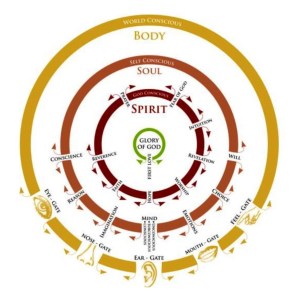
We are exploring transformation through communion, and it will take a few parts to unpack properly. Picture the spirit, soul and body gateways diagram with God’s glory at the centre—the River of Life flows outward through us, but only if the blockages are removed.
Transformation involves our whole being, and communion can be part of that process. Communion is more than a ritual. It is a powerful way to engage the body and blood of Jesus in a practical, daily way—not just on Sundays. The early church did it as part of life. We can do the same, wherever we are. The power lies not in the physical bread and wine or juice but in the spiritual reality we engage by faith. When we take communion, we are participating in something that imparts life and transformation. I often go beyond the natural act and engage with communion in the heavenly realms.
Like Isaiah, we can present our hearts and be purified. God’s word penetrates our inner life—revealing our behaviours, motives and even genetic triggers. Communion helps address all of these, even down to our DNA. Old songs like Nothing but the Blood of Jesus capture this truth: there is real, transformational power in the blood.
We can engage the power of Jesus’ blood to receive truth and revelation:
Ephesians 1:7 — In Him we have redemption and forgiveness through His blood, according to the riches of His grace.
Ephesians 2:13 — We, once far off, are now brought near by the blood of Christ, into relationship with Him.
Hebrews 9:14 — His blood cleanses our conscience from dead works so we can serve God in real relationship, not ritual.
Hebrews 13:12 — We are sanctified, set apart and transformed through His blood.
Colossians 1:20 — He reconciles all things through the blood of the cross, bringing peace in every realm.
Romans 5:9 — We are justified by His blood—declared innocent, as if we had never sinned.
Revelation 5:9–10 — Jesus purchased us with His blood to be a kingdom and priests. He opened access to our destiny scrolls, paid for at great cost.
When we break bread, we use declarations born from personal revelation. They help align our faith and words with God’s truth. Without that alignment, it is just bread and juice.
Here are my declarations. There is a lot in them, so we will look at it over the coming sessions.
I eat your flesh and drink your blood so that I will not die but live forever
Jesus said, “Eat My flesh, drink My blood.” This is not physical but spiritual.
John 6 — He says that those who eat of Him will not die but live forever. It is about abiding in Him and Him in us. The manna given to the Israelites could not prevent their ultimate physical death—but this bread can.
Luke 22 — At the Last Supper, He gave bread and wine and said, “This is My body… this is the new covenant in My blood.”
1 Corinthians 11 — Paul received this revelation directly from the Lord. He said we must examine ourselves—’Search my heart, O God’—because this is about covenant, not ritual.
We approach communion, examining our lives and seeking transformation. We do not stop at recognising what needs change—we eat and drink so that change may come. If failing to discern the body properly brings judgment, weakness, sickness and even death, then rightly applying the body and blood brings life and wholeness.
God’s intention is not that we die and go to heaven. That is religious tradition. The Kingdom is within us, and we are called to live it out now. Religion has made a covenant with death by promising heaven only through dying. We do not expect death: Jesus already defeated it. We do not need to die; we apply the cross to reverse the curse.
Transformation—transfiguration—is spiritual and physical. The law of the Spirit of life sets us free from sin and death, and scripture teaches not life after death, but divine life now. We are to partake in God’s nature, putting on immortality and escaping corruption. Jesus dealt with sin so we can live. There is no reason we should not live forever.
Eternal life is both quality and duration. If we are still going to die, it can only be because there is still the record of sin in our DNA. We can address this through the body and blood of Jesus, which restores us to our heavenly origin.
Others have done this—become transfigured, radiant, shining—even without the revelation we now carry. With it, we can accelerate that transformation. God wants us to radiate His glory.
I engage in the DNA of God; I embrace the transforming power of the body and blood of Jesus
To engage means to actively participate by faith—not just partake, but be transformed. Engage by faith. Embrace transformation as a choice. By faith, access the light, sound and frequency that carry God’s image. We were made to reflect him and extend his likeness into creation. The Greek word for ‘image’ is ‘icon’. Our lives should reveal God—like an icon opens a program on your phone or computer—but sin distorts that image. Communion restores it. Jesus’ body and blood carry the DNA of God. In them is the power to transform us into his likeness and live forever.
I engage the record containing the light, sound and frequency of God’s image for transfiguration
We each have a scroll—our original design. We were created as beings of light. That image still exists and can be engaged. Light stores information; as does DNA. God’s DNA and ours are meant to align; as we take communion, we resonate with his frequency and are changed. Jesus was transfigured in light, and as we draw close and align with God, we will radiate his glory. That is what sets creation free.
It is God’s voice that holds everything together. Communion lets us align with that sustaining frequency. Step into the spirit by faith and let your DNA be transformed: your two strands becoming three, incorporating the light strand of your original design. This is how we live and do not die. Choose to apply it by faith.
Mike’s latest book, Unconditional Love, is out now as an ebook on our website and available to order in paperback from your local or online bookseller.
At that time, the Bible was still the living Word of God for me—not Jesus. I saw the Bible as the Word that washed me, not Jesus. I relied on the Bible to separate my soul and spirit, rather than allowing Jesus to do it. I used the Bible as a mirror to see myself, rather than looking to Jesus or the Father.
Jesus, mediator of a New Covenant
During this process, I was presenting myself in the heavenly tabernacle as a living sahttps://freedomarc.blog/2014/01/21/present-a-living-sacrifice-3-practice/crifice, prepared by me, acting as my own high priest. Now, that might sound bizarre, but when I first received this revelation and began engaging in the heavenly tabernacle, this is what I thought I was doing.
I approached the laver—a basin used for washing—which I understood to have a bronze, mirror-like surface. I used it as a mirror to wash myself through the Bible, performing the role of my own high priest. I consumed the showbread as biblical food, again as my own high priest. I sought wisdom from the light of the menorah, the Bible, instead of Jesus. I engaged the altar, refining myself through the Bible, all the while acting as my own high priest.
In truth, all of this was a self-reliant, religious duty—a “do-it-yourself” form of faith. The reality, as I later came to understand, is that I am not my own high priest—Jesus is. Hebrews 6:20 makes it clear: “Jesus has entered as a forerunner for us, having become a high priest forever, according to the order of Melchizedek.” Jesus is the mediator of the New Covenant, not me. I made no covenant with God—Jesus did.
Deeply ingrained religious mindsets
My deconstruction was revealing God’s grace and the finished work of Jesus, and that was challenging my old covenant thinking. My “do-it-yourself” religious mindset had trapped me and severely limited my ability to truly know God and my original, authentic self.
Now, that might sound really odd to you, and you may never have approached things in this way. I would certainly encourage you not to. However, it shows how deeply ingrained these mindsets can be, distorting our view of God and His work. Only when those limitations and restrictions were removed could I begin to discover my true origin, identity and destiny as a son of God. It was then I began to see how powerful the finished work of Jesus truly is.
Jesus accomplished everything on our behalf so we don’t need to rely on our own efforts. He died for me, and as me, so I died. He was resurrected for me, so I was resurrected. He ascended for me and I ascended. Jesus established the New Covenant for me and included me in it. He is my high priest, he is my mediator—I don’t have to do it myself. Jesus did everything necessary to restore the whole cosmos, reconciling everyone, corporately. We are not required to achieve this individually in our own strength. He has accomplished it on behalf of all mankind; he took away the sin of the entire cosmos.
Renewing the mind
We may need to transition into a renewed mindset because most of us have likely been programmed by some form of works-based mentality. Even if it wasn’t specifically religious works, cultural influences can drive us to succeed and build our identity around what we achieve. Transitioning from an old to a new mindset requires a deep deconstruction—a process of renewing the mind. it is a process, that is the key.
It’s a process that God orchestrates and that he leads us through. It is relational, and through this relationship, our thinking about God—and everything else—begins to change. Old restrictive doctrines and theological mindsets need to be replaced by a relational lifestyle of face-to-face innocence with God. This is the amazing truth of the relationship He has invited us into.
No need to fear deception
Through this, we can learn to trust our Father to father us without fear of deception. Personally, I struggled with a deep fear of “getting it wrong.” This fear was instilled in me through the belief that everything had to be done strictly “by the Bible,” as the Bible was my sole source of security against error and deception.
The reality, however, is that every Christian sect or cult uses the Bible in some way, so relying on it alone for safety didn’t truly protect me from deception. I believed the Bible was God’s Word: all of it was infallible, inspired, and entirely inerrant, and I thought that following it would keep me safe. But whose version was I following? Whose interpretation of the Bible was I basing my life on?
These questions were hard to face because I had been conditioned to think otherwise. In truth, that belief system itself was the deception that was keeping me religiously bound in fear, unable to move beyond the Bible. I was afraid that if I went beyond its pages, I’d fall into some weird error or be led astray. This is a fear shared by many people I have spoken to: their families and friends often worry that they are going off into some error or cult-like movement, because they are no longer going to church or no longer reading their Bible in the same way they once did.
But the fear of deception is itself a powerful form of deception that keeps us locked up. We don’t need to live in fear of deception, because we have the Holy Spirit of Truth within us, guiding us. Jesus, who is the Way, the Truth and the Life, is also in us and with us, discipling us. Our loving Father is within us, fathering us into our true identity as sons and daughters. And if we measure everything against agape love, we won’t stray far. Love is the ultimate standard, and if we root everything in love, we can trust the process.
This video blog is an excerpt from Mike's current teaching series, Restoring First Love. Get the full length videos every month, only at eg.freedomarc.org/first-love
Rest in Love (guided meditation)
Close your eyes, Slow down your thinking, Rest—rest in love. As you are breathing in, And breathing out, The very breath of God.
And as you rest in love, Let the unconditional love of God Rest on you.
Open your heart, Open your mind, Ask the Father to reveal: “Are there any Old Covenant mindsets, Any Old Covenant belief systems, Still operating? Is there any mixture of covenants In your heart?
Open up your heart to listen That the Father could show you.
And if there is anything That’s a mixture of covenants In your experience Just hand it over to him.
Take off those old covenant mindsets And clothes, if you like, And hand them over to the Father.
And let Him clothe you In robes of righteousness, Let Him clothe you In new covenant grace, In mercy, In unconditional love.
As individuals and as humanity as a whole, all we, like sheep, have gone astray, following our own path of independence. But God proactively came to seek and save that which was lost. The Good Shepherd sought out the lost sheep—and still does. He is continually seeking those who are living in lost identity. And a lot of Christians are still living in lost identity, even though they have a relationship with God at a certain level. Whatever level of relationship we have, God wants to take it deeper. He doesn’t want us to remain in the same place.
Mankind may have turned away from God to live in that lost identity and independence, but God never turned away from us. God, as Father, has always seen us as His children through the lens of love. He has always desired that we all return to our first love—our origin. This is the key, and there are a number of Bible verses that speak about this love and its depth. , For example,
For I am convinced that neither death nor life, nor angels nor principalities, neither things present nor things to come, nor powers, nor height, nor depth, nor any other created thing [including ourselves] will be able to separate us from the love of God that is in Christ Jesus our Lord (Romans 8:38-39).
That’s quite a statement, but it’s based in God and not in us. It’s not based on our ability to maintain a certain standard. It’s purely a statement of God’s grace, mercy and love. The Mirror Bible puts it like this:
This is my conviction: no threat—whether it be in death or life, be it angelic beings, demon powers, or political principalities, nothing known to us at this time or even in the unknown future, no dimension of any calculation in time or space, nor any device yet to be invented—has what it takes to separate us from the love of God demonstrated in Christ Jesus, our ultimate authority (Romans 8:38-39 Mirror).
Relationship
When we go back through Romans 8, we see there are a number of things that lead up to that passage which are talking about our relationship with God. Romans 8:14 says:
For all who are being led by the Spirit of God, these are the sons and daughters of God.
As we come into union with Him, joined to God—not separated from Him in our own understanding—we become one spirit with Him. This union enables our spirit to mature, to grow, and to develop into who we were always intended to be. It helps us discover who we were before we came here.
For you have not received a spirit of slavery leading to fear again… (Romans 8:15a).
Yet how many people became Christians and, through the church or religion, ended up back in fear—living in works of appeasement to an angry God? But God is a loving Father. He wants us to know the truth: we are sons and daughters.
… but you have received a spirit of adoption as sons and daughters, by which we cry out, ‘Abba, Father.’ (Romans 8:15b).
This was impossible under the old covenant. Crying out “Abba, Father” is a new covenant reality. Jesus came to reveal His relationship with His Father so that it could become our relationship with our Father too.
The Spirit Himself testifies with our spirit that we are children of God (Romans 8:16).
This is what happens in this union: the Spirit testifies to our innermost being, confirming that we are children of God. Not only that, but we always have been; we always will be—we will never, ever not be children of God.
And if children, heirs also—heirs of God and fellow heirs with Christ, if indeed we suffer with Him so that we may also be glorified with Him. (Romans 8:17).
Now, this is where the way this is written may challenge some people because it uses the word ‘if.’ However, this ‘if’ is not conditional, as though we need to do something to make it happen. Instead, it is a declarative statement, affirming that something has already taken place: because we are children, we are heirs. Heirs of what? Heirs of God Himself and fellow heirs, co-heirs with Christ in the whole of creation. And “if indeed we suffer with Him so that we may also be glorified with Him,” is not suggesting that we must endure suffering to earn glory. Instead, it means that we identify with His sufferings because He went through them for us. We don’t have to go through it, other than by identifying with Him.
We originate in God
So if we go back again and read those verses in the Mirror Bible:
The original life of the Father revealed in His Son is the life the Spirit now conducts within us.
So the spirit is now looking, with the Father and the Son, to reveal our original origin and identity, the original life that He intended us to
have as children of God in relationship.
Slavery is such a poor substitute for sonship. They are opposites. The one leads forcibly through fear, while sonship responds fondly to Abba, Father.
This is what God desires: for us to engage with Him as Abba, Father, Daddy, without fear—resting instead in wonderful peace and intimacy.
Verse 16: His Spirit resonates within our spirit to confirm the fact that we originate in God.
Through this process, God is showing us our origin—who we really are, from the beginning, so that who we are now will be in alignment with who we were in the beginning, not as a product of our lives up to this point.
Because we are His offspring, we qualify to be heirs. This isn’t something we earn—it’s purely by grace. God Himself is our portion. We co-inherit with Christ, since we were represented and included in His suffering. This is very different than us going through suffering. We were already included in His suffering, and we equally participate in the glory of His resurrection. This isn’t something that happens in ‘Glory’ (as they used to call heaven); this is something that can happen now—because as He has been resurrected, so also we died with Him and we are now alive with Him, to fully embrace the glory of that resurrection power that reveals who we really are. You could say that ‘who we really are’ is our glory. It is our true identity, the clothing of that glorious nature we have as children of God.
This video blog is an excerpt from Mike's current teaching series, Restoring First Love. Get the full length videos every month, only at eg.freedomarc.org/first-love
Activation
Close your eyes, come to a place of rest. Begin to think of living loved, being loved in that first love way.
Again, start to focus your breathing, just begin to slow down, relax, focus your thinking as you breathe slowly, and breathe deeply, thinking about God, who is love, who loves you.
As you breathe in slowly, you breathe in that unconditional love of the Father. You’re breathing it into your very being. Every breath that you take is a life-giving force of energy, of love.
That unconditional love, as you breathe it in, flows through your being. Start to feel it flowing through you. Breathe deeply. Be still, as God releases that love in you, on you, through you.
You are cocooned in unconditional love, filled to overflowing. Unconditional love flowing through you as God demonstrates to you how much He loves you, how valuable you are to Him.
You are the apple of His eye, the treasure of His heart, the object of His desire. He calls you into union and oneness. He’s calling you into this union of relationship. Be filled with love.
Stay in that place of intimacy and love. Just embrace it.
The music in this activation is by Samuel Lane.
Stream or download more of his soundscapes at linktr.ee/SMLMusic
Salvation is not about “going to heaven after death.” Surprisingly, the words “saved” and “heaven” never appear together in the Bible. Salvation means restoration to wholeness in the present, not something that happens after death. The idea of being “promoted to heaven” or “crossing the Jordan” is part of a religious system that has promoted a mistaken tradition.
Salvation is about experiencing wholeness here and now, bringing us into the true identity of who we are. If you have been indoctrinated to think that your salvation depends on your efforts in any way, you will remain stuck in trying to secure it. This was my experience, coming from an evangelical background, where salvation seemed to depend on my ability to trust God, my faith, or what I did in asking God into my life.
Rather than realising what had already been accomplished, I viewed salvation as an ongoing effort—trying to be good enough and acceptable to God through practices like reading the Bible, praying every day, witnessing, and fulfilling the perceived requirements of being a “good Christian.” But who said we were supposed to do those things? Jesus did not—the church did. Deconstruction is the process of removing that indoctrination and replacing it with truth, renewing and transforming our minds.
All of humanity is included
Even if someone does not believe they are saved, they still are; they just do not believe it yet. This is the truth: all of humanity is included in what the Father already accomplished through Jesus to forgive, redeem, and reconcile us to himself. The work is finished, and everyone has been declared righteous, justified, and forgiven. Whether or not someone believes this truth, it remains the truth.
The New Covenant was made between the Father and the Son and included all of humanity. Teaching that we must make a free will decision to be included is ‘a church-invented heresy’, as Don Keithley says. “Our free will decision is simply to accept what has already happened, to realise that we are already included—not to make it happen. If Jesus included the doubter, Thomas, the denier, Peter, and the traitor, Judas, I seriously doubt anyone is excluded from his work today.”
No one is excluded from what Jesus came to do and to finish. He came to take away the sin—the lost identity—of the world, not just a few people but the whole world, and every person in it. What we believe about God does not define him, and our doctrines do not even define us, though they often label us. Many of us have been labelled by what we believe, whether Baptist, Charismatic, Pentecostal, Anglican, or any other denomination. But God knows the truth about us, and what he knows, demonstrated in Christ, is what defines us.
Equal Value
Jesus is what God believes about us. The love God has for his Son, Jesus, is the same love He has for us. When we are reconciled to God, it is important to understand that God was in Christ, reconciling the world to himself. The term ‘world’ here is the Greek word kosmos, and ‘reconciliation’ in this sense is an accounting term. The debit and credit must balance.
The value we hold for God is the same value God holds for Jesus. This is a profound truth: we are of equal value to God as Jesus. Understanding this is key to grasping the fullness of our identity and value in the eyes of God.
The truth that sets us free
Adam’s choice to walk independently of God did not change the nature of God the Father. God still desires a relationship with us, just as he did with Adam. The Father still longs to walk with us in the garden, to restore that relationship. We need to see that this relationship can be restored, and this realisation is an essential part of our journey.
Deconstruction takes different forms. Some people reject the conditional love taught by religion and walk away from organised faith, while others discover unconditional love outside of religion. God is love, and this is a fundamental truth. However, God does not deconstruct us by focusing on the lies we believe, but by revealing the truth that sets us free. This process renews our minds to the truth, and in doing so, those false beliefs naturally fall away.
The truth we know through experience will set us free. So let us focus on positive solutions, not negative problems. Do not try to deconstruct your beliefs with the same thinking that created them. Instead, allow God to encounter you in such a way that it changes what you believe, leading to a transformation based on truth, not on doctrine.
The ‘Second Coming’
Many Christians are still waiting for the second coming of Jesus. However, as I have discussed before, the ‘second coming’ already happened, in AD 70. This means that many are looking for the wrong event. Creation does not recognise Christians waiting to be rescued; it recognises sons and daughters who are living out the truth. Religion has deeply ingrained in us a fear of the future—the fear of tribulation, of the rapture, of trouble to come.
But we do not not need to fear the future. The Spirit of Truth was given so that we, as sons and daughters, might shape the future. Fear never comes from God, and perfect love casts out fear. Therefore, let’s ensure we are not operating out of fear, worrying about what might happen tomorrow, but instead live in the blessing and provision of today. There is no ‘Great Tribulation’ on the horizon. There may be personal tribulations, but God will be with us through them. The biblical ‘Great Tribulation’ was the end of the old age, the age of the old covenant, and it has already passed.
If you enjoy these teachings, please take a moment to like, comment, and subscribe, whether here or on YouTube—it really helps. Thank you very much!
Dominion is the rule of God or the government of God. It is a government of life. When Jesus said that the enemy wants to rob, kill, and destroy, but He has come to give us life in abundance, that’s what He meant. It wasn’t a case of just getting through by the skin of your teeth and hoping for the best. It was about abundance. He came to give us a whole, restored relationship and connection to creation. But we have to bring that government and peace because there is no end to the increase of God’s government and peace in the Kingdom of God. We have to seek first the Kingdom of God so that everything else is added to us. We can’t live selfishly or independently. We’ve got to live an interdependent life with God, dependent on His life, with rivers of living water flowing in our innermost being.
Well, what is that river doing? It’s bringing life wherever it goes. If you read Ezekiel, it talks about the temple and the water that went under the threshold of the temple, going ankle-deep, knee-deep, waist-deep, until it was flowing. What was its purpose? To bring life wherever it went. So, initially, that river flows in us because we are the temple of the River of Life. The Spirit is flowing in us, and it should bring life to us, energising, restoring, and making us whole. Then, as recipients of that, we are to flow that outward, creating an environment or atmosphere of it around us—fields of energy. Peter had an energy field around him, and it says his shadow healed somebody. Well, it wasn’t his shadow, as the shadow is just an absence of light. It was the energy within him that created the shadow. Was it the sun, or was it his own light? Who knows? They used the best words they could to describe what happened, but they weren’t scientists using scientific expressions to explain what really occurred when Peter walked past someone and they were healed. I believe he was producing an energy field that brought life.
Our capacity as sons of God
Now, we’re discovering wellness and technology that produces energy fields, life, and health, but I do ultimately believe it will be through the power of our own choosing of reality and consciousness. Our consciousness is expanding to fully embrace the capacity we have as sons of God, just as Adam did, using sound, light, and energy—things we are only now beginning to discover technologically. He had the power of his own mind and consciousness to choose, and creation responded to him as a son of God, to be fruitful, to multiply, to fill the earth, to overcome, and to rule, having that dominion. But you can’t do that by living independently and selfishly. Jesus came to model this, but He only did what He saw the Father doing. So, we need intimacy with the Father if we are to live that sort of life.
A lot of people just want to live forever, but they don’t necessarily want to live forever in the purposes of God. They just don’t want to die so they can carry on having a good time. Whereas I don’t want to die because I want to outwork the purposes of God. It’s a different motivation. If it’s going to be technology that extends life, guess who will get it first? The rich, the wealthy, those who can afford to pay millions or billions for it. But that’s not how God wants it to be. He shows no partiality. This technology, or these abilities when restored, are for everyone, not just a few. That’s why we must ensure that any discoveries related to health, agriculture, and energy are for everyone, not just some. These things need to come into the right hands and be administered correctly, not just treated as another discovery to be suppressed or kept for the few. God wants to bless every family on the earth, not just some, and certainly not just the rich ones.
Hidden from view
That’s why the administration of these discoveries, such as advances in energy, agriculture, and water, needs to be done properly. A lot of new advances are out there, coming from heaven, but they are being administered away from the usual people who control all this stuff—the financiers who essentially control the energy producers. There have been many free energy solutions out there for a while, but they’ve been suppressed because no one is going to make any money out of free energy. There’s no incentive for it. Boilers and cars that run on water have been possible for some time, but these technologies have been suppressed and could never get funding or come to market.
We need new energy sources not based on heavy metals, which are poisonous, but perhaps on gravity or other natural things that can produce energy. And there’s also the quantum field, producing zero-point energy from the quantum field, as it’s designed to re-energise the planet. We are being re-energised all the time, but we’re not focusing that into specific energy that can be used to power things or run things. So, a lot of interesting things are happening behind the scenes, much of it hidden from view, being prepared to be released at the right time to the right people in the right places.
Let’s be honest, if there were new advances in water technology, for instance, that meant water could function like a gel to irrigate crops, who should get that first? Third-world countries that have no irrigation, living in famine and drought. We don’t really need it in America or the UK, because we have plenty of water and irrigation. So let’s ensure that those who need it most get it first, because that is what God would want. But that’s not going to make money, is it? They can’t pay for it. We want these developments in the hands of those who won’t charge for it.
The well-being economy
So there’s a lot that needs to be in place in terms of the government of God, the rule of God, to facilitate the changes that need to happen to bring about heaven on earth; to bring about the well-being economy, where we focus more on people being happy than being rich. Finances shouldn’t be the measure of the world, but they’ve become the measure over the last couple of centuries—particularly in the last 2,000 years, and even worse over the last 400 or 500 years—where most of the world is controlled by very few people using their influence and money to control things. God wants everyone to be blessed, not just some.
Please help us by liking, sharing, commenting and subscribing. That way, the algorithms know that this is something worth presenting to more readers and viewers!
A lot of our understanding of the Old Testament comes from what we’ve been taught from a very literal perspective. However, much of the Old Testament can also be figurative. There’s poetry, and all sorts of things which can have a deeper meaning for us. In Noah’s day, the flood is often referred to in terms of Jesus being the Saviour, and it’s illustrative of how God came and rescued those who were willing to get on the ark.
What we must be careful of is not taking this too literally, as it was written with a different understanding of God. They didn’t have the New Testament understanding of God, nor did they know God in the way Jesus revealed Him. Their perspective was through their own understanding at the time. When we look at it now, we see it doesn’t line up with the God that Jesus came to reveal. So it’s our understanding that needs adjusting, not the idea that God was ever like that. God didn’t destroy the world.
Figuratively as well as literally
Now, there are those who say, “Yes, but the world was totally corrupt, and there were no genetically pure people left other than Noah.” Illustratively, of course, God desires that nothing within us be contrary to His image, the image He created us in. Our lives are being transformed by the renewing of our minds so that we come into that correct image. You can view these things figuratively as well as literally.
When it comes to questions like Sodom and Gomorrah—who caused the fire and brimstone? Well, who causes earthquakes? God doesn’t cause them. Who causes many other things? These are often the result of the natural world being in tension, not yet restored, groaning and longing for the sons of God to be revealed.
Fire and brimstone
Now, when you look at fire and brimstone—fire is often seen as God’s consuming fire. But we tend to think God destroyed them with fire. Fire could also be seen as a purifying force, a purification of what Sodom and Gomorrah represented, rather than a literal destruction of two cities. Some people believe they’ve found Sodom and Gomorrah, pointing to tar pits in the Middle East.
Brimstone actually means “God’s presence”—it’s the word “sulfur.” Brimstone is mentioned in the Book of Revelation, and the word used is “Theon,” from “Theos,” meaning “God.” So, brimstone signifies the presence of God, and God’s presence is purifying. These stories can be seen in that light. I know God didn’t cause these events because He doesn’t pour down judgment on people in that way. However, He does judge things that operate against the truth and will bring fire and brimstone to anything in our lives that hinders us from knowing and experiencing the truth and His love. But He’s not destroying people—He’s destroying the obstacles in our way.
There are different ways to look at it. Ultimately, I believe that God is love, God is good, and what He intends for us is to know His goodness and love. A lot of the Old Testament stories are figurative, but they’re written in a way that often doesn’t differentiate clearly between sowing and reaping. If someone sowed something bad, they reaped the consequences, not from God, but as a result of their actions.
The one who accuses
So, who brings about the consequence? The one who accuses and then comes to execute that accusation. We sow, and we reap the accusations against us for what we’ve sown. You could say the enemy brought the fire. In the undifferentiated view of God, if something bad happened, they thought God must have done it. But it could have been the enemy bringing the consequences of their behaviour, as the enemy seeks to rob, kill, and destroy.
Jesus said the enemy comes to do just that. So, who brought fire and brimstone? The enemy. Who brought the flood? You could say the enemy, or you could say the Earth itself reacted to the violence and horror, as described in Genesis 6, where violence was continual. The Earth washed itself clean. There are different ways to view it.
God is good
What I do know is that God is love, God is good, and He doesn’t kill or punish anyone, even if the Old Testament seems to say otherwise. Jesus came to reveal the truth. He said, “You’ve heard it said, but I’m saying to you,” and “If you’ve seen me, you’ve seen the Father.” Jesus didn’t destroy anyone. He only wanted to gather them to Himself because that’s what love does.
If you enjoy these videos, would you please take a moment to like, share, comment and subscribe, whether here or on YouTube. It really does help. Thank you very much.


 Unconditional Love – new book out now











 Sons of Issachar