It’s helpful to know how to do something—until it becomes so ingrained that it functions instinctively, programmed into our unconscious. I no longer have to consciously think every day about how to focus energy into the seven energy gates. I am that now. It’s moved beyond a linear practice—it’s become my entire model of thinking.
But to reach that point, I had to go through the process. I had to intentionally practise it daily. I would focus the rivers of living water into the Merkabah at the core of my being. I energised that with the life of immortality, and then directed that energy to flow through the gates within my physical body. That process empowered me for everything I needed to do—and yes, even to keep myself alive through the flow of immortal life. I can choose to focus that energy.
It’s a journey of learning, of growth and maturity. Eventually, it becomes who you are. It stops being a conscious act and becomes a state of being. Just as we don’t need to remind ourselves to breathe or to keep our hearts beating, once this kind of energy flow is fully established, it moves into the unconscious realm. It’s built into us. It simply flows.
In the same way we’re not constantly thinking, “Better breathe… better pump blood…”—we can be reprogrammed with the energy of life until it becomes automatic. Immortality can become who we are. But this requires intention. Most people aren’t disciplined enough to focus in that way. They hope immortality will just happen. But we have to choose to live from that reality. We have to embrace the I AM—the source of immortal life.
Jesus said that if we drink from the springs of living water, we will live forever. But you have to drink. It’s a choice. It’s not some mythical fountain of youth, or a secret serum. The source is not external—it’s the Spirit, it’s life, and it’s already within. That well is bubbling up inside us, and it will never run dry.
Jesus told the woman at the well, “If you drink from this, you will never be thirsty again.” That’s the key—drawing from the right source. When that becomes your only source, your life changes. You don’t eat to survive—you eat to fellowship, to enjoy. You’re living from a completely different perspective.
And I truly believe that’s God’s intention: that we all come into this state of being—dwelling in it, living in it. A state that frees us from the limitations of the world around us. Living from an immortal state means I’m not bound by the laws and conditions of a world still in the process of restoration. I’m choosing not to live connected to death.
Even though people around us are dying—and just yesterday, a close friend of mine passed away—I know where he is now. He’s in a better place, but I don’t believe it was God’s ultimate intention for him to die. Still, everyone has to find their own place of understanding and reality. Over the last couple of years, I’ve known people who believed in immortality, yet they still died. Does that shake my belief? No. I won’t let it stop me living in the truth of immortality. But I do grieve with those left behind. It’s tragic, heartbreaking, and I feel deep sorrow for those now facing that loss.
But just because things haven’t fully manifested yet doesn’t make the truth any less real. God’s desire is to restore immortality to all of us.
Please help us by liking, sharing, commenting and subscribing – it really does make a difference!
If you start by developing your internal relationship with God—recognising that He dwells in you and allowing that relationship to expand within—you’ll ultimately discover the union of Father, Son and Spirit with your own spirit, soul and body at the core of your being. This forms the foundation for all other experiences. It’s the source of abundant life. You’re no longer just sipping from the well—it becomes a river that flows from within you. As that inner relationship grows, love begins to flow from you. The more you experience God’s unconditional love, the more you become unconditionally loving. What you’ve received begins to pour out of you.
My personal journey started with an unexpected experience. In 2008, I was simply sitting at my desk when I had a sudden encounter—I was drawn into heaven through what felt like a portal. It was overwhelming and surreal. The first thing I encountered wasn’t scenery or angels—it was love. A level of love I’d never experienced before. My whole being—spirit, soul and body—was immersed in it. I was completely saturated, and that moment transformed me. I knew there was something more than I had ever known, and I couldn’t ignore it. For the next two years, I kept seeking it, longing for that connection again. It ruined me—in the best way.
Eventually, in 2010, that experience became a lifestyle. My daily life began to open up to spiritual realities. I engaged with God, with heaven, with the garden, the River of Life, the Tree of Life—all these beautiful things. But the most important revelation was this: I was His dwelling place. And as I dwelt with Him, and He with me, I began to understand myself.
He showed me how my soul worked, how I had formed my identity around what I knew and did. Eventually, I surrendered. I stopped striving to know and control. I just trusted Him. And that trust opened the door to a deeper journey—one of daily, ongoing transformation.
Love began to expand
That intimate love began to expand within me. I experienced healing, not through ministry from others, but directly from Him. Inner healing became personal and profound. It was no longer something done to me—it was something He and I walked through together.
Over time, He led me into a union that felt like a marriage—something I never expected or imagined. And it all began from within. That’s the invitation: engage with what you already carry. Let it grow. Because it will not stay contained. It will flow into your relationships, into your life, and others will see the reflection of your relationship with God.
You don’t need to prove anything to anyone. It’s God’s job to reveal Himself. Our part is simply to love. Jesus said the world would recognise us by our love for one another. He didn’t say we’d be known by power or knowledge or supernatural gifts—but by love. And to love like Jesus, we first have to let Him love us. That means letting go of conditions and assumptions we’ve picked up—mindsets that need renewing. Many of us are deconstructing, but God may still want to go deeper within us.
Seated with Christ
Yes, there are external experiences—heavenly encounters, visions, spiritual senses being awakened—and I’ve walked in those. I can activate my spiritual eyes and see what’s going on in the spirit, but I rarely do that now. Not because I can’t, but because I don’t need to. I know where I dwell. I know where my spirit is—seated with Christ in heavenly places. You may not have caught up with that reality cognitively, but it’s true all the same.
Most people aren’t taught this, so they never fully grasp the reality of the spiritual realm or their identity in it. But Jesus ascended into that realm, and we ascended with Him. We’re seated there—not just in Him but with Him. We have a position of identity and authority as sons.
Part of my journey was discovering that, at the centre of my being, God has placed spiritual “gates”—like energy centres, if you will—connected to the River of Life that flows within us. They bring vitality, health and wholeness. This internal structure connects us to heavenly places, and it all flows from the relationship we nurture within.
Grounded in love
So, start there. Cultivate intimacy. Let His unconditional love dwell in you and grow in you. From that place, everything else will open up. Every journey is unique—God doesn’t deal with us like clones. But His work is always grounded in love. He always seeks our best. Even when we make mistakes, He brings good from them, because He is merciful and kind.
His mercy triumphs over all. His grace is without limit. His love is totally unconditional. And when we rest in that love, it opens us up to so much more within relationship.
Mike’s latest book, Unconditional Love, is out now as an ebook on our website and will soon be available to order in paperback from your local or online bookseller.
When people get drawn into deceptive teachings, it can completely distort their understanding of God. But the truth is, the very nature of God is love. Just think about it—some claim that if someone uses a different name for Jesus, or a Hebrew version, they’re going to hell. It’s absurd. But that’s the level of deception and depth of religious programming some people fall into.
Take the Hebrew Roots movement, for example. It’s just as deceptive as the Judaizers in the first century, who tried to pull followers of Jesus back under the law of Moses. Jesus warned us about the leaven of Herod and the Pharisees—the political and religious spirits. And sadly, that same spirit has infiltrated some mystical Christian groups today.
There’s a growing narrative that says you must understand Hebrew, take Hebrew classes or grasp the Hebrew language to understand God. But God is not Hebrew—God is God. Hebrew was simply the language of a people He chose for a time to demonstrate His desire for relationship. That doesn’t make it the one true language of divine understanding. In fact, many of the religious leaders in Jesus’ day—Pharisees, Sadducees, and others—had a deeply flawed understanding of God, and Jesus came to correct that.
Much of that misunderstanding came from syncretism. When the Jewish people were exiled in Babylon, they began to incorporate foreign beliefs and customs into their system. The same happened later under Greek influence. This led to writings like the Talmud—an oral tradition passed down and eventually written. Some of its content is shockingly harsh, treating non-Jews as lesser beings. It became equal in status to the Torah for many, yet it’s a book that contains things Jesus clearly came to oppose.
Jesus came to reveal who God truly is—a God of love. The Hebrew Roots movement, though, seeks to drag people back into a law-based, old covenant mindset. When people get into it, you often notice a lack of love in their attitudes. They become harsh, critical and defensive—clear signs of deception. Paul addressed this in his letter to the Galatians when he said, “Who has bewitched you?” They started with grace and were being tempted to go back under the law. But no one could keep that law, and that was the whole point.
Christianity is not Judaism plus Jesus. Jesus didn’t come to start a religion—He came to invite us into a new covenant relationship. He is the fulfilment of every old covenant promise and every feast that pointed to something greater. So why go backwards? Why follow the Jewish calendar or wear religious garments like kippahs or prayer shawls to seem more spiritual? It’s just mixing covenants and returning to bondage. And again, it often shows in how little love these teachings produce in people.
Some insist we must use the Hebrew name for Jesus. But God speaks to us in our own language. He’s spoken to me about Jesus using that name, because He meets us where we are. I’m not Hebrew—why should I feel compelled to use a Hebrew name? Unfortunately, many who fall into this movement become zealous, dogmatic and, sadly, unloving. They act as if God will condemn people for using the “wrong” name, which is utterly absurd. But that’s indoctrination. There’s a religious spirit behind it, trying to pull people out of the freedom found in Christ and back into bondage through law-keeping.
The Hebrew Roots movement, at its core, aims to reintroduce legalism. There’s even a wider agenda pushing something called the Noahide laws, attempting to bring the whole world under a religious legal system. But we’ve been called to freedom—not to religious control.
Mike’s latest book, Unconditional Love, is out now as an ebook on our website and will soon be available to order in paperback from your local or online bookseller.
God isn’t commending you, endorsing you or recommending you based on what you’ve done—but on who you are, and who he created you to be. Your destiny isn’t a long checklist of things you have to accomplish in order to be good enough. It’s about being you. That’s really the heart of it—discovering and becoming your true self in relationship with him.
So God’s not looking at your performance and saying, “Well, I can’t work with them, they’ve not done a good enough job.” He’s looking at you as his son, as his beloved creation. You’re the apple of his eye, the treasure of his heart. His desire is for you to be you. And as you live out of that true identity, you’ll naturally express things through creative sonship that reflect who you are—and that’s what’s truly worthy.
So when he says, “Well done, my son,” it’s not because you ticked off a list of achievements. It’s more like, “You had a go. You used your creativity. I’m pleased with you.” Think about Jesus—God spoke over him and said, “This is my beloved Son, in whom I’m well pleased” before he even began his ministry. God’s approval wasn’t based on what Jesus had done. It was based on who he was. And that’s the same for us. God wants us to rest in who we are. That rest then becomes the source of everything that flows out of our lives. Just being, without striving or doing, releases the doing in a natural and authentic way.
Now, when it comes to things like creating wealth, we don’t need to strive for it. God is our provider. If we’re in tune with him—moving with his heart, doing what we sense he’s doing—then everything we need will be provided. He’s already promised that we have more than enough for all our needs, and abundance for every good deed. And those good deeds aren’t random acts—they’re connected to who we are. They’re expressions of our true self in a world that needs it.
If I’m striving to make money or create wealth in my own strength, it’s probably because I’ve moved out of that place of trust and into anxiety. But when we’re at rest—when we’re not worried or fearful—we draw provision to us. We’re not grasping, we’re receiving. There are people out there—Joe Dispenza, Sadhguru and others—who’ve tapped into some of the principles that God operates by. Things like sowing and reaping, or what some might call “heavenly technology.” They may be working with these principles, but not necessarily in relationship with God. So while they might be doing generally good things, it can have a kind of humanistic flavour—because it’s often built on information, not revelation. It’s not flowing from intimacy with the Father.
And look, I’m not heavily into any of that stuff—I’m just aware of it because people talk about it, and I have friends who are really into those ideas. And in many ways, there’s nothing inherently wrong with what’s being said. But the problem is, without relationship, it becomes a formula or a technique. And that’s not what God wants from us. He wants union—a living relationship with him as our Creator.
That’s totally different from working a technique to get a healing, or meet a financial need. Being in relationship with him draws all that we need to us. We don’t have to chase after it. When we live from rest, we don’t fall into striving or performance to try and earn his blessing or approval. He already wants to bless us because we’re his children. And he wants us to relax into that identity; to be at peace with who we are. From there, everything else flows.
If you enjoy these video blogs would you please take a moment to like comment and subscribe – it really does help! Thank you very much.
Mike’s latest book, Unconditional Love, is out now as an ebook on our website and will soon be available to order in paperback from your local or online bookseller.
Of course, Jesus is the way we come to the Father. But He is a door… He said, “I am the door,” and He’s introducing us into a relationship with the Father. I do engage with Jesus at times—sometimes as the Truth—when I feel led to connect with Him in that way. But the bottom line is, we are sons, and a relationship with the Father is absolutely vital. I don’t believe for a moment that if you don’t consciously talk about Jesus, or think, “I must go through Jesus to have a relationship with the Father,” you’ll somehow open the door to the demonic. That’s not how it works.
At the end of the day, demons cannot take control of our lives. We have the Holy Spirit within us—the presence of God living in us. Unless someone deliberately chooses to give access to an external force, by surrendering or submitting to it, a demon cannot simply take over. You’re not going to be overrun just because you didn’t say the name of Jesus. That’s not how it works.
Your relationship with the Father is exactly what Jesus wants you to have. He’s not jealous or overly protective about His name. What He wants is that relationship. And actually, when you have a relationship with the Father, you’re also in relationship with Jesus and with the Spirit. They are one. They exist in perichoresis—a divine dance of mutual indwelling. So if you’re talking to the Father, Jesus is fully aware of the conversation. It’s not like you’re excluding Him or shutting Him out. You’re not.
I think sometimes people come under a kind of religious bondage, and I believe God wants to set us free from that. Intuitively, I think many people know what’s right in their own walk with God. If you’re experiencing and enjoying that relationship, you don’t need religious rules saying, “You must do this,” or “You must say that.” When people start saying things like “demons disguise themselves” or “if you don’t say Jesus’s name, you could be deceived,” it brings confusion and fear, which is not from God.
Just to clarify—demons are not fallen angels. They are disembodied souls, roaming the earth, looking for someone to express through. Angelic beings and fallen angelic beings exist, yes, but they’re not the same as demons. And actually, it’s very easy to discern which is which when you’re in relationship with God. That relationship gives you the discernment to recognise love, and love is the plumb line by which you measure everything. If something carries the frequency of love, it’s not demonic or fallen. You learn to recognise what God is using, who He is communicating through, and who He is Himself, by experiencing His love.
So I’d just say—lay all that other stuff down. Don’t get confused. Go with what’s in your own heart. Loving God, feeling His love in you, and expressing that—that’s what matters. In my Patreon teaching this month, I talked about what Jesus said: “If you love me, you will keep my commandments.” That doesn’t mean law or obligation. It means desire. His one desire is that we would be loved and empowered to love others in the same way. That’s the essence of it.
He wants us to be who He created us to be and to express that in love to others. It’s not about demanding obedience—it’s about desire and relationship. The word “commandment” has a goal built into it—entole, which means that in the end, there’s a result. And the result is this: “Let me love you, and you’ll be empowered to love others.” That’s what Jesus is really looking for.
In our relationship with the Father, He empowers us to love, because He’s loving us as sons—or daughters, if you prefer. There’s no gender in this—it’s not about physical identity, but about our position in God’s heart and government. So again, it’s not that Jesus has to be the focus in the sense that you must always say His name or fix your thoughts only on Him. He is the way we’ve come to engage the Father. The Father revealed Himself in us through Jesus, but Jesus doesn’t need to be approached legalistically. They are all one. There’s no jealousy or competition within the Godhead.
Ultimately, love and experiencing love is the primary thing. If someone says that’s not enough unless you explicitly follow Jesus, I’d say that following Jesus is following the way of love—true love, not how the world defines it. Some people might have a relationship with God but not yet know it came through Jesus. But He’s not worried about that. They’ll know in time. The truth will be revealed, and they’ll come to see it.
So don’t get caught up in arguments or pressures that bring confusion and discomfort. If someone’s pushing a particular view that doesn’t sit well with you, don’t follow it. Go with your heart. If what you’re experiencing is love, then it’s safe. The devil cannot deceive us when we’re grounded in truth—and Jesus is the Truth. But He wants us to know truth not just intellectually, but experientially—through love. Love is truth.
You’re not wasting your life by having this wonderful relationship with the Father. The angelic realm is there to help. We each have guardian angels assigned to us. They’re not going to deceive you. And you don’t need to live in fear of deception when you’re in relationship with God, grounded in truth and love.
Love is the primary way truth is revealed. So enjoy it. Rest in that love. Anything that pulls you out of love’s rest and into fear, anxiety or worry isn’t coming from God. Perfect love casts out fear.
And yes—your relationship with the Father and the Holy Spirit is enough. Through that relationship, you are also connected with Jesus. You don’t need to separate them out in your mind. They are in perichoresis, in union. So when you engage with the Father, you’re engaging with Jesus as well, one way or another.
Mike’s latest book, Unconditional Love, is out nowas an ebook on our website and is available to pre-order in paperback from your local or online bookseller.
One of the things you asked is whether you’re doing something long enough, or if you should spend more time on it. But it’s not really about the length of time—it’s about the focus of your intention. It’s your intention that activates something. Your desire directs that intention, and your intention focuses on what you’re seeking—whether that’s DNA cleansing or something else. When you engage in communion, when you live from that place of communion, it’s not so much how long you stay focused, but the strength and clarity of your intention and desire in that moment that makes the difference.
Essentially, what you’re doing is choosing a reality. You’re choosing the reality that your desire and intention are working together to bring about. And if you then live in a state of rest—living in the reality that you’ve already received what you’ve intended—then you begin to align with what was always in God’s heart for you. His heart has always been for everything to be as it should be. His desire flows from what was, into what is, and shapes what will be. So you live in the presence of your future. Your desire draws you there, and staying focused on that future in the present means you are living loved, loving living, and living loving. You’re enjoying the process, resting in the reality of your intention. It may not have fully manifested yet, but you’re already living in it.
Jesus said about prayer, “believe you have received, and you will receive.” This operates on the same principle. You’re focusing your attention, you’re directing your desire, and you’re choosing to live in that reality now. That present moment, infused with intention, is what creates the future—because it flows from the eternal heart of God. ‘What was’ is not just something that happened a long time ago: ‘what was’ is the ‘eternal now’. And when you allow that to manifest in your life—when you bring that into your present through focus and intention—your future begins to show up in the now.
And ultimately, when you live in rest—not striving, not chasing, not driven by fear or anxiety—you can maintain that state of peace no matter what’s happening around you. Whatever the circumstances, you’re grounded. You’re steady. You’re not swayed. You’re always encouraged, always encouraging others, because you’ve learned to stay in a place of rest. From that place, you can focus your intention, knowing that what you’re aligning with is the very heart of the Father. You’re simply cooperating with His desire for you—to live in the fullness of righteousness, to experience the vast sum of His thoughts towards you, which are always good and always rooted in unconditional love.
As you live that way, the full manifestation of it will come. But even before it does, you’re already living in the reality of it. You’re enjoying it now. That means you’re not focused on what you don’t yet have. You’re not living from a place of lack. Instead, your thoughts and desires are shaped by what is already true in the eternal, and that becomes your experience. In that way, manifestation is simply the natural outflow of the rest you live in, in the present.
Please like, comment, share and subscribe – it helps us, helps you, and helps others to see our posts!
Mike’s latest book, Unconditional Love, is out now as an ebook on our website and is available to pre-order in paperback from your local or online bookseller.
Going in to meet the person of God—that is an experience beyond any other I’ve ever had. I could never have entered into that in the state I was in, but God began to change me, prepare me, in all those things in the soaking room, so I could get to that place where I was able to meet Him face to face. Now, I’d met God in many different ways, but there’s a difference between engaging the presence of God and engaging the person of God.
Metamorphosis
Metamorphosis is a process that produces transformation. Not only do things get removed, but things also get changed, added, to enable us to go into deeper levels of intimacy. So we have the ability to live in multi-dimensional realms, in the fullness of our eternal nature and identity.
An example in nature of metamorphosis is the transformation of a tadpole into a frog. It hatches from spawn and begins life restricted to water, breathing through gills—but that’s not God’s intention for it, that’s just the beginning. The tadpole eventually loses its gills and tail, develops legs and a new respiratory system, so as a frog it can be free from restrictions and live in both water and on land. A butterfly goes through a similar process—starting as a caterpillar, restricted to crawling on the earth, but changing through the chrysalis into something that is free to fly.
These are symbolic of the change and transformation that’s needed. We also go through a similar transformation that removes, adds, and restores abilities.
Many times in the Bible, you’ll find characters placed in a place of restriction to prepare them for their destiny. Now, sometimes people really struggle with that. They find it really difficult—to be restricted. They think God is putting that restriction on them in a negative way. But it is a positive thing when God places us in a position that brings about the change and transformation needed in our lives.
Some examples of that—Jacob under Laban, where he was looking to receive his wife, and there were all these conditions put on him, and tricks and everything else, but it produced character in him. Moses in the wilderness—he was called, but lived in the wilderness until he was able to take his position, after he had matured. David in Adullam’s cave—called for the kingdom, but in this place with a group of misfits, and God used that. Jeremiah was in anguish of soul, but came out into a place of fulfilling his destiny.
And then Joseph and Esther—they were also prepared. Joseph was prepared in the pit—his brothers threw him into the pit. How difficult must that have been? Then in slavery, in stewardship, and in prison—the prison of obscurity—until the time was right when his dreams and destiny would be fulfilled. Joseph, in his father’s house, was never going to fulfil his destiny. It was Joseph who’d gone through the process of change and transformation, who grew, who matured, who would end up in leadership in Egypt—in a way beyond what we’d have thought possible. But God prepared him, took him through seeming injustice and different situations that so challenged him—and yet he remained humble through those situations.
Esther went through 12 months of preparation before she could come before the king. That was so difficult. I’ve engaged Esther in the spirit—I’ve engaged her in the cloud of witnesses. I asked her, “What was it like?” And she said, “I didn’t want to be prepared to go and see the king.” That was not something a young Jewish girl would ever have wanted—to be a concubine of a king, a foreign king. But God had a purpose for Esther that would bring about the salvation of her people.
So it’s really important we don’t just look at the external circumstances of our life and think, “This is terrible. How can I get out of this?” We need to understand that sometimes, places of restriction are the places of greatest transformation.
For our soul to be prepared, there needs to be an identification of the things in our lives that are hindrances—coping mechanisms, defence mechanisms, trauma—and all of that leads us to a place of surrender. We surrender our independence. We learn to trust the Father for our provision, protection and direction in life. We’re no longer going to do it by the DIY tree path.
This video and blog post are taken from Mike’s current teaching series, Restoring First Love. Get the full-length videos every month, ad-free and with many extras, only at eg.freedomarc.org/first-love
Realign with our divine origin
Our spirits, souls and bodies realign with our divine origin—get realigned and brought into union and oneness with each other and with God. The identification of our false identity and any works- or performance-based orientation gives us the opportunity to find our true origin and redemptive gifts.
There’s preparation for glorious sonship in restored First Love, and creation is longing and waiting for the revealing of the sons of God—for the revealing of our true nature and how that can bring freedom to the whole of creation.
So the soaking room experiences began to engage my body, they began to engage my soul, to prepare my body to radiate glory and my soul to operate in light. This soaking begins to realign the frequencies of our being, to restore resonance with God, with our true identity—harmony and balance to our whole being.
We experience the sound and light frequencies of glory—God’s nature—for transfiguration from one degree of glory to another. We don’t stay the same. We increase in glory. So we increase in the full revelation of who we are, and begin to express that and live from that place.
Now literally, excitation of light waves of specific frequencies causes our DNA photons to be energised and transformed. That light is God Himself. We begin to be transfigured in light by God, who is light. We become sons of light, living in physical and emotional harmony, health and wholeness—and it all happens by the presence of God.
The symbols of the things in soaking are symbols of God’s presence—of God Himself. God as our Father is calling us to embrace the restrictions of transformation, to receive the freedom of our sonship. And it’s so important that we receive that freedom, so we can receive the full revelation of our eternal destiny—to live trans- and multi-dimensional existences, fully embracing all of the eternal characteristics of sonship that are our eternal identity, our true authentic self.
John 3:30 says, “He must increase, but I must decrease.” Now I’ve heard that preached as if it’s something we need to beat ourselves up about—as if we need to put ourselves on the cross every day. It doesn’t mean that. He reveals in me what is like Him—I embrace that. He takes away from me what is not like Him—I embrace that. It’s not something I have to try and do, like “I’ve got to decrease,” as if I’m nobody and nothing and with this sort of false humility. No—this is allowing Him to increase. Therefore, if He increases, then everything that’s not like Him falls away.
So I learn to surrender, where I can present myself to Him—I can be changed, conformed to sonship through this whole process by allowing Him to soak me in His presence.
So, what is soaking? Soaking is to make or allow something to become thoroughly wet by immersing it in liquid—that’s the dictionary definition: to immerse, to steep, to submerge, to submerse, to dip, to sink, to dunk, to bathe, to wet, to rinse, to douse, to marinate, to steep, to pickle. I mean, some of it’s really important.
To baptise in water, to baptise in the Spirit, to baptise in fire—in which we are immersed in those things which bring about the changes. I’ll go into that in more detail in a future session when I look at the heat and how heat transforms us. But the soaking room is the place of preparation that has parallel heavenly encounters in the River of Life, which is a river of energy—of Spirit—and in the river of fire.
God is a consuming fire. His love is a consuming fire. We can be baptised in the River of Life and in the associated waterfalls that cascade down. We can be baptised in the river of fire, engage the altars of fire, engage the process. See, the River of Life is Spirit energy—living water. It’s not H₂O, but the very essence of life, encoded with the frequencies of God—God’s essence. And when we are baptised into it, when we submerge ourselves into it, it begins to change and transform us.
The sound of many waters—it says God’s voice is like the sound of many waters. The sound of many waters are the creational frequencies of God’s voice that will realign us to who God created us to be.
I encourage you right now
just to close your eyes.
Get comfortable.
Begin to relax.
To focus your thinking on God.
Focus your thinking
on God’s love, grace, mercy for you.
Focus your breathing by slowing down.
Breathe in more slowly.
Breathe in more deeply.
And as you’re breathing in,
you’re breathing in
the unconditional love of the Father.
You’re breathing in love.
You’re breathing in joy, and peace.
And as you breathe it in, just receive.
Let it flow into your being.
Whether you feel it, or sense it,
just let it flow.
Continue to be still.
Breathe in
and breathe out slowly.
Breathe in slowly
and breathe out slowly.
Slow everything down and totally relax.
Just become mindful
that you’re cocooned
right now
in God’s presence.
As you are still,
He is cocooning you in love.
He’s loving on you.
Consciously invite love,
invite joy,
invite peace,
to come upon you,
to flow in you,
to flow through you—
to create an atmosphere of rest around you
that you are completely submerged in –
baptised into the higher frequency of love.
Vibrating in that energy.
Vibrating in peace and joy.
Overshadowed with the presence of the Holy Spirit,
energising you,
transforming you,
changing you.
Be open to that overshadowing.
For the presence of God
to rest upon you.
People often ask doctrinal questions, but it’s important not to answer them with doctrinal answers, because doing so only reaffirms another doctrinal stance. What we really need to do is bring it back to the nature and character of God. Behind every doctrinal question lies an assumption about who God is and how He acts. The person asking the question might no longer resonate with that assumption, or they may be going through a process of having their previous beliefs challenged. For example, when God began challenging my own belief in penal substitutionary atonement—something foundational to my upbringing—it led to a cascade of further questions. Doctrines are interconnected. When one is questioned, others naturally follow, and this often challenges the very foundation of someone’s faith.
Some doctrines may seem less significant, but if someone is asking about them, there’s usually a reason. The real issue is not necessarily the question itself but why they’re asking it. Understanding the motivation behind the question can reveal where they are in their journey. Perhaps God is working in them, nudging them to reconsider something. If they’re asking just to win an argument or prove their own belief right, then engaging in debate is usually fruitless—they’re not really open to listening.
So when someone asks about theology, I try to understand what’s prompting the question. Is God speaking to them? Challenging them? What’s He doing in their life that might explain why they’re now curious about this topic? Once I get a sense of that, I can align with what God is doing in that person’s life. I don’t want to get ahead of where God has them. If I tell them something they’re not ready for, they may react badly and retreat from the journey they’re on. I try not to give people something ten steps ahead when they just need the next step.
I often won’t answer the question they’re literally asking. Instead, I try to give the answer they actually need at that moment. This can be frustrating—some will say, “But you’re not answering my question.” And that’s true, but if God doesn’t want me to answer it right now, then I won’t. I want to share what God is saying to me to say, not just what I think I should say. The goal is always to discern what’s really behind their question, what’s in their spirit and heart, and then respond to that.
Rather than giving them answers, I try to point them to the Father. If they come to know who the Father really is, they’ll be better equipped to receive the answers directly from Him. That’s far more helpful than just believing or disbelieving something I tell them. Often doctrinal misunderstandings come from a distorted view of God, so pointing people to the true nature of God helps correct those distortions more effectively than tackling the doctrine itself.
In a recent Zoom on Patreon, I shared how mistranslations have distorted our view of God—how we see the cross, ourselves, and how God relates to us. These come from reading Scripture through doctrine instead of revelation. Take Isaiah 53:10—most English versions say it pleased the Lord to bruise him, suggesting God took pleasure in punishing Jesus. That paints God as abusive, which pushes people away.
But Jesus used the Septuagint—the Greek Old Testament—written between 300 and 100 BC. It reflects a shift in understanding. Earlier, people had thought everything came from God—good or bad—because they didn’t separate God from Satan. But over time, that changed. The Septuagint shows a growing revelation of who God really is—not a punisher, but a healer.
The Septuagint says the Lord wished to cleanse him of his wound—not bruise or crush him. That word cleanse is the same used when Jesus healed a leper. God didn’t punish Jesus—man did, inspired by the enemy. Jesus took on mankind’s wound so the Father could restore our identity. Penal substitution paints God as an abuser and makes love hard to grasp.
Similarly, Jeremiah 17:9 is mistranslated. It doesn’t say the heart is deceitful and beyond cure, but the heart is deep—who can know it? These distortions fuel a false view of humanity as wicked and unfixable, rather than whole, loved and made in God’s image.
Romans 5:9 is very often translated as saying we’re saved from the wrath of God, but “of God” is added by translators—it’s not in the original. The King James and Young’s Literal just say the wrath. So whose wrath is it? Not God’s—it’s the enemy’s. The one who comes to rob, kill and destroy. Jesus came to give life and to destroy the works of the evil one.
For then the blameless man made haste, and stood forth to defend them; and bringing the shield of his proper ministry, even prayer, and the propitiation of incense, set himself against the wrath, and so brought the calamity to an end, declaring that he was thy servant. So he overcame the destroyer, not with strength of body, nor force of arms, but with a word subdued him that punished, alleging the oaths and covenants made with the fathers. For when the dead were now fallen down by heaps one upon another, standing between, he stayed the wrath, and parted the way to the living. (Wisdom of Solomon 18:21-23 KJV).
So the Wisdom of Solomon, part of the original canon of scripture [and included in the King James Bible until it was removed in 1885] says it is “the destroyer“ who punishes and brings death, and Paul would have known this as scripture. So when he talks about ‘the wrath’, he is referring to the enemy’s destruction, lies and identity theft—not God’s supposed anger.
So, a few mistranslated verses have propped up an entire theology that presents a false view of God’s nature.
{The video continues]
Mike’s latest book, Unconditional Love, is out now as an ebook on our website and is available to pre-order in paperback from your local or online bookseller.
When we become whole, spirit, soul and body should be seamlessly integrated, so that we no longer need to constantly think in terms of spirit, soul and body. but when we’re learning, it helps to understand how each functions—and how they work together.
So, in terms of our body, we have the five physical senses—sight, hearing, taste, smell and touch—which are obviously housed in the body. That’s primarily how we’ve received information throughout life, and so we’ve learned from those experiences. Now, the body itself has often been treated as the lesser part, with the soul and spirit seen as somehow “higher realms”. I don’t believe that’s the case. I believe God made us whole. One part isn’t more important than the others; they’re all equally important, but they do have different functions.
The body needs to be treated with honour and respect—as a temple, if you like, a temple of the Holy Spirit. So, we need to look after ourselves and be aware of the signs our body may be giving us. These might be physical indicators that we’re not getting enough sleep, enough rest, exercise or the right food. Our body might be communicating to us that we’re feeling lethargic or unwell or lacking energy. That’s a sign that we may need to change our lifestyle—how we care for our body and emotions.
In the same way, we need healthy emotions. Emotions are good, but they shouldn’t control us. Our emotions, which are part of the soul, often come from our life experiences. But again, all these parts—body, soul and spirit—need to work together.
At the core of our being, in the very centre of our body, is the place where spirit, soul and body are in union with Father, Son and Spirit. Most people have never learned to interact with that centre. They might engage with their soul, their spirit, or their body, but not with their innermost being. A lot of people think that our innermost being is our spirit. It’s not. Our innermost being is the core, where that union takes place.
Within that core, we have energy gates. These are associated with the body, but also connected with the soul and spirit. We need to learn to be in tune—physically, emotionally and spiritually—so we’re fully energised. That energy is Living Water—rivers of Living Water. It’s spiritual life, the abundant life that flows out of heaven into us, into our innermost being. But it needs to be used correctly.
Most people have never been taught any of this. They’ve never been shown that we have gateways or how our spirit, soul and body interact. But as we begin to learn and grow in this, our body becomes the energising centre of our being—a place where soul and spirit can function together.
So if we’re going to be healthy, we need to listen to our body in different ways, and we also need to communicate with it. I don’t let my body rule me, but I do let it inform me. I’m interested in how my body is feeling. Am I treating it well? Does it feel healthy, well, whole? If I damage my body in some way, I’ll communicate with it. I might apologise for the damage—whether it was through an accident, carelessness or neglect. Then I’ll work with my body, cooperating with it in the process of healing and repair. The body is designed to self-heal, to restore itself. So I can work with that—I can cooperate with it, energise it, and assist that process. I can be in partnership with my own cells as they replicate and restore, becoming whole.
Eventually, that becomes my state of being. When that happens, it functions almost automatically, instinctively—it’s programmed into my unconscious mind. My soul functions in the subconscious mind, and I’m active in the conscious mind. So, I want that state of being to be programmed in, so I don’t have to go around thinking all the time, “Oh, I’ve got to do this, I’ve got to do that…” That becomes tiring and stressful. It’s about living from that inner function—having the how I live operating from the inside, as part of who I am. When that becomes reality, my spirit, soul and body can function together in unity.
I do speak to my body. I listen to it. I want it to be healthy and whole. That means getting enough sleep, eating well, and avoiding addictions. The body can become addicted—to chemicals, certain foods, or even feelings. Some people are addicted to exercise because it releases endorphins that make them feel good. That’s fine—it’s how the body is designed—but not to the extreme. Some people can’t stop exercising because they’re addicted to the endorphin release, not just the exercise itself. And actually, endorphins are chemically similar to some drugs. So we have to manage all of that well.
We need to avoid becoming obsessive—to the point where these things control what we do. If the body starts controlling us, then we’re being driven by physical factors. That’s not how we’re designed to function. We’re designed to work together—spirit, soul and body—in a seamless way.
Mike’s latest book, Unconditional Love, is out nowas an ebook on our website and is available to pre-order in paperback from your local or online bookseller.
We are tripartite beings, made in the image of God to be in union with the Father, Son and Spirit. We have gateways that connect our spirit, soul and body, facilitating the flow of abundant life within us. Most of you will probably be familiar with the gateway diagram. Usually, it consists of four concentric circles, each one inside the other, representing body, soul, spirit and the glory of God— that place of first love at the very centre of our spirit.
Discernment is essential
The body is how we experience world consciousness. The gates of our body—our five physical senses—include the eye gate, nose gate, ear gate, mouth gate and feeling gate. These are designed to help us interact with the world, but not to interpret what we experience from the outside in, without spiritual discernment. If we rely solely on what we see, hear, smell, taste or touch, those things can deceive us if not interpreted correctly.
Our soul represents our self-consciousness, how we become aware of who we are. It too has functions that help with this self-awareness, but again, it’s not meant to function based only on external information or independently of revelation from our relationship with God. The soul gates include conscience, reason, imagination, mind (conscious, subconscious and unconscious), emotions, choice and will. If these operate independently, they can lead us to create an identity based on what we do and the programming we receive from the world.
The River of Life flows
Our spirit also has senses or gates that are meant to work together with the flow from that place of first love, where God’s glory dwells. This is where the River of Life and the life energy of the Spirit flows, to touch the soul and engage our whole being—so that we interpret the world only through the lens of the spirit. That was how Adam lived originally. He experienced the physical realm through the discernment of the spirit, because he was clothed with the spiritual glory of his identity in the union of relationship with God.
Now, instead of walking with God in a garden, we have His presence within. Our spirit is within our body, and our body relates to the world. This is the picture illustrated by the four concentric circles. We have spirit gates such as the communication gate, prayer gate, fear of God gate (which is not about being afraid, but about awe), intuition, revelation, worship, hope, faith and reverence. Each of these relates to a corresponding soul gate. For example, reverence and fear of God engage our conscience. Communication may flow through intuition or revelation. Worship helps us to engage with the world around us from a place of relationship with God, echoing how Jesus only did what He saw the Father doing.
Three spheres
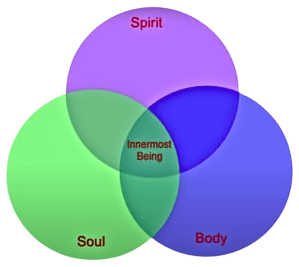
So it is helpful, but that image doesn’t fully capture the reality. It’s more accurate to think of three spheres—spirit, soul and body—that overlap and connect. So rather than seeing these interactions as two-dimensional, we can see our spirit, soul and body as spheres in quantum entanglement—connected in such a way that our spirit can be anywhere and still instantly relate to our soul. There is a place – our innermost being – where all three are connected. That is our core, the centre of our being, where our union with the Father, Son and Spirit takes place.
This video and blog post are taken from Mike’s current teaching series, Restoring First Love. Get the full-length videos every month, ad-free and with many extras, only at eg.freedomarc.org/first-love
Only a trickle
At the core, in our spirit is the glory of God’s presence within the first love gateway. God dwells within everyone, but often that gateway is closed or restricted, with only a trickle of life flowing through—like the stream under the threshold in Ezekiel’s temple. But that flow can increase: ankle-deep, knee-deep, waist-deep—until it becomes an overwhelming flood. This is God’s desire: that we be saturated with His love and presence.
We have the choice to open that gate. It’s a daily decision. In my experience, this daily opening of the first love gate led me into deeper intimacy with God. Often, Father, Son or Spirit—or all three—would embrace me, and that hug would lead me further. The flow would often carry me into my soul.
I walked with Jesus
When I first started engaging with these gates, I walked with Jesus through each one, asking Him to help me understand how I function. We are all different, and the interaction between our gateways is unique. I learned why some of mine were blocked or inactive. For many, the first love gate may appear chained or overgrown, seemingly impossible to open. That image is often a projection of fear or trauma—a deception of the soul. But in truth, the handle is on our side. We can open it.
When opened, the first love gate releases an increasing flow of life—no longer a trickle, but a flood. Most of us have lived on a trickle for too long. This flood can energise us at the core of our being, through the energy gates and the merkabah, leading to a state of immortal life.
Mike’s latest book, Unconditional Love, is out now as an ebook on our website and is available to pre-order in paperback from your local or online bookseller.











 Sons of Issachar