220. Sacrifice, Transformation, Destiny – Redemptive Gifts (4)

Mike Parsons
with Jeremy Westcott

My redemptive gift (Romans 12:6-8) is how am I wired up or made that enables me to engage in the process of restoring creation (Rom 8:19-21).

We have seen that there are both positive and negative potential characteristics that go with each gift. Like me, perhaps you have been wondering why the negatives are there. So I asked God about it. I mean, from our point of view it would be much nicer if everything was just positive, wouldn’t it?

But He reminded me that it is through overcoming things that we mature and grow. That process teaches us to develop and maintain our dependence on Him, as we learn to trust Him and engage with Him. He is with us on that journey which brings us into the image of Christ. Adam was sinless when he was created, but he was not perfected – even if he had not sinned, he would still have needed to mature into the fullness of the stature of Christ (Ephesians 4:13).

We need each other’s gifts so that we learn not to act independently. Other people outworking their gift contribute to helping us outwork our gift, and in a culture of honour, we allow one another to speak into our lives, to encourage and to challenge. That helps us maintain our humility, and stops us being arrogant, or full of ourselves. When we are aware of our weaknesses it becomes very clear that it is not all about who we are, but rather about who God is in us.

Do not focus on the negative

We have looked at the principles and blessings associated with each gift, and at some of the other factors that can influence how our gift works in us. In this post and the next, we are going to look at some of the negatives but it is important to realise from the outset that we can overcome all these things with the virtues that God puts in us and with the blessings inherent in the gifts. Do not focus on the negative but take any issues to God and allow Him to transform you into the image of Jesus. Our series on ‘Transformation’ can help with this process.

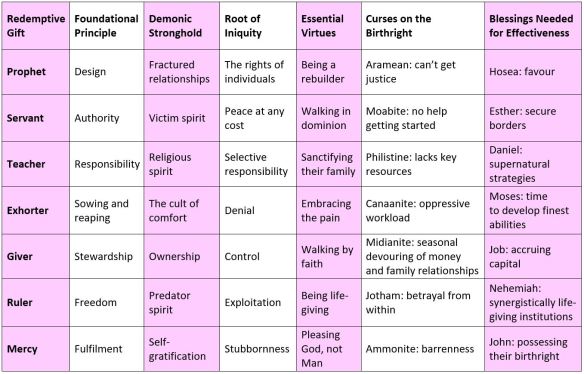
Associated with each redemptive gift are:

  1. a demonic stronghold where the enemy looks to engage,
  2. a root of iniquity, and
  3. curses associated with the birthright.

Below is a table which sets those things out for you, and you may recognise some of them outworking in your life. I am not going to go into detail here, but as I said, please take any issues to God and ask Him to show you how you can be transformed so that they can be overcome.

rg4-table
Click on the image to download this table as a PDF

Note: Arthur Burk has gained a great deal of revelation on this and taught on it much more fully. If you want to go into this more, I would encourage you to seek out his treatment of Redemptive Gifts on YouTube and elsewhere.

Let our spirit rule

We must learn to let our spirit rule over our soul. For years, before we became Christians, our soul ruled. Often it still tries to do so and gets into a mess by trying to use things of the world to meet the needs that God placed in us.

Adam and Eve walked with God in the garden, a picture of intimate relationship. And so in the process of our journey with God, coming into our identity and destiny, we must walk it out relationally with God. He is with us in this process: we are not on our own. We don’t have to do it in our own strength: we do it by surrender.

And He was saying to them all, “If anyone wishes to come after Me, he must deny himself, and take up his cross daily and follow Me” (Luke 9:23). We can allow God to lead and direct us, through the power and victory of the cross, so that we can be like Jesus and outwork all that He has for us.

Sacrifice and surrender

We cannot get around the fact that maturity and transformation come through sacrifice and surrender. We might wish for an easier way, but there isn’t one. If we choose not to sacrifice and surrender to God and allow Him to work it out, then we continually fight against Him and we continually have problems with our soul.

I have been crucified with Christ; and it is no longer I who live, but Christ lives in me; and the life which I now live in the flesh I live by faith of the Son of God, who loved me and gave Himself up for me (Gal 2:20).

Jesus was our example. He loved us and He gave Himself up for us so that we can enter a relationship with Him. And He wants us to do the same – to give ourselves up for Him.

Let’s apply the victory of the cross to our lives, stop living independently, and stop living selfishly. God wants us to be in relationship with Him, which is why we have to go through a process in which our soul gets transformed and changed. This scripture was the basis for the ‘Transformation’ series, so we probably know it really well by now:

Therefore I urge you, brethren, by the mercies of God, to present your bodies a living and holy sacrifice, acceptable to God, which is your spiritual service of worship. And do not be conformed to this world, but be transformed by the renewing of your mind, so that you may prove what the will of God is, that which is good and acceptable and perfect (Rom 12:1).

Right there, that is your destiny; that is your redemptive gift; that is your identity. It comes as you are transformed from the ways of nurture, nature and trauma that the world has imposed on you to come into what God says about you, and having your life operating in the good of that.

So the process is this: Sacrifice > Transformation > Destiny.

Related articles from Freedom ARC
Other resources from Freedom ARC
Recommended resources from Arthur Burk

Support Freedom ARC

'Donate to Freedom ARC' button

Our Patreon patrons give a small amount each month and can join us for our monthly group Zooms, get exclusive or early access to Mike’s teaching and enjoy further patron-only benefits. Or you can use the blue button to contact us about making a one-time gift.
Thank you!
*Note Sadly, because of abuse by scammers we can no longer offer a ‘click to donate’ option. However, if you contact us, we will get back to you with a simple means of giving. 

219. Redemptive Gifts (3) and Other Influences

Mike Parsons – 

Since we have gifts that differ according to the grace given to us, each of us is to exercise them accordingly: if prophecy, according to the proportion of his faith; if service, in his serving; or he who teaches, in his teaching; or he who exhorts, in his exhortation; he who gives, with liberality; he who rules, with diligence; he who shows mercy, with cheerfulness (Rom 12:6-8).

We are continuing to look at the seven redemptive gifts mentioned in these verses: Prophet, Servant, Teacher, Exhorter, Giver, Ruler and Mercy. We receive those gifts at conception, and they affect the course of our lives. But there are other contributing factors that will also influence how the redemptive gifts are expressed in a person’s life.

Parenting

Every child’s parents have their own redemptive gifts, which impact how they view the world and how they raise their children. So the parents’ gifts will leave a very significant imprint on the children, independent of what the child’s own gifts are. Any potential character weaknesses of a parent’s gifting can shape the child as well.

If a child’s parents are servant and exhorter, for example, the child may grow up in a home where the exhorter is financially irresponsible and is living in denial. The servant parent will try to help meet the child’s need, and the child may grow up lacking the knowledge needed to be financially responsible and a good steward of resources, which will be a particular problem if their own gifting is giver!

On the positive side, a child who has the redemptive gift of prophet and is raised by an exhorter will most likely be much more relationally oriented than others with the gift of prophet.

Birth Order

Firstborn children tend to be more driven and perfectionist by nature. Second-born can be competitive or very passive, and the baby of the family is often much more relational and horizontally focused. Being firstborn can intensify all the strengths and weaknesses of any gift (perhaps double the benefit, but also double the challenges).

Maturity

A person’s level of maturity will colour how they live out the characteristics of their redemptive gift at different times in their life. Those who are immature (or those who are not seeking to live in the fruit of the Spirit) will exhibit the weaknesses of their gifts more than the strengths. Whilst none of us has reached perfection, we should all be working on our character issues to grow up to maturity. The recognised weaknesses of our gifting are not an excuse for immature behaviour.

Gender

It is easy to stereotype certain gifts such as prophet, ruler and teacher as being more masculine and servant and mercy more feminine, so that men often reject the idea of being a mercy or servant because they perceive it as being weak. In fact, the gifts of servant and mercy have some of the strongest spiritual authority.

Women with the gifts of prophet and ruler often find it hard to be accepted, validated, and nurtured in a church setting, since the natural boldness and strength of their gifts can intimidate some men who traditionally occupy those roles.

Both men and women need to see the beauty of God’s design, instead of trying to be something other than who God made them to be.

Woundedness

Everyone has experienced painful situations and relationships that have left them wounded. Wounds can change our perception of ourselves and of God.

For example, someone who grew up with an abusive authority figure may become very self-sufficient and independent because they believe they have to make it through life on their own. If they are an exhorter, servant or mercy gift, this will seriously conflict with how God designed them to function.

How we are broken, the pain in our soul, our wrong response to pain, the coping mechanisms, and how we compensate for those wounds will influence how our gift is expressed. Any walls of self-protection we build as a way of surviving painful circumstances may hinder the proper expression of our gifting.

Left-Brain vs. Right-Brain

Whether a person is right-brained or left-brained is an organic issue.

Right-brained people tend to see the whole picture. They are generally more creative and emotional because emotional concepts and messages operate in the right half of the brain. Left-brained people see the various parts, process logically and in a linear fashion, and think more strategically.

Some people have a fairly effective blend between the two sides of the brain and can transition between them with ease, whilst others may be dominated by one side or the other.

Each of the gifts will be expressed differently, depending on whether the person is right-brained or left-brained. For example, a left-brained teacher will look different from a right-brained teacher. Left-brained teachers will enjoy spending hours researching in the lab or in the library, whereas right-brained teachers will flourish in the classroom and light up when their students “get it”.

Prophet and ruler tend more toward being left-brained in their basic God-given essence and expression, whilst the servant and mercy gifts are more right-brained and therefore may tend to be more emotional and expressive through actions, rather than vocally.

Culture and Time Frame

The family, community and time in history in which a person lives can have a radical impact on how they perceive themselves and express their gift.

A woman with a gift of ruler who lives in a culture where women are subservient will likely have a large reservoir of untapped potential if she is not given an opportunity to shine.

Your nation and family of origin also have an impact.

Your family and your community or country have influenced you because of what they needed or what was expected. If you were raised in a nation with a redemptive gift of prophet (such as the United States or Germany), you will have a natural affinity for more of the characteristics of prophet, because it is what your culture affirms and cultivates. But this does not mean that your redemptive gift is prophet.

While we are on that subject, notice that redemptive gifts are not restricted to individuals. Nations, regions, cities and churches have them too. Here are some more examples of the gifts of nations, as identified by Arthur Burk:

England – Ruler
Wales – Exhorter
Scotland – Prophet
Ireland – Teacher
Brazil – Giver
Canada – Mercy
France – Exhorter
Germany – Prophet
India – Servant
Italy – Exhorter
Netherlands – Giver
Norway – Mercy
Spain – Prophet
USA – Prophet

In summary, then, we may not know a particular individual’s redemptive gift, but we can observe the external behavioural characteristics of the seven gifts. We can observe whether someone is quiet or verbally expressive, whether they prefer to work alone or to be in a group, or whether they are task-oriented or relational-oriented. But we need to bear in mind that we cannot always tell just from observation whether what we see is a true expression of their redemptive gift or is being affected by one or more of the influences we have mentioned.

Here again are the links we gave last time, to questionnaires which can help you identify your own primary and secondary redemptive gifts. But before you jump into them, you might like to read what Arthur Burk thinks of tests such as these!

[Please remember that all of these are only indicators which may give different results, and that those results may be skewed because of the ‘other factors’ we have looked at in this post].

Related articles from Freedom ARC
Other resources from Freedom ARC
Recommended resources from Arthur Burk

Support Freedom ARC

'Donate to Freedom ARC' button

Our Patreon patrons give a small amount each month and can join us for our monthly group Zooms, get exclusive or early access to Mike’s teaching and enjoy further patron-only benefits. Or you can use the blue button to contact us about making a one-time gift.
Thank you!
*Note Sadly, because of abuse by scammers we can no longer offer a ‘click to donate’ option. However, if you contact us, we will get back to you with a simple means of giving. 

218. Principles and Blessings – Redemptive Gifts (2)

Mike Parsons
with Jeremy Westcott – 

We saw in the last post that every redemptive gift has a particular principle that operates with it, and a blessing or birthright that goes with it as well.

The ‘principle’ is simply how things are designed to work, or (if you are looking for something more technical) it can be defined as a universal, non-optional, cause-and-effect relationship. The ‘birthright’ or ‘blessing’ is how creation and people are supposed to benefit from our gifts.

Let’s look at the principles and birthrights of each gift in more detail:

Prophet

  • Principle: Design – the art of weaving principles together in order to produce change.

God speaks to prophets before He does anything (Amos 3:7), because prophets are wired to bring about change. The principle of design is foundational to all the other principles. God has called the prophet to study principles (to look at problems and opportunities) and assemble them into sets that produce results.

  • Birthright/Blessing:

The passion of the prophet is to take themselves and others to the outer limits of excellence with God, to explore the boundaries of what is possible (and nothing is impossible with God). The prophet wants to demolish barriers and expand our understanding so that we can go further.

The prophet will display a picture of God so dynamic and real that it moves people out of their comfort zones (which can become prisons) and into a journey that will bring them to fulfilment of all God created them to be.

Servant

  • Principle: Authority.

God gives more spiritual authority to servants than to other gifts precisely because they will not use it for their own ends. They are not infected with the empire-building germ like the other gifts. The servant’s prayers for leaders carry more weight than other gifts.

The servant has the highest level of authority over the Death Spirit in spiritual warfare because God desires to set people free and servants serve the needs of others. God trusts the servant to do only what He has asked them to do.

Authority over land (restoration of ecology) comes naturally to those with a servant gift.

  • Birthright/Blessing:

The servant walks in holiness in their own life. They are willing to embrace a high calling of holiness and bring a sense of purity and cleanliness.

When the servant hears truth spoken it resonates deeply.

The servant has the tenacity to reach out to the wounded and hurting (not limited to, but especially in, family situations).

The servant finds fulfilment in being a life-giver to enable others to do their work.

They provide cleansing and authority to others.

There is a deep desire to empower others to achieve their best.

Teacher

  • Principle: Responsibility

The teacher is to walk in responsibility in every area of their life.

Their highest responsibility is to worship God. They must make worship a lifestyle, that they would anticipate and enjoy being with God.

If the teacher is carnal they will be selectively responsible and unwilling to impose responsibility on others.

The teacher would prefer to work hard at persuading people to change, rather than confronting them (or their behaviour) head-on.

A teacher must realise that their relationship with God is of primary importance, because otherwise they will just be bringing theory. There is no value in expounding theoretical principles to others without having worked them out yourself.

  • Birthright/Blessing: Intimacy

The teacher must know who they are as they walk out God’s will and then reveal the manifest presence of God to the rest of the body of Christ. Again, this must come out of personal experience and not just study. The Lord wants to be present in the life of the teacher, having them experience and celebrate Him.

Exhorter

  • Principle: Sowing and Reaping

Exhorters will use their life experiences to help others: therefore they must embrace pain and suffering. The most difficult area for the exhorter is to suffer rejection. But they must confront sin and be willing to face rejection from within the community without becoming disheartened or taking it personally.

Exhorters must incarnate truth, must live it out, through the authority they receive via their own personal experience. An exhorter who has gone through pain and suffering is well placed to use their own testimony to help others who are experiencing the same.

  • Birthright/Blessing:

Know God personally and experientially, which involves taking some time away from people in order to truly know God and have His authority.

The body of Christ is dependent upon the exhorter becoming all God created them to be; God has called the exhorter to be a world changer!

Giver

  • Principle: Stewardship

The giver knows that God doesn’t want 10% of their finance/assets; He wants everything the giver is and has. This is about establishing relationship so that they are able to release blessing. Money is not the issue, it’s about their relationship with God.

Example: in Job 31:16, Job had an incredible relationship with God, and was a good steward of his money and assets. He walked in high justice, holiness and ethical behaviour in all that he did.

  • Birthright/Blessing:

The blessing for the giver is to release a generational anointing. The giver has the authority to release a generational blessing into their family line and community and be a life-giver through blessing (and again, this is not just about money). Givers have a desire to see others succeed and prosper in fulfilling their destiny; they give to enable others.

The giver is to have a generational worldview – to think long-term.

Example: Abraham received authority from God and passed it on. He changed the world and was considered a friend of God.

Ruler

  • Principle: Freedom

The ruler is to go from bondage to obedience to freedom. But rulers have the tendency to be focused on task and do what’s required – and not walk in freedom. The ruler must learn to walk in spiritual freedom.

Like the giver, they are good at making things happen in the natural, but God wants this to be in the context of total dependence upon Him. The ruler is to be first of all righteous.

  • Birthright/Blessing:

Generational freedom from sin.

The ruler is to release generational blessings into the world and the spiritual realm. The ruler who honours God and goes beyond obedience will possess a high level of spiritual authority. The ruler is called to express that immense authority in the heavens and release it to the generations.

Examples: David, a man after God’s own heart, and Noah.

The ruler must seek God to find out what He has called them to do and then honour Him in walking it out.

No other gift has the spiritual dominion that the ruler has.

Mercy

  • Principle: Fulfilment

By design, the mercy is able to engage spirit to Spirit with God. This is the highest fulfilment for the mercy, who loves intimacy with God. In Hebrew thought, every end is a new beginning, so the mercy needs to find fulfilment – if things are partially done, they struggle.

  • Birthright/Blessing:

The mercy finds fulfilment in God and imparts blessing to others.

As the mercy is sanctified they sanctify their environment (time, people, place) and are able to transform the sinful into the holy.

Where do I fit?

In going through these characteristics, I encourage you to ask ‘Where do I fit?’, ‘What is it that I resonate with when I read these things?’ so that you begin to see how God has made you to be. Some of us may need to stop fighting against these characteristics and embrace them, especially if the way we have been brought up, or other people’s opinions, have caused us to undervalue or even reject them.

Here is a link to a PDF ‘Redemptive Gifts Survey‘ which you can use to help you identify your primary and secondary gifts: http://bit.ly/2gOFX8i.

If you would like more detailed questionnaires which open as Excel spreadsheets and do the calculations for you, you can find examples of those here (#1)  and here (#2).

Please note that Arthur Burk, an acknowledged expert in the field, says that even the best tests he has seen are only about 60% accurate and he declines to use them! So do bear in mind that all of these are only indicators and may give different results. We will look at some of the reasons for this inaccuracy next time.

Appreciate the other gifts

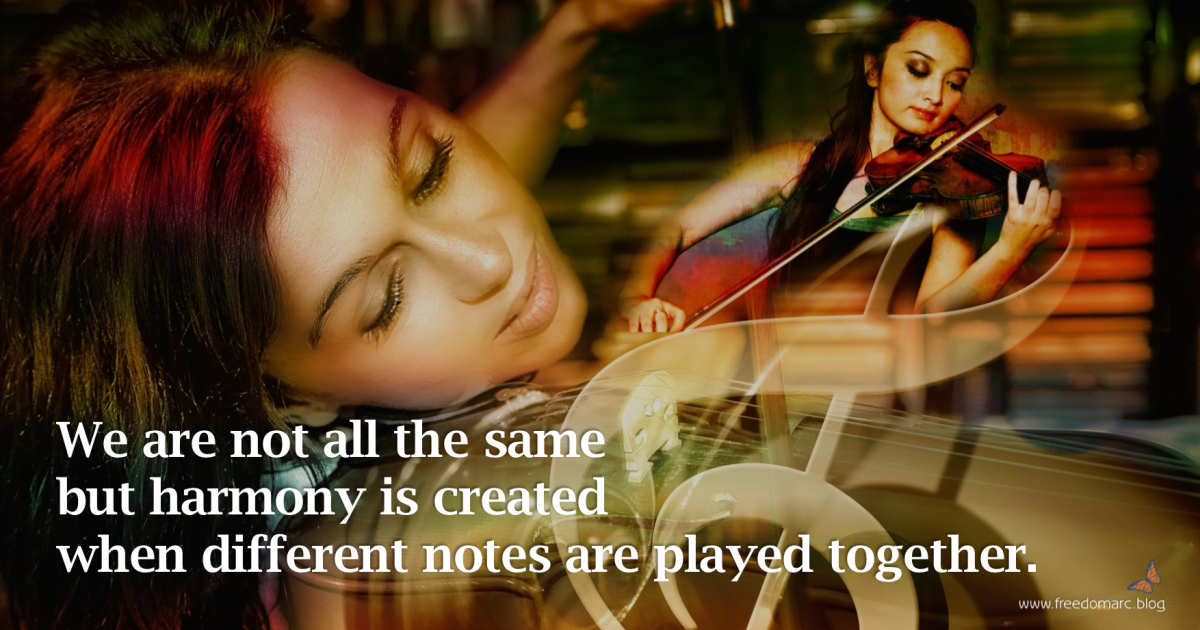
Let’s learn to appreciate our own gifting. And the reciprocal argument is also valid: let’s acknowledge that people with different gifts to us will think and operate in ways we just don’t understand. We need to learn not to be frustrated, but to appreciate them too! This is part of a culture of honour. We will more readily live in harmony if we recognise that God has hard-wired each one of us to respond to Him in a unique fashion. In music, harmony is created when a number of different but related notes are played together to create a really pleasing sound. We are not all the same, but God has called us to relate together.

Getting a handle on this can be really helpful if we are working in a team on any kind of project because we can assign tasks to individuals in line with their gifting – and avoid asking people to carry out tasks for which their gift is not suited. Let’s learn to honour the different gifts in one another and receive the blessing and benefits which those gifts confer.

Yet how many of our churches function in ways that reward those who conform and marginalise those who don’t? How would it be if we were to learn instead to prize distinctiveness rather than uniformity, as God does, and to see how beautiful diversity can be in making us a ‘whole church’?

Related articles from Freedom ARC
Other resources from Freedom ARC
Recommended resources from Arthur Burk

Support Freedom ARC

'Donate to Freedom ARC' button

Our Patreon patrons give a small amount each month and can join us for our monthly group Zooms, get exclusive or early access to Mike’s teaching and enjoy further patron-only benefits. Or you can use the blue button to contact us about making a one-time gift.
Thank you!
*Note Sadly, because of abuse by scammers we can no longer offer a ‘click to donate’ option. However, if you contact us, we will get back to you with a simple means of giving. 

Redemptive gifts harmony

Header meme created using background image ‘Ever Present’  by JD Hancock. Used under Creative Commons licence.
Original image: https://www.flickr.com/photos/jdhancock/5545810212

217. Redemptive Gifts (1)

Mike Parsons

In this series on ‘destiny’ we have looked at ‘who I am’, and it is time now to move on to our redemptive gifts or ‘how I am made’. After that, we will go on to ‘what I am made for’.

And we know that God causes all things to work together for good to those who love God, to those who are called according to His purpose (Rom 8:28).

If we want things to work together for good (and not just our own good but for the good of everything and everybody), then we really need to know that we are called and that we have a purpose.

  • Do you know His purpose for your life?
  • Have you accepted His call?

His purpose and His call will work together to enable us to see our lives outworked for the glory of God and bring transformation to this earthly realm. If we know His purpose for our lives and know what He has called us to, both in this realm and in heaven, that will enable us to be a gateway of heaven on earth.

Transformed or conformed?

‘A redemptive gift is the grace of God woven into who we are; that when we are made right with God we become able to honour Him with how He has made us to be’.

Sadly there may have been other threads ‘woven into us’ which have affected us negatively.

And do not be conformed to this world, but be transformed by the renewing of your mind, so that you may prove what the will of God is… (Rom 12:2).

God’s will is for an open heaven over us, for us to engage with the Father, Son and Holy Spirit in intimacy, and for that, we need to be transformed (not conformed). The world wants to conform us to a particular pattern and rob us of what God intends us to have and experience.

The world may have masked, damaged or perverted our identity, our gift and our destiny, because of our own experience and that of our generations. If we don’t know who we really are we will forever be asking ‘where do I fit?’ and ‘where do I belong?’

God desires to transform us to outwork who we really are, in His service. In that way, we will be able to fulfil our part in restoring the whole of creation.

Redemptive gifts

Redemptive gifts are different from the spiritual gifts of 1 Corinthians 12 (healing, words of knowledge, wisdom, distinguishing of spirits, tongues etc.), and from the offices appointed for the church in 1 Corinthians 14 (apostle, prophet, teacher, miracle worker etc.), and from the ministry gifts of Ephesians 4 (apostle, prophet, teacher, evangelist, shepherd).

Redemptive gifts are found in Romans 12.

Since we have gifts that differ according to the grace given to us, each of us is to exercise them accordingly: if prophecy , according to the proportion of his faith; if service, in his serving; or he who teaches, in his teaching; or he who exhorts, in his exhortation; he who gives, with liberality; he who rules,  with diligence; he who shows mercy , with cheerfulness (Rom 12:6-8).

There are seven different gifts, and these are given to ‘each of us’, which leaves nobody out. We are to line up with what God has given, rather than what the world has attempted to impose on us. Each of us is to exercise the gift(s) He has given us; as we do we are to be that gift to the rest of the body.

The seven gifts are prophet, servant, teacher, exhorter, giver, ruler and mercy.

Paul writes that faith is intrinsic to being a prophet and that a servant will actually serve (you cannot be a servant in theory). The same with teacher and exhorter – it is only in teaching or exhorting that they express themselves. The next three are interesting. ‘With liberality’ describes how a giver gives. ‘With diligence’ describes how a ruler rules. Finally, mercy operates ‘with cheerfulness’, indicating that the mercy gift may perhaps struggle to be cheerful. We will look at each gift in more detail in coming posts.

Why ‘redemptive’ gifts?

For the anxious longing of the creation waits eagerly for the revealing of the sons of God. For the creation was subjected to futility, not willingly, but because of Him who subjected it, in hope that the creation itself also will be redeemed from its slavery to corruption into the freedom of the glory of the children of God (Rom 8:19-21).

Everything God created, both in the spiritual realm and in the physical realm, is waiting for God’s sons to be revealed, and to bring back to creation what is missing. So ‘creation itself will also be redeemed’, and we are called to be part of God’s plan to do that. That plan includes the gifts God has given us, and when we discover who we are then we can discover how we fit into God’s overall purpose. The way we are wired and designed enables each of us to fulfil our destiny and engage in the process of restoring creation.

Redemptive gifts are dealt to each person in differing measures of faith.
God gives people as the different gifts.
God gives these gifts as necessary to fulfil his redemptive will on earth.
Each of us is a gift, differing according to the grace given to us by God.

Each person is and has a primary gift, but will have others as well, and the mix and degree of the various gifts in each of us is a unique combination.

Received at conception

“Before I formed you in the womb I knew you, And before you were born I consecrated you; I have appointed you a prophet to the nations” (Jeremiah 1:5).

Redemptive gifts are received at conception, rather than salvation. We are born with them and they will influence the course of our lives, regardless of whether we become Christians or not (though they will be more effectively expressed if we do). Psychologists term these differences in people ‘basic temperaments’ or ‘personality types’.

We are designed on (and with) purpose.

Redemptive gifts tend to shape our personality. They also affect the way in which we may receive or express one or more of the spiritual gifts, offices or ministries.

So my redemptive gift is how I am intrinsically made to function, ideally with spirit and soul in harmony. But because of separation from God, my soul or heart personality traits developed independently of my spirit. I need to discover the gift, then purify and refine the heart to define and polish it, so that it begins to shine.

There are some common behavioural characteristics which can help us identify our redemptive gifts (primary and secondary). Compassion, for example, may come more easily to servants and mercies than prophets and rulers. However, we must not use our gift as an excuse for not growing in love! We are all called to walk out the fruit of the Spirit, whether it comes naturally or not.

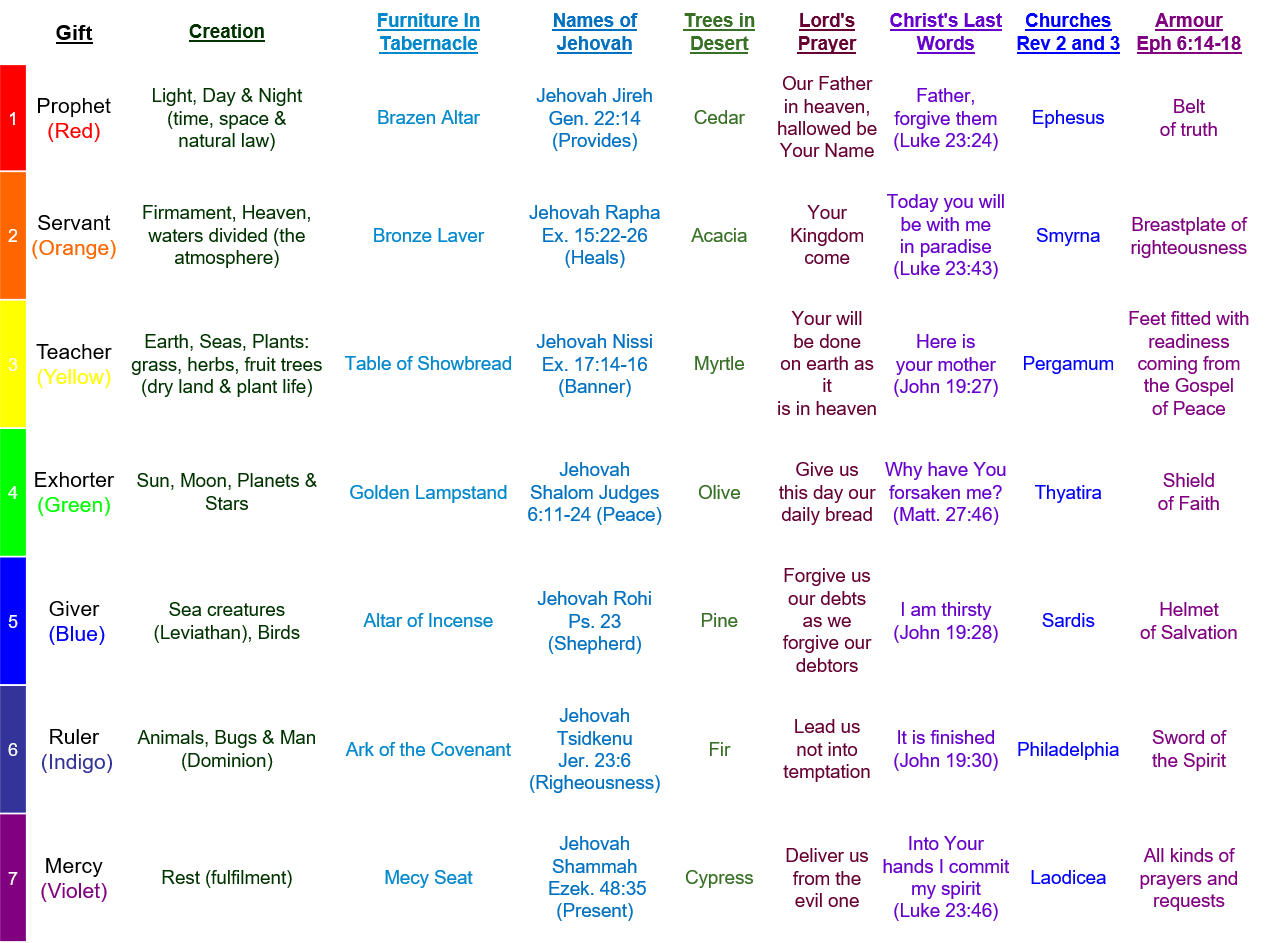
Arthur Burk has done a great deal of research into redemptive gifts. Here are some of the characteristics he has identified and how he correlates them with other sevens in the Bible (click here or on either image to view or download them both in one PDF file):

slide-1-hd
slide-2-hd

God is your Father and designer, and He desires to call forth your identity as His child. He desires to reveal your redemptive identity. He wants you to know who you are and how you are designed. You are called to be a world-changer.

As you exercise your own gifting you are free of the need to compare yourself (favourably or unfavourably) with anyone else. You can be comfortable in your own skin, not having to try to be like other people.

You are you.

You are unique;
Everyone else is also unique.

You are messed up in some way;
Everyone is messed up in some way.

You are a mixture;
Everyone is a mixture.

Every one of us is in the process of being refined, purified and transformed so that we can be ‘us’ as designed by God.

We must learn to respect and honour the differences and uniqueness in each other. As members of the body we will not all see things the same way, but when we put it all together we (as a body) will see things as Jesus does.

Next time we will begin to look at each of the gifts in more detail.

Related articles from Freedom ARC
Other resources from Freedom ARC
Recommended resources from Arthur Burk

Support Freedom ARC

'Donate to Freedom ARC' button

Our Patreon patrons give a small amount each month and can join us for our monthly group Zooms, get exclusive or early access to Mike’s teaching and enjoy further patron-only benefits. Or you can use the blue button to contact us about making a one-time gift.
Thank you!
*Note Sadly, because of abuse by scammers we can no longer offer a ‘click to donate’ option. However, if you contact us, we will get back to you with a simple means of giving. 

216. Twelve Steps to an Orphan Heart

Mike Parsons – 

We are coming into a revelation of who we are as sons of God, and learning how to live out of that revelation. But if instead, we listen to the whisperers, the familiar spirits which empower demonic strongholds and mindsets, then we can find ourselves on a downward spiral.

12 steps to an orphan heart

Humans are designed to be survivors. We develop coping mechanisms and protection mechanisms – layers, walls or skins that we believe keep us safe. But they quickly become behavioural blind-self prisons, and they are stumbling blocks to our destiny.

How does a slavery mentality or an orphan heart form?

  • Nature – we can inherit it genetically from previous generations.
  • Nurture – upbringing, parental and relational influences. Words, attitudes and treatment can have a powerful effect on how we see and think about ourselves.
  • Traumatic events.

And we too can pass it on in our DNA to future generations. In the field of epigenetics, scientists are showing that genetic material can change, even within a single generation.

Here are the 12 steps:

  1. We are affected by faults in parental activity.
  2. We receive parental faults as disappointments, discouragement, grief, rejection or insecurity.
  3. We develop unmet needs and coping mechanisms.
  4. We move into the fear of receiving love, comfort and admonition from others.
  5. We develop a closed heart.
  6. We take on an independent, self-reliant attitude.
  7. We start controlling our relationships.
  8. Our relationships become superficial.
  9. We develop an ungodly belief that says no-one will be there to meet our needs.
  10. We begin to live life like a spiritual orphan.
  11. We begin chasing after counterfeit affections.
  12. We begin to daily battle a stronghold of oppression.

Counterfeit affections

Depending on individual circumstances we may have extreme or mild symptoms. But we are all born with a sense of separation from God, so our souls have unmet needs and an emptiness that must be filled. Until we come to a full revelation of being truly loved and accepted in God, the counterfeit affections we seek include:

  • Passions – addictions – food, alcohol, drugs, sex, pornography, escapism etc. – comforts for our needy hearts.
  • Possessions – security in materialism.
  • Performance – perfectionism, doing things to prove or feel better about ourselves.
  • People – looking to people to meet our needs as substitutes for God – whether being people-pleasers or abusers.
  • Places – needing somewhere better to be happy – wanderlust, looking for home.
  • Position – striving for acceptance and approval, especially from significant others, including God: praise of man.
  • Power – seeking to control life and our own destiny by controlling emotions, people, or circumstances so as never to be hurt or disappointed.

We have all tried these things, and we know they do not work. Only God can truly meet our needs. So how can we get free of this bondage?

We have a 20-part series on Transformation which will certainly help!

We need healing from our wounds. We need to surrender our defences and be willing for those coping and defence mechanisms to fall away. We need to experience the reality of being redeemed, reconciled and restored to our relationship with God. We need to open our hearts to God as our Father and receive His adoption, acceptance and affirmation. Nothing and no-one can replace our Father God, He wants us to receive our security and acceptance in the fullness of relationship with Him.

We need to desire an intimate relationship with God where trust develops; to pursue Him – to ask, seek, knock, as Jesus taught (and it takes persistence to overcome the obstacles). Let’s give Him our first love, give Him our priority time, and then we will get to know Him personally and feel His great love for us by experience.

Love languages

God desires to father us in such a way that we know we are truly loved as individuals. We are not just a ‘job lot’. We all have different love languages – the way we feel love is different. Our particular love languages may correspond to our different gift types or unmet needs. We need to find out which is ours:

  • Gift-giving
  • Quality time
  • Words of affirmation
  • Physical affection
  • Acts of service

Our love language with God may be different from the one we have in our natural relationships. It took me a long time to realise it, but quality time is my spiritual love language. Father God sharing revelation with me of His heart, mind, purpose, and word is what makes me feel loved, valued and appreciated. I am unique, special, and He fathers me uniquely, according to my destiny.

At one time we were ‘alienated and hostile in mind’ (Col 1:21), feeling separated and orphaned from God, and separated from our souls and bodies, and from our heavenly home too. That was the ‘reality’ we lived in until we realised the truth that we were included when ‘God was in Christ reconciling the world to Himself, not counting their trespasses against them’ (2 Cor 5:19). The spirit was orphaned and the soul, therefore, had a slave mentality.  Satan was the first orphan spirit, and therefore disunity, disharmony and division is always his goal.

Meeting our soul’s needs

We have seen this diagram before:

orphan1

Our soul has natural needs but is accustomed to living in separation from God and from our spirit. Our body (flesh) reaches out to the world looking for love, acceptance, security, significance and purpose – it does not know where else to look. That causes damage (including hurt, pain, rejection, insecurity, fear, disappointment, guilt and shame).

orphan2

When we realise we are born again and our spirit is brought back to life, we then have access to the fountain of living water that is within us. We can find love, acceptance, security, significance and purpose in God and in our relationship with Him. We are connected to the source of life. So when we go through a process of transformation, in which we are restored and renewed to God’s original intended condition, we have this tension between how we have learned to meet our needs when disconnected from God and how we now know we can get those needs met in Him. After years and years of following the flesh, this is a battle we must persevere in and win. Once we learn to be cut off from the world, then we can be healed, restored and ultimately transfigured, so that the flow of life from heaven goes through our spirit, soul and body out to the world. We will begin to manifest God’s glory, His presence and His power to change the world in which we live.

We are supposed to be world-changers. It was always our destiny to bring God’s dominion and His blessing to the earth. But to fulfil that destiny we need to be willing to persevere and go through this process.

In Genesis 2 God said that it is not good for man to be alone, and that is because relationship is key to reflecting heaven on earth. Relationship is at the core of the life of the Triune God, Father, Son and Holy Spirit. God’s desire is for man to experience being joined, reunited, reconciled, and restored to Him in relationship. That is why unity is so important, as we see the early church of one mind, one heart, in one accord. They were together in their love for and their pursuit of God, and they changed and transformed their world.

Centre of our being

Here is another familiar diagram, representing the gateways in our spirit, soul and body.orphan3

But we have a black hole on the inside which absorbs everything, lets nothing in and nothing out, until we experience relationship with God through Jesus. Then we can connect with God’s glory and His Presence in the very centre of our being (see the next two images), so we can engage with God in our spirit. However, for far too many believers God is locked away in there.

orphan5
‘Gateways’ by Adam Butterick (Vimeo video). Click the image above to play (opens in new tab).

One spirit with Him

“But the person who is united (joined) to the Lord becomes one spirit with Him” (1 Cor 6:17).

That is God’s intention, that we become one spirit with Him by being joined or united to God. We do that by opening up our first love gate because that establishes a reconnection between our spirit and the Father and heaven. It also reconnects our spirit to our soul and body, so that we become one, holistic, unified piece. God’s desire is for us to be whole, that we would be completely reconnected to everything, to have the relationship with the Father and the Son that our spirit was designed to have in eternity.

Our spirit will be orphaned unless it finds its home with the Father and in heaven and God finds a home in us, which connects it all back together.

I encourage you to look at this picture right now, at the First Love door in the centre. Behind that door is the presence of God, the glory of God, God Himself. This is in the midst of your spirit.

orphan6
‘Gateways’ by Adam Butterick (Vimeo video). Click the image above to play (opens in new tab).

“Behold, I stand at the door and knock; if anyone hears My voice and opens the door, I will come in to him and will dine with him, and he with Me” (Rev 3:20).

That is an invitation to relationship, fellowship and intimacy. It is an invitation to all – whether or not we call ourselves ‘Christians’. Maybe you have never opened that door. The handle is on our side, so we have to open the door. Will you open that door today? Will you become joined and reconnected to God today?

Open the door

Close your eyes and imagine this picture in your mind’s eye. There is a door, and behind it is God: His love, His acceptance, His affirmation. If you have never opened it before, you can do so now. You can say, in your heart, “I open that door to you, God. I choose to let you into my life. I choose to receive Your love. I choose to follow you and become Your disciple. I choose You.”

I encourage you, open up the door of your life to God. He is knocking, wanting relationship with you so that you can begin this journey from slavery to sonship, this journey of intimacy with God. Meet Jesus, meet the Father, meet the Holy Spirit; hear what they say to you.

Now for those who have done this before, maybe you too are feeling separated, distanced from God? Again, just open up that door right now, because Jesus is the source of life, and start drinking from the river of life that begins to flow. Get into that river of living water, allow it to envelop you. As you open the door, feel His love, feel His embrace, feel the joy that comes from His heart to you. Jump in the river. Let the energy of that source of life begin to flow in you, becoming rivers of living water, ready to flow out of you. Just spend some time there, if you just need that refreshing, enjoy the feel of His arms around you.

Perhaps you are used to opening this door, and you want to go further, then you can walk through the open door and follow that river back into heaven. You can get into the river of life there and follow it back to its source at the throne of grace, back to the Tree of Life, back to the garden of God. The atmosphere of heaven is the breath of life, the glory of God is the oxygen of heaven. You can experience Him in the realms of heaven because you have opened that door and it becomes a two-way flow of life.

Meet the Father today.

Wherever you are in your journey, just spend a few minutes today in the presence of God, in your own heart or in heaven, experiencing His presence and receiving His love and affirmation. Receive His acceptance. Hear these words of affirmation from your heavenly Father.

I love you, my child. Receive My words of affirmation.
I accept you. I affirm you. I embrace you.
Receive My peace. Receive My love.
Return to me. Return to your heavenly home. Return to the intimacy of relationship.
I love you.

Related articles from Freedom ARC
Other resources from Freedom ARC

Support Freedom ARC

'Donate to Freedom ARC' button

Our Patreon patrons give a small amount each month and can join us for our monthly group Zooms, get exclusive or early access to Mike’s teaching and enjoy further patron-only benefits. Or you can use the blue button to contact us about making a one-time gift.
Thank you!
*Note Sadly, because of abuse by scammers we can no longer offer a ‘click to donate’ option. However, if you contact us, we will get back to you with a simple means of giving. 

215. Revealing the Sons of God

Mike Parsons

We are all on a journey from slavery to sonship, and those two conditions are very different. Slavery breeds a poverty spirit, fear and lack of identity; sonship breeds faith, identity, resources and responsibility.

Empower a slave and it leads to rebellion, betrayal and treason, as with Israel in the wilderness. They were given freedom and responsibility, but they showed no loyalty to God or to Moses because they still had a mindset of slavery (see Exodus 15-17, 32, Numbers 21). On the other hand, restrict a son and it will hinder creativity. When someone knows who they are, God can inspire them to release their own creativity into His creation.

So we have to be careful not to empower people who don’t know who they are nor to restrict those who do. We need to put things in place which will help sons come into the fullness of sonship and to deal with any slavery mentality they may have.

The spirit of slavery vs the spirit of sonship.

The root issues of how we think are in our hearts, not our heads. To use a computer analogy, the heart is like the hard drive and the head is like the Random Access Memory (RAM): things get loaded from our heart into our conscious thinking and then we act out of them.

Our characteristics and behaviour will help us identify to what extent we are acting out of a spirit of slavery and to what extent out of a spirit of sonship. Almost none of us will fall completely into one category or the other. A spirit of slavery is often the product of poor nurture, unhealed wounds and brokenness in our own lives, but it can also be generational: particular ways of thinking handed down to us from previous generations.

We are going to look at a number of areas. It’s important to be honest with ourselves, not asking ‘how ought I to think?’ but ‘how do I in fact think?’ And please, let’s use this as a tool to assess our own condition, not to label or judge anyone else!

In the tables below, you will see a category in the centre column, and on either side of it, the characteristics typical of slaves and sons. You can download these tables as a PDF file to save or print if you wish.

slavery #1 Slavery #2 Slavery #3 Slavery #4

An opportunity to be transformed

Spend some time working through this. Use these checklists to ask yourself: “do I have more thinking on the left side as a slave or more on the right side as a son?” Then you will get an idea of where you are on this journey. Allow the Holy Spirit to bring conviction, so that you can change.

If you recognise demonic strongholds in your thinking, see it not as a criticism but as an opportunity to be transformed. Those strongholds are defended and empowered by familiar spirits – spirits that are familiar with your mindsets, your patterns and ways of thinking – and they constantly seek to ensure that you continue to think that way. Continuing in that way of thinking only results in continuing to demonstrate the same patterns of behaviour, or worse, a downward spiral that leads to an orphan heart, shaping us and blocking our destiny.

But God wants to do something about it. He is only showing you any slave-mentality you may have so that He can free you from it and enable you to think and act more and more like a son. Access to heaven and heaven’s blessing, heaven’s authority and heaven’s power all come from knowing who we are as sons.

In the heavenly realms we have places of authority that God has destined for us: mountains with thrones that God is calling us to possess. We can only possess them when we come into maturity (see Gal 4).

What do we do?

When we recognise that our mindset is not right, we:

  • forgive and release those whose words and deeds have resulted in us being the way we are. We don’t rationalise it away. We see that it happened and had an effect on us, and forgive and release them.
  • own the way of thinking or the behaviour. We don’t make excuses for it, it is sin to think like a slave when God has said you are a son, and if you don’t treat it as sin you will most likely carry on and be comfortable with thinking that way. Confess it, renounce it, repent of it (turn from it and turn to the truth). Take it to the courts, if you know how to do that, and get divorce papers which enforce separation from that way of thinking and behaviour.
  • meditate on the truth of God’s love for us and his acceptance of us. Meditate on the destiny He has for us. Get these things into our spirit by experience and encounter so that they become the basis of how we live. This is not an instant fix – it takes time.
  • attack the familiar spirits. Don’t let them lie to us and whisper into our minds. Take captive every thought. Deal with the thoughts that come, don’t entertain them and allow them to take root. Challenge them! We must be very careful about what is coming out of our mouth, not saying negative things that line up with the spirit of slavery. Speak out the truth.
  • get help if we need to. If we cannot deal with familiar spirits ourselves, we enlist the help of someone else who can minister deliverance to us. We may need healing from a wounded heart, and someone to minister that healing if we are not receiving it on our own.

Then we can be restored, and come back into a place of peace and rest, knowing who we are as children of God, knowing God’s love.

He really wants us to know our identity as His sons, and to renounce our slavery and orphan mentalities. He wants us to receive our security and acceptance from Him. Then we will be manifested as sons on the earth, to bring the whole of creation back into alignment with God’s eternal intentions before Satan fell.

For the anxious longing of the creation waits eagerly for the revealing of the sons of God (Romans 8:19).

That’s us!

Related articles from Freedom ARC
Other resources from Freedom ARC

SoundTrack: Identity in A (SML Music) – Engagement and meditation music composed and performed by Samuel Lane.

Support Freedom ARC

'Donate to Freedom ARC' button

Our Patreon patrons give a small amount each month and can join us for our monthly group Zooms, get exclusive or early access to Mike’s teaching and enjoy further patron-only benefits. Or you can use the blue button to contact us about making a one-time gift.
Thank you!
*Note Sadly, because of abuse by scammers we can no longer offer a ‘click to donate’ option. However, if you contact us, we will get back to you with a simple means of giving. 

214. The Hearts of the Children

Mike Parsons

Our fathers were unwilling to be obedient to him, but repudiated him and in their hearts turned back to Egypt (Acts 7:39).

A whole generation saw their home as Egypt and not the Promised Land, because they saw themselves as slaves, not sons. How do we see ourselves? Are we looking to our past to define us, or are we believing what God says about us and looking to our future? The fact is, we tend to look the way we’re going and go the way we’re looking.

Generations of slaves

They were generations of slaves. They had no understanding of freedom, and no understanding of godly leadership – they had to do what the taskmasters told them to do. They had no connection to God as Father, and had lost sight of their covenant family identity from Abraham, Isaac and Jacob. They had no sense of belonging, no sense of heritage, no sense of purpose. They had riches, because they came out with the gold of Egypt, and yet they had no wealth. Money does not bring happiness or fulfilment, and it does nothing to root out an underlying poverty mentality or an orphan spirit.

They had no loyalty either to God or to Moses, no faith or trust in God, and as a result they all died in the wilderness except Joshua and Caleb – including Moses himself. Joshua and Caleb had a different spirit, and a different relationship with God. They knew him as Father and were able to enter in, taking the next generation in with them.

Turn our hearts

He will restore the hearts of the fathers to their children and the hearts of the children to their fathers, so that I will not come and smite the land with a curse (Mal 4:6).

God’s desire is to turn our hearts back to our Father in heaven, and to see that His heart is for us. This is a fatherless generation, a strategy of the enemy to steal destiny by separating and removing fathers from their families, but we do not have to be part of it. We do not need to have an orphan spirit.

  • Orphans have no parents
  • Orphans have no inheritance
  • Orphans have no home
  • Orphans have no connection to heritage
  • Orphans think like slaves

A son or a slave?

Let’s ask ourselves, do we think and act like a son or a slave? It may not be black-and-white: perhaps sometimes we think and act like sons but then slip back into thinking and acting as slaves. De we identify with slavery or sonship? Do we know our identity as a son, our royal identity as a son of the king?

God wants to heal your father- (or mother-, or other relationship-) wounds. He wants to remove the scars that are on your life. He wants you to have a home in Him. He wants you to know you are adopted, accepted, and loved. He wants you to know and fulfil your destiny.

Will you allow God to be your Father? Or will you allow your relationship with your earthly father to rob you of that intimacy?

Will you trust Him with your heart? If your heart has been damaged, if you have been betrayed, disappointed, let down and hurt, then it is no small thing to trust someone with your heart again (even if that someone is God). It is a choice, and a choice that comes with risk attached.

Will you allow him to deliver you from an orphan spirit? Will you lay down your old natural identity? Will you pick up your new supernatural identity?

Stand and speak

If you will, then stand and speak these declarations out loud (if you can’t do that now, please be sure to come back and do it later, because speaking these things out carries power). When we have made these declarations, God is going to minister to us and speak to us in our hearts.

I choose to lay down my old identity as an orphan and slave
I choose to turn away from my past
I choose to forgive and release my earthly father for not representing true fatherhood to me
I choose to look to my heavenly Father for my acceptance

I choose to let go of rejection, fear and insecurity
I choose to embrace my destiny
I choose to give my heart to You, Father, afresh today
I choose to allow you to heal, deliver and restore me.

Now receive what God is going to do for you.

In the authority you have released I loose each person who made those declarations from an orphan spirit and a spirit of slavery and a spirit of rejection. I pray for the power of the anointing of the Holy Spirit to break those yokes, destroy those burdens and loose them from the control of their mind, their emotion and their will, from that orphan spirit and that spirit of slavery.

I loose them from it in Jesus’ name, in the power that Jesus is releasing today under an open heaven.
I bind each of them to their full destinies in heaven and on earth as sons of God

Now I want you to close your eyes for a few moments and see with the eyes of your heart the scars that may be over your heart from the past. You may picture them, you may feel them, or just sense that they are there.

Now hear the voice of Father God speaking to you and to those wounded areas of your heart. And this is what God says to you:

‘I love you my child – I love you, I love you.
I love you my child – I love you, I love you.
I love you my child – I love you, I love you’.

Over and over, hear Him repeat those words. Allow His words of love and acceptance and affirmation to heal the wounds and remove the scar tissue from your heart.

I release the angels, release the Holy Spirit’s presence and power, to bring that healing oil to heal the wounded hearts. Receive the love of God, receive the Father’s embrace, as He says:

‘I accept you as my child
I affirm who you truly are
I call out your spiritual identity as my son
I invest you with the authority as a prince (or princess) to subdue, rule, and manifest My kingdom on earth as it is in heaven’.

Receive that into your spirit. Let your spirit embrace and begin to expand and grow and mature. Let it bring God’s blessing into your life.

Receive a revelation of who you truly are as a son of God, and allow Him to continue that process of conforming you into His image, into the image He always had of you from eternity, into the image of Jesus. A son of God, taking up the full responsibility of who you are in the heavens and on earth.

God’s desire is for you to truly know that you have a home, that you have a family, that you are accepted, that you are loved.

Related articles from Freedom ARC
Other resources from Freedom ARC

SoundTrack: Identity in A (SML Music) – Engagement and meditation music composed and performed by Samuel Lane.

Support Freedom ARC

'Donate to Freedom ARC' button

Our Patreon patrons give a small amount each month and can join us for our monthly group Zooms, get exclusive or early access to Mike’s teaching and enjoy further patron-only benefits. Or you can use the blue button to contact us about making a one-time gift.
Thank you!
*Note Sadly, because of abuse by scammers we can no longer offer a ‘click to donate’ option. However, if you contact us, we will get back to you with a simple means of giving. 

213. Embrace the New!

Mike Parsons

Moses had an orphan mentality. Imagine what it was like for him, growing up in Egypt. He didn’t look like one of them, didn’t feel like one of them, and probably got sick of hearing the story of how he was found floating in a basket. Apparently abandoned by his parents, he was adopted by the Egyptian royal court, adopted by an enemy system, and he was even a prince within it. Many of us have sought for success in the world’s system, and maybe even been quite successful, but it will never satisfy our eternal destiny. At the age of 40, something rose up in him, calling him to his destiny, but we saw last time how he tried to do it his own way, failed spectacularly, and ran away into the wilderness.

The wilderness prepared Moses for his future, and after another 40 years God called him again to embrace his destiny. His natural identity was as a shepherd, looking after sheep in the wilderness for his father-in-law. Sheep are really awkward and certainly do not always readily go where you want them to, which meant he was well prepared to lead a bunch of obstinate, ill-tempered, quarrelsome people through the wilderness into the Promised Land.

But when he met God at the burning bush, God took something from him: his badge of office and all-purpose tool-of-the-trade, his staff. His natural identity as a shepherd was stripped away from him, and he was given a new, supernatural ‘shepherd-identity’. No longer an orphan or a slave, no longer a success in the systems of the world, instead he was to be the deliverer for a nation. But Moses still had issues.

Let go of the old, embrace the new

Now God was asking him to lay down that symbol of his natural abilities and identity – not just a staff but all it represented: his job, his well-being, his financial welfare and his future. That was the choice he faced.

When he picked it up again, it had become a powerful symbol of all that God was going to do through him. He used that staff supernaturally in the years that followed – he threw it on the ground and it transformed into a snake (Exodus chapter 4); he used it to split the Red Sea (Ex 14:16), to bring water from a rock (Ex 17:6), and throughout Israel’s wilderness journey.

But he had to choose to let go of the old, and embrace the new. It is a choice many of us have to make. Even when we become Christians, we still face that ongoing choice: am I going to do things my way, or God’s way? And your own way never works – you feel uncomfortable around ungodly people and uncomfortable with God – you have one foot in one camp and one foot in the other.

Who am I?

But Moses said to God, “Who am I, that I should go to Pharaoh, and that I should bring the sons of Israel out of Egypt?” (Ex 3:11).

Moses began to reject his destiny, to avoid doing what God was calling him to do. God was going to use his position and experience, but Moses didn’t think much of God’s HR skills. And ‘who am I?’ – well, he was a prince of Egypt, so naturally speaking he was well-placed for the task God was giving him, but he didn’t want to do it. Certainly he had things in his past which were holding him back, but God is always ready to deal with issues like that. Unlike Moses, let’s not allow our past to spoil our present and hinder our future.

Here am I – send somebody else!

Then Moses said to the Lord, “Please, Lord, I have never been eloquent, neither recently nor in time past, nor since You have spoken to Your servant; for I am slow of speech and slow of tongue.” The Lord said to him… “Now then go, and I, even I, will be with your mouth, and teach you what you are to say.” But he said, “Please, Lord, now send the message by whomever You will.” (Ex 4:10-13).

Either he was unaware of his own abilities, or he was lying to God to try to get out of his destiny (the New Testament tells us “Moses was educated in all the learning of the Egyptians, and he was a man of power in words and deeds” (Acts 7:22)). And finally he asked God to please send someone else! But God swept aside all his objections and every obstacle he tried to put in the way, eventually agreeing to send Aaron to speak for him.

God wants to set us free

God is calling each of us to embrace who we really are and what He has called us to do. He wants to set us free from everything that would seek to hold us back from fulfilling our destiny: our mind-sets, our slavery mentality, any way of thinking that prevents us knowing who we truly are as His sons.

This Moses whom they disowned, saying, ‘Who made you a ruler and a judge?’ is the one whom God sent to be both a ruler and a deliverer with the help of the angel who appeared to him in the thorn bush. This man led them out, performing wonders and signs in the land of Egypt and in the Red Sea and in the wilderness for forty years. (Acts 7:35-36).

How many of us have felt rejected, even disowned, as Moses was? Yet God called him to be exactly what others failed to recognise in him, and even sent an angel with him for the rest of his life to ensure that he accomplished everything He intended for him. And we, too, have angels assigned to us, ready to supernaturally help us fulfil our destiny.

Familiar slavery

All the sons of Israel grumbled against Moses and Aaron; and the whole congregation said to them, “Would that we had died in the land of Egypt! Or would that we had died in this wilderness! Why is the Lord bringing us into this land, to fall by the sword? Our wives and our little ones will become plunder; would it not be better for us to return to Egypt?” So they said to one another, “Let us appoint a leader and return to Egypt” (Num 14:2-4).

God does not want us to miss out on receiving our full inheritance because of the issues in our lives. He wants us to deal with them. Israel saw God come down on a mountain; the Red Sea part (and close behind them, drowning their pursuers); clothes and sandals not wear out; food provided for them every day; and water spring from a rock (twice). Yet they still felt like slaves, and they wanted to go back to the ‘comfort’ of their familiar slavery instead of going in to possess the inheritance God had lined up for them. They continually rejected Moses’ authority, grumbling and complaining.

Robbed of his destiny

That rejection eventually caused Moses to react out of his insecurity. Instead of speaking to the rock (a further dimension of the supernatural that God was calling him into), he went back into his own familiar comfort zone and struck it instead. As a result, he missed out on leading Israel into the Promised Land, and there is no record of him ever doing another miracle.

Moses allowed his need for acceptance and approval from people to rob him of his full destiny. Little wonder, then, that those he led also allowed their issues to rob them of their own inheritance and destiny by refusing to go into the Promised Land.

It is possible to perform amazing miracles and enjoy remarkable encounters with God, and yet still miss out on the fullness of our inheritance. Instead, let’s allow God to reveal and deal with our issues, to heal us of past hurts and transform us into the image He has of us from eternity past.

Search me, O God, and know my heart;
Try me and know my anxious thoughts;
And see if there be any hurtful way in me,
And lead me in the everlasting way
(Psalm 139:23-24).

Related articles from Freedom ARC
Other resources from Freedom ARC

SoundTrack: Identity in A (SML Music) – Engagement and meditation music composed and performed by Samuel Lane.

Support Freedom ARC

'Donate to Freedom ARC' button

Our Patreon patrons give a small amount each month and can join us for our monthly group Zooms, get exclusive or early access to Mike’s teaching and enjoy further patron-only benefits. Or you can use the blue button to contact us about making a one-time gift.
Thank you!
*Note Sadly, because of abuse by scammers we can no longer offer a ‘click to donate’ option. However, if you contact us, we will get back to you with a simple means of giving. 

212. Who We Really Are

Mike Parsons

We are on a journey from slavery into our full inheritance as children of God. Even as natural children, we start out as babies, infants, and coming into maturity is a process that takes time and perseverance. Yet God has always intended us to have a relationship of intimacy with Him, our Heavenly Father: and He wants to embrace us and reveal Himself to us as Father so that we can begin to feel, think, and act like sons.

As we saw last time, we need to be willing to allow Him to heal any relationship wounds which hinder us from having a proper child-to-father relationship with Him.

Characteristics of slaves

Our journey has many parallels with the history of Israel coming out of slavery into their Promised Land. Like them, we may have generational slavery in our family line, yet God wants to bring us into something entirely new. Our journey is from a slavery mentality to a mentality of royalty, knowing our identity as sons of the King. There is both blessing and responsibility associated with that, and so different from thinking of ourselves as slaves:

  • Slaves own nothing
  • Slaves live in survival mode
  • Slaves have no hope
  • Slaves have no expectations
  • Slaves have a poverty mentality

God wants to deal with those slave characteristics in us so that we can know the fullness of who we are and what we have in Him. Otherwise, that spirit of slavery, or orphan spirit, will effectively prevent us from being who God created us to be. If we persist in poverty thinking, our mind will stop us fully engaging with the truth of who we really are.

If you are a slave and an orphan, with a poverty mindset, it demonstrates a lack of trust in relationship. The children of Israel knew God’s works, they saw some of the things He did, but they did not know His ways. As a result, they did not trust Him, as we read over and over again in the story of their wilderness experiences. They had been set free from Egypt, but were still thinking like the slaves they had always been. It is the same for us. We have been set free from sin, and from slavery to a world system that exists to keep us enslaved and rob us of our inheritance, but sometimes it is a real struggle to trust and to enter into a deeper relationship with God.

Every time they faced an obstacle, they blamed God, or Moses, or both. They were motivated by fear. At the Red Sea, it was “Oh! You have brought us out of Egypt and now we’re all going to die. We might as well go back”. On the mountain, when God came down, they wouldn’t go to meet Him themselves and told Moses, “we can’t go, you go for us”. Whenever there was no water, or no food, they kept on grumbling and complaining instead of trusting that God would meet their needs.

They did not know God well enough to trust Him to be their deliverer and provider: they made Moses their intermediary and then gave him a hard time as well, because he represented God to them. Authority figures are always obstacles to people who think like slaves, because they think they are being robbed by people in authority, when in reality those in authority are there to release them into sonship.

Destiny

You see, Moses had a destiny but the enemy tried to destroy it by wiping out a generation of children, just as he would later try against Jesus (with a similar lack of success). When Moses then tried to fulfil his destiny independently from God, using his own natural strength and resources to fulfil the call he knew in his heart, he experienced rejection by his own people, which caused him to run and hide from his destiny.

But when he was approaching the age of forty, it entered his mind to visit his brethren, the sons of Israel. And when he saw one of them being treated unjustly, he defended him and took vengeance for the oppressed by striking down the Egyptian. And he supposed that his brethren understood that God was granting them deliverance through him, but they did not understand (Acts 7:23-25).

Many people will not understand who we are, will not understand our destiny. Many people will try to get in the way and prevent us from fulfilling what we are called to do. But we must not try to fulfil it in our own strength, as Moses did. If we have been trying to make our way in life by doing things that make us feel accepted, loved, approved of and valued by others, rather than depending upon God, that will always cause problems.

On the following day he appeared to them as they were fighting together, and he tried to reconcile them in peace, saying, ‘Men, you are brethren, why do you injure one another?’ But the one who was injuring his neighbour pushed him away, saying, ‘Who made you a ruler and judge over us? You do not mean to kill me as you killed the Egyptian yesterday, do you?’ At this remark, Moses fled… (Acts 7:26-29).

How many times have we baulked at the obstacles people have put in our path? How many rejections have we experienced? Have we given up, and fled from what we know is in our heart, just because something difficult happened? If we are not actively pursuing our destiny, what happened to deflect us from it? Every one of us has a destiny from God: when He started to reveal it to us and draw us towards that destiny, did we start to try to make it happen our own way, and mess up?

After forty years had passed, an angel appeared to him in the wilderness of Mount Sinai, in the flame of a burning thorn bush. When Moses saw it, he marvelled at the sight; and as he approached to look more closely, there came the voice of the Lord: ‘I am the God of your fathers, the God of Abraham and Isaac and Jacob.’ Moses shook with fear and would not venture to look (Acts 7:30-32).

Forty years on, God appeared to Moses again, reminding him of where his heritage lay and where his destiny came from – ‘I am the God of your fathers, the God of Abraham and Isaac and Jacob.’

And this time, he would do it God’s way.

Related articles from Freedom ARC
Other resources from Freedom ARC

SoundTrack: Identity in A (SML Music) – Engagement and meditation music composed and performed by Samuel Lane.

Support Freedom ARC

'Donate to Freedom ARC' button

Our Patreon patrons give a small amount each month and can join us for our monthly group Zooms, get exclusive or early access to Mike’s teaching and enjoy further patron-only benefits. Or you can use the blue button to contact us about making a one-time gift.
Thank you!
*Note Sadly, because of abuse by scammers we can no longer offer a ‘click to donate’ option. However, if you contact us, we will get back to you with a simple means of giving. 

Try ‘Engaging God’ FREE for 2 weeks!

Start your FREE 2-week trial today!

“Oh at last! A progressive, structured and inspired journey through to being a Son of God. Thank you Mike Parsons and Freedom Centre; you guys rock!” (Tony C)

SUBSCRIBE: click here to begin your FREE two-week trial!
£12 per month or equivalent after two weeks.

Engaging God on the Heavenly Pathways of Relationship and Responsibility
Equipping a Joshua Generation of supernatural sons of God to live according to the order of Melchizedek

‘Engaging God’ is an interactive modular programme developed by Mike Parsons.

Through using it you will learn how to access God through Jesus who is the Way, Truth and Life, in the realms of heaven and within your own spirit and heart; and how to take up your responsibility as a mature son [daughter] in God’s kingdom.

Many people have had involuntary or ecstatic encounters or experiences where they have engaged God (Father, Son and Holy Spirit) and the realms of heaven in visions. Whether you have had such experiences yourself or not, through this programme you will learn to develop the ability to engage and re-engage those encounters at will, and to mature in outworking the revelation you receive from God on a daily basis.

Choose monthlyquarterly or annual options for your automatic recurring subscription payments via credit or debit card, and try Engaging God free for 2 weeks – no payment will be made until after 14 days, during which you can easily cancel if you wish.

Find out more and get started today*

*Technology permitting: automated process on completion of online registration form and payment plan setup. Terms and conditions apply.