

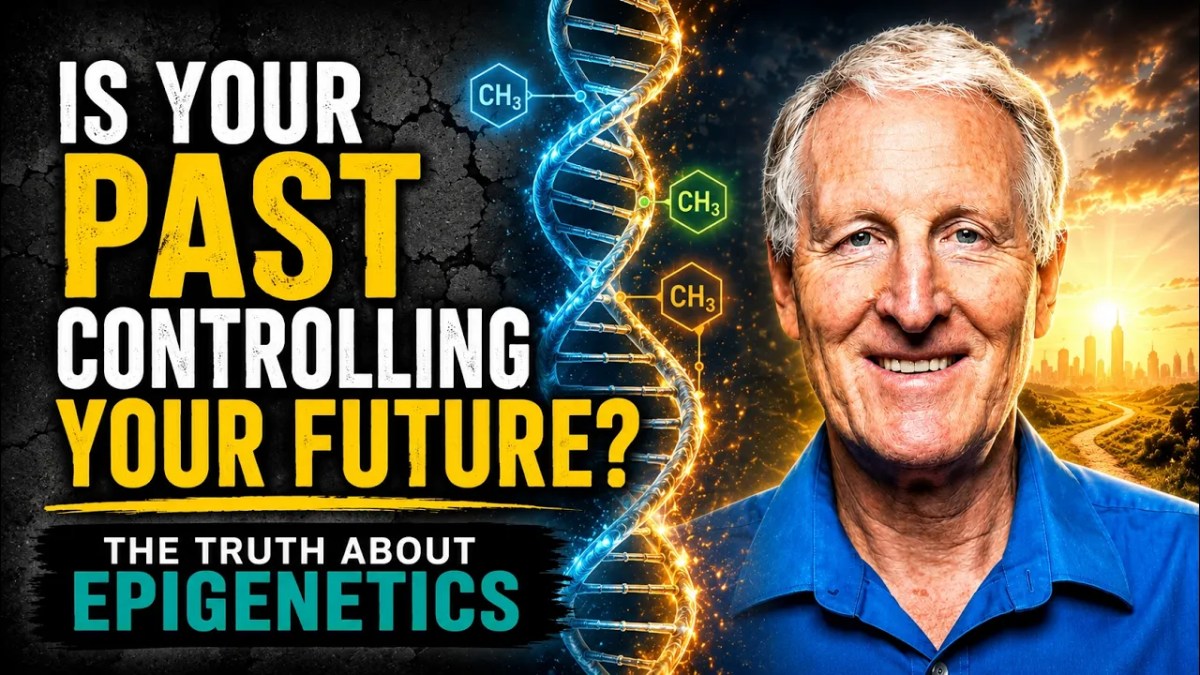

548. The Truth About Epigenetics | Is Your Past Controlling Your Future?

Get more from Mike when you join any tier at patreon.com/freedomarc.

If you do not see the video below, please click here.

Mike Parsons

Epigenetics, Behaviour, and the New Creation: What Gets Passed On?

At the end of the day, if the Father shows you something, then yes, you can deal with it. It is not automatic. But the question would be why did he do it, what was going on in his mind, and from that perspective, can it have an effect?

Epigenetic factors are factors of behaviour that are passed on to the next generation, but they cannot be passed on purely spiritually. What a father did after a child’s birth could not be passed on to that child attached to their genetic material. Genetics is an attachment of sulphonated groups to the genetic material. It is not our gene sequencing, which makes up what we look like and all of that, but it is an effect upon it. So if your father was an alcoholic, that could be passed on epigenetically, not genetically, but epigenetically, because it is a behavioural system. A lot of people can have behavioural factors passed on to them through genetic material, but not through the genes themselves. And that can happen within one generation. Something happens to a parent that can be passed on to the child because it affects their epigenetic factors, and that can then be passed on.

There has been a lot of psychological research into epigenetics to identify certain traits that are passed on, and they usually start off in mice or similar, where certain behavioural programming is applied to the parent, and then the offspring carry that programming. It did not change their genetic material, but something was attached to their genetic material that then influenced the offspring in some way. Epigenetic transformation or mutation normally takes a long time, whereas this can be instant. It can affect the genetic material epigenetically in an instant and then be passed on to the next generation, but not once that generation has already been born, because it cannot be attached to them at that point. They would have to create it themselves.

Now, behavioural example through nurture can cause a person to respond out of seeing their parents and behaving like them, and that can then also become attached to them as an epigenetic factor in them, which could be passed on to the next generation. But they created that by following the example of a parent. And sometimes you can get what is called bitter root judgment: if you judge a parent over something and do not forgive them, that can cause the very thing you judged to come upon you. Certain people have judged their parents for alcoholism and then found themselves drawn to alcohol in their own lives, not because of epigenetics but because of the judgment. So these issues of nature and nurture are complex, and they do affect people.

You can take identical twins and separate them at birth, and there will be some things that are epigenetic and will be exactly the same in both. But if one is brought up in a very rich home and one is brought up in poverty, that will have an effect on the way they think and what their belief systems are. A lot of issues are nurture as opposed to nature, and some are nature as well.

But these are influences that God can undo. That is where taking communion and dealing with the effect that there may be in our genetic and epigenetic material comes in, and actually seeing that we are new creations in Christ. That needs to renew our minds and bring us into alignment with who we really are, and not have us believe the lies of what we thought we were or who we thought we were.

Help take the message of God’s unconditional love to all his children when you join any tier at patreon.com/freedomarc.

If you enjoy these videos, would you please take a moment to like, comment, and subscribe? It really does help. Thank you very much.

508. God’s Desire For You | Discovering True Intimacy

Mike Parsons

This is the relationship God wants us to have: the deepest, most intimate relationship we could ever have with anyone.

He wants to reveal Himself in such a way that this relationship becomes possible, because we are no longer caught up in the issues that have separated us from Him or made us fearful of intimacy.

Often we are afraid of getting close because we think, well, He will really know me. But He already knows us, and He loves us anyway. That love is unconditional. Because of that, we do not need to be afraid to be real or honest with Him. We can share how we feel. We can learn how He feels towards us and be inspired by that. This is real relationship. It is not abstract or distant. It is real, and because it is real, it includes everything.

Sometimes we struggle. Sometimes it is difficult. Sometimes things happen that we do not understand and we ask, how could God allow that to happen? We have questions. We have doubts. At times, we even experience unbelief. God understands all of that. He is not threatened by it. He wants to draw us closer and closer, deeper and deeper, bringing us to a place where He truly reveals Himself.

As He does that, we begin to see ourselves reflected back in the wonderful mirror of His face. We see ourselves as He made us. He reveals who we really are. He wants us to live in that intimacy, but intimacy always brings change. It brings transformation. Sometimes the crucible gets hot, releasing the things in us that hinder relationship and closeness. But there is no guilt, no shame and no condemnation in that process. There is only love.

It was love that inspired me to trust God and to open my heart and my life fully to Him. It was love that brought me to the judgment seat, where the fire of His presence burned away the wood, hay and stubble of my scroll. It was love that brought me to a place of complete surrender. If I had feared Him, I could never have done that. He wants us to come to a place where the intimacy of His presence reveals the true nature of His heart, and we discover that this is home.

Not knowing who we are keeps us from Him. Sin is not primarily a verb, something we do, but a noun, something we are affected by. We lost our identity, and because we do not know who we are, we feel unworthy, undeserving or unqualified for relationship with God. Sometimes we even think we do not need it. All of these mindsets keep us from the relationship God always intended and has always prepared for us.

God’s desire has always been for us to return to restored innocence, to face-to-face relationship. The things that keep us from that are lies. Paul said that we are alienated in our own minds. God has never been separated from us. We think these things keep us from Him, but in reality, God embraces us as we are. In that intimacy, He reveals who we truly are.

As we come into agreement with that truth, we begin to resonate with it. The frequency of truth changes us. We are entrained into alignment with who we always were, but lost sight of and forgot. It is not behaviour that keeps us from God. It is mindset. It is the way we see ourselves.

That is why God wants to renew our minds, to the true nature of who He is and who we are. He wants us to realise that the only thing that keeps us from Him is our own perception. Once we begin to see rightly, we discover that nothing can separate us from God, not even ourselves, because His love never fails and never gives up.

As the psalmist David said, where can I go from Your presence? If I go into the grave, You are there. If I go into the highest heavens, You are there. In Him we live and move and have our being. We cannot be separated from Him except in our own minds. God has never separated Himself from us.

If you enjoy these videos, please take a moment to like, comment and subscribe. It really does help. Thank you very much.

284. His Love Never Fails

422. From Rejection to Acceptance | Understanding Your Identity in Christ

442. Unconditional Love – NO GUILT, NO SHAME

446. Embrace Love’s Fire