This is the relationship God wants us to have: the deepest, most intimate relationship we could ever have with anyone.
He wants to reveal Himself in such a way that this relationship becomes possible, because we are no longer caught up in the issues that have separated us from Him or made us fearful of intimacy.
Often we are afraid of getting close because we think, well, He will really know me. But He already knows us, and He loves us anyway. That love is unconditional. Because of that, we do not need to be afraid to be real or honest with Him. We can share how we feel. We can learn how He feels towards us and be inspired by that. This is real relationship. It is not abstract or distant. It is real, and because it is real, it includes everything.
Sometimes we struggle. Sometimes it is difficult. Sometimes things happen that we do not understand and we ask, how could God allow that to happen? We have questions. We have doubts. At times, we even experience unbelief. God understands all of that. He is not threatened by it. He wants to draw us closer and closer, deeper and deeper, bringing us to a place where He truly reveals Himself.
As He does that, we begin to see ourselves reflected back in the wonderful mirror of His face. We see ourselves as He made us. He reveals who we really are. He wants us to live in that intimacy, but intimacy always brings change. It brings transformation. Sometimes the crucible gets hot, releasing the things in us that hinder relationship and closeness. But there is no guilt, no shame and no condemnation in that process. There is only love.
It was love that inspired me to trust God and to open my heart and my life fully to Him. It was love that brought me to the judgment seat, where the fire of His presence burned away the wood, hay and stubble of my scroll. It was love that brought me to a place of complete surrender. If I had feared Him, I could never have done that. He wants us to come to a place where the intimacy of His presence reveals the true nature of His heart, and we discover that this is home.
Not knowing who we are keeps us from Him. Sin is not primarily a verb, something we do, but a noun, something we are affected by. We lost our identity, and because we do not know who we are, we feel unworthy, undeserving or unqualified for relationship with God. Sometimes we even think we do not need it. All of these mindsets keep us from the relationship God always intended and has always prepared for us.
God’s desire has always been for us to return to restored innocence, to face-to-face relationship. The things that keep us from that are lies. Paul said that we are alienated in our own minds. God has never been separated from us. We think these things keep us from Him, but in reality, God embraces us as we are. In that intimacy, He reveals who we truly are.
As we come into agreement with that truth, we begin to resonate with it. The frequency of truth changes us. We are entrained into alignment with who we always were, but lost sight of and forgot. It is not behaviour that keeps us from God. It is mindset. It is the way we see ourselves.
That is why God wants to renew our minds, to the true nature of who He is and who we are. He wants us to realise that the only thing that keeps us from Him is our own perception. Once we begin to see rightly, we discover that nothing can separate us from God, not even ourselves, because His love never fails and never gives up.
As the psalmist David said, where can I go from Your presence? If I go into the grave, You are there. If I go into the highest heavens, You are there. In Him we live and move and have our being. We cannot be separated from Him except in our own minds. God has never separated Himself from us.
If you enjoy these videos, please take a moment to like, comment and subscribe. It really does help. Thank you very much.
So between 2005 and 2010, I had a number of experiences which I described at the time as hell-like, simply because I had no other reference point in my life. I thought I had encountered hell, and so my framework for understanding was the usual concept of hell. That’s what I believed the experience meant, because I couldn’t see it any other way; I had no other frame of reference.
Once I actually encountered God and encountered love, I was able to revisit those experiences and see what he had really been showing me through them. I came to realise that I had completely misunderstood and misinterpreted what had happened, just as many others do when they claim to have been in hell for a few minutes. They are framing their experience through their theological understanding of hell.
We should weigh both what we feel and what we believe God has said. Does this align with love? If it does, we can wholeheartedly accept it. If it does not, then something has gone wrong in how we’ve understood it. In that case, we can take it back to the Father and ask why we misinterpreted it, recognising that often it is our own mindset that causes misunderstanding.
I had to do that many times when my experiences did not line up with what I thought to be true. When that happened, cognitive dissonance arose, and I was left with a choice: which should I trust—my experience, or my belief system? Over time I came to see that when my experience was aligned with love, that was what I needed to trust. And when it was not aligned with love, it was usually my interpretation of the experience that was the real issue.
We should weigh the things that we feel and what we think God has said. We should weigh them. We shouldn’t just accept them carte blanche. We should weigh it.
What do we weigh it with? How do we measure it? I measure it with love. Is this loving? Is this going to help people experience God and experience His love? So I’m measuring it against that.
So I know that if I thought God told me to do something which was contradictory to love, I know it couldn’t be Him. And people say, but you’re now saying that God can’t do something! Yes, I am. He can’t contradict Himself as being love, and he wouldn’t ask us to contradict himself and contradict what love is either.
So whenever something we think God said is not aligned to true love – true unconditional love – then we’ve got to question it.
If you do not see the video above, please click here.
There are many questions we should be asking and signs we should be looking for. If God is doing something—like Enoch appearing or other unusual things—what is that about? I cannot give a hard, fast answer, but I do believe God is challenging us to think and to question what we believe. What are the foundations of our lives and the way we live? Are they kingdom foundations, or are they cultural?
If they are cultural and oppose God’s kingdom, which is love, then we must ask, where is my heart? Is it aligned with God’s heart, or with the culture where I live? I do not want to be known culturally as British. Yes, I was born in Britain, it is on my passport, but I do not want to be subject to the culture of Britain if it is anti-kingdom. I would never call myself a British Christian, or even a Christian. I just want to be seen as a follower of God, of the Father.
So, what might cause me to have views which may be contradictory to the kingdom? We need to ask: what has shaped my life, my thinking, my belief systems, my worldview? Are they aligned with God’s heart, or do they need deconstruction? I see three main areas where God is challenging people (there may be more): religious deconstruction, political deconstruction, and financial deconstruction. A friend of mine said God was taking him through those things, and I realised he was doing the same with me. I now know to look at things differently in those areas and make sure that I am not thinking in a cultural way that puts me into contradiction to God.
So, financially, my views have changed from religious rules about tithing to simply asking, “God, what do you want me to do?” Politically, I had to face assumptions about why I voted as I did. I had assumed God agreed with me, but he showed me I had never asked him. I had to be completely unravelled and deconstructed in that area. Now I ask, “Is there a way you want me to vote?” And if he says it does not matter, then I examine my own heart and motives. Each of us may have a different way of looking at that question.
God wants our whole mindset aligned with the kingdom and with one another, to become one mind, the mind of Christ. That requires major shifts, deconstruction, and honest questioning of why we think, believe and act as we do. Most people never really consider these things, but I believe it is part of the process God is taking us through so that heaven can be established on earth.
For the past ten years, God has been deconstructing most of my old assumptions. My thinking has changed in many areas. This does not mean there are simple answers, because each of us must discover what God is asking of us in our own sonship. But it does mean we must begin to make decisions based not on selfishness, economics or cultural conditioning, but on God’s heart.
Strong opinions are often shaped by culture rather than by God. Even in raising my children, I tried to let them think for themselves, yet they still reflected my political views. That made me wonder whether I had been more vocal than I thought. The key is not to pass on political perspectives but to help people find God’s heart.
Some people vote based on economics, others on compassion, but the real question is whether our choices reflect God’s heart or merely our conditioning. I am not convinced God is as invested in political systems as solutions as we might think. Much of the prophetic movement seems to have become politicised in a way it never was 20 years or so ago, perhaps out of disillusionment when promised revivals did not happen as expected. Whatever the reason, it seems to have become blind to the real issues in some way…
If you enjoy these videos, would you please take a moment to like, share, comment, and subscribe? It really does help. Thank you very much.
We are following a book which has been translated by people with an agenda and a preconceived confirmational bias, rather than out of relationship with Jesus. Yet Jesus said he would speak to us and that we could follow him. We have the Holy Spirit, the Spirit of Truth, within us. We do not need another teacher.
So why are we telling people they must follow a book, when they can be guided by the Holy Spirit and through Jesus, who is the Truth? Jesus is the Word of God. The Bible is not the Word of God. The problem is that we have been taught otherwise. I hear people say, “We are going to read the Word.” But they are reading a book, half of which was never intended for them, the other half written for people in the first century preparing for the end. We are not those people.
That does not mean God has not used the Bible. He has used it in my life, but it has also caused huge confusion. I was deceived into believing things simply because I was taught that was what the Bible said. Now, I go with what Jesus says. I will not live by an interpretation of a book; I will follow a person in relationship. He is the Way, the Truth and the Life. The Bible is not. Even if someone had never read a verse, never seen a Bible, they could still encounter Jesus and through him engage the Father.
This is why I would never encourage a new believer to start with the Bible. It will only confuse them, as they are faced with conflicting interpretations and even two seemingly different versions of God. But it was always just people’s limited view of God, not who he truly is. Relationship is what matters. I can walk in relationship even with those I disagree with, because I do not need to prove them wrong. My faith is grounded in personal experience and testimony, not in the teaching of a book.
I use the Bible only as a frame of reference, because that is how people have been taught. Yet I can count fewer than five times when the Father or Jesus has actually quoted a Bible verse to me. When they did, it was revelatory. For example, “Come to me, all who are weary and heavy laden…” was spoken to me when I was striving to be good enough and keep a behavioural standard. It showed me why I was weary and how I could come into his rest. The principle was what mattered, not the verse.
Jesus is quite capable of saying directly, “Follow me and enter rest.” He does not need to quote Matthew 11:28. People can and do go astray, but many have also gone astray while following the Bible. History shows how it has been used to persecute, to endorse slavery, the Inquisition and Christendom itself. The Bible is not safe. Only Jesus and the Holy Spirit, as the Way, the Truth and the Life, keep us on a safe path. If you use love as the plumb line, you will not go far wrong.
This is what God showed me when he challenged my views of the Bible. He brought me back to the relationship I had with him, and how he speaks directly. He weaned me off my need for Bible confirmation. I know many still need that, but their thinking must eventually shift. They were told “the Bible says this,” but that has to be undone if they are to truly follow God.
Some quote verses about people falling away from sound teaching in the last days. But those last days were AD 66 to 70, when many fell away under persecution. That does not apply to us in the same way today. And this is the issue.
If you enjoy these videos, would you please take a moment to like, comment and subscribe. It really does help. Thank you very much.
God loves people and takes a genuine interest in their lives. If we fail to show any interest ourselves, how will they ever believe that God is truly interested in them? Demonstrating care means asking about their situation and engaging with their story. It is not about forcing a single message upon someone, insisting that they must receive it whether they want to or not.
Instead, it is about recognising that God personally meets each person in their own circumstances. He cares, He desires to help, and He longs for them to discover who they truly are. In doing so, they can understand that God already loves them. This is a very different approach, one that treats each individual as unique rather than as a commodity, project or statistic.
Meeting People Where They Are
In the past, many forms of evangelism tended to focus on strategies and techniques. Courses often emphasised how to deliver a message and how to ensure that people listened. Yet this approach often missed the point. Evangelism should not be about ticking boxes or securing conversions. It ought to begin with real interest in people themselves—the realities of their lives and the struggles they face.
Rather than asking, “How can I insert this message into a conversation?”, we should be asking, “How can I develop a genuine relationship with this person, one that may open the door for them to encounter God for themselves?”
A Personal Approach
People need to meet God in us. They need to see and sense something of Jesus expressed through our lives. This may not always be conscious on their part, and sometimes it may not even be conscious on ours, yet God shines through us all the same. In this way, we carry His presence into every encounter.
As Scripture explains, Jesus was the clear image of the Father, revealing to those around Him what God was really like. Many have no true idea of God’s character until they encounter Christ.
Treating Individuals as Unique
In the same way, we are called to be ambassadors of reconciliation. Our role is to represent God’s heart faithfully and to help others to see that He has already done everything needed to restore their relationship with Him.
Summary: When our lives reflect His presence, others can begin to sense His love and discover for themselves the truth of who they are in Him. By treating people as individuals rather than commodities, we embody the message that God cares deeply for them. Evangelism then becomes not about delivering a formulaic message, but about relationship, love and presence.
If you enjoy these blogs and videos, please like, comment and share! Thank you.
We can find ourselves really constrained within certain systems and among people who all think the same way—which leaves little room for personal growth or enjoying life. Christians, for example, often end up repeating the same routines—organising potluck meals and eating quiche and such things, which can become a bit staid and, frankly, rather dull and boring. That’s not to say Christians can’t have fun—but generally speaking, the world exists for us to discover, to enjoy, and to bring light into, ideally in a way that’s enjoyable and adventurous.
Sometimes I wonder why anyone would want to become a Christian when, so often, Christians come across as quite miserable. Then there’s the expectation of attending church three times on a Sunday. Why should that be necessary? If I’m enjoying myself by going out, why can’t I worship God in the fresh air? These mindsets persist: we invite people to join us, and then expect them to give up what they find pleasurable in order to join a ‘Christian club.’ In the process, such people often lose touch with real life—and many of the positive experiences they had with God in the past are lost. They end up just becoming ‘church people,’ which really doesn’t attract anyone.
Representatives of God’s love
Instead, we ought to show that life can be enjoyable, that we can have fun, love others, and care for them—that’s the sort of dynamic we should be bringing to the world. We’re meant to be representatives of God’s love, demonstrating care and compassion through what we do. When people hit a crisis, they’ll seek out those who are authentically loving, relatable, and understanding—the kind of people who can help them encounter God through genuine relationships.
I wholeheartedly believe in continuing to enjoy life. Since embracing this perspective, I enjoy life much more as I believe it was intended to be—without imposing a set of rigid rules and obligations that dictate where I should be and what I must do.
Going to church
I go to church meetings with Debbie because she enjoys fellowshipping with others. I like singing too, so I don’t mind joining in, but I doubt I would go if it weren’t for her. I value those friends and connections, but sometimes I do find it a struggle. In the home group, I occasionally bite my tongue to avoid offending others, but now and then God gives me permission to say something a bit provocative, to open up honest discussion. Ultimately, though, if Debbie didn’t attend the group, I wouldn’t go there either. This week, there’s football on—so I’ll watch that, as I’ll probably enjoy it more than wrestling with theological discussions I find hard to connect with. I don’t attend to cause trouble; I simply value the freedom to go or not to go.
No option
Reflecting on my past, especially when I was in church leadership, I remember having no option—I had to be there, unless I was on holiday. It was expected of me as a leader. I was often speaking—which meant there was little choice, and as I was being remunerated, there was a sense of obligation. I would have felt guilty for not going. Although it was genuinely more than just a job for me, there was still a mindset that I needed to “give them their money’s worth.” That way of thinking comes from conditioning: it is certainly not freedom.
If you enjoy these video blogs, please take a moment to like, share, comment, and subscribe—it really does help. Thank you very much.
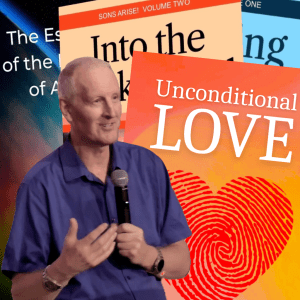
All Mike’s books, including Into the Dark Cloud and Unconditional Love, are available to order from online and local booksellers; or you can buy them as ebooks and download them instantly from our website.
More info at eg.freedomarc.org/books
Nothing can change God. He is love. He will never, ever be anything other than love. That love is always unconditional—it is never-ending, and totally unconditional.
So, if what you read about God—whether in the Old Testament, New Testament or anyone’s writings—appears to contradict or fall short of love, then either what is written is wrong, or your understanding of it is flawed. Most likely, it is the result of. This goes beyond religion—it is rooted in how different cultures have understood and presented God. Religion has twisted concepts like holiness and righteousness—true characteristics of God—so that they seem to trump grace and mercy. But they do not. They are equal. God’s grace and mercy are expressions of unconditional love.
Mike Parsons’ new book Unconditional Love is out now. Order a print copy from your favourite bookshop or online retailer, or get an instant download from our website. More details at eg.freedomarc.org/books
No guilt, no shame.
God is a righteous judge, and therefore He is a God of true justice. The problem for many is that religion has conditioned them to believe that judgment and justice mean wrath and punishment. But judgment, made by God our Father, is not based on human ideas of justice. It is grounded in loving kindness and in the fact that He has already reconciled the world to Himself, not counting anything against anyone. Every accusation against us has been nailed to the cross.
Judgment is a verdict, a decision—not a punishment. And the Father’s verdict is always made in love. That verdict is: not guilty. Innocent. You have been declared not guilty—innocent of all charges and accusations made against you. So if you hear accusing thoughts, reject them. They either come from your own mind, or from another source that thrives on guilt and condemnation. If you believe you are guilty or condemned, and not innocent, you will live a lesser life than the one God intends.
God so loved the world that Jesus came to reveal love. But that love goes even deeper and further back than the cross. Jesus offered Himself before the foundation of the world, so that love would always win, so that love would overcome. The Father’s judgement—’not guilty’—was agreed before we were ever created. All accusations were nailed to the cross. Nothing is held against us.
Jesus, the Lion, fully identified with humanity as a lamb—because all of us, like sheep, have gone astray. Each one of us follows our own way. He came to bring us back into relationship. We may be lost in our independence, but I believe the term “humanity” does not reflect the nature and character of God. It reflects a humanistic mindset that seeks to do everything in its own strength. But God, in Jesus, fully identified with us. Why? Because He loves us.
That “transaction”—figuratively compared to being slain—was a choice to identify with us so completely that He became one of us. In becoming us, He represented us entirely. He became not as Adam was, but as Adam became. He entered a fallen world and fully identified with our fallen nature. That is why He cried out from the cross, “My God, my God, why have You forsaken me?”
But that cry was, in reality, a lie—because God never forsook Jesus. God was in Christ, reconciling the world to Himself. God never rejected or forgot us. It was only how we thought of Him, through our guilt and loss of identity, after we chose independence. He became us so we could be restored to who He always intended us to be. And now we live in a new age, under a new covenant. A covenant Jesus made with the Father—and all of mankind is included in it.
Jesus warned us of the religious and political spirit, likened to leaven, that would permeate the whole lump. In my own experience—through churches and movements I have been part of—my understanding of the new covenant was tainted by old covenant ideas.
Unconditional love does not require sacrifices or offerings. But an old covenant mindset always demands something: our obedience, our obligation, our duty. These are dead works. They carry no value before the Father. He does not require them—and, in truth, He never did. That may come as a shock to many. We must be careful not to operate under an old covenant, works-based, performance-oriented mindset towards God. It will exhaust us. We will never find rest if we think we must earn God’s love or favour.
There is no guilt, no shame, no condemnation in unconditional love. Those things are religious constructs designed to keep us coming back for more religion.
If you enjoy these videos, please take a moment to like, share, comment and subscribe, here and on YouTube. It really does help! Thank you.
No Law, no punishment
Hebrews 6:1-2 are often misunderstood—and I misunderstood them for most of my life. I even taught them as foundations of new covenant faith. But what Hebrews 6 actually says is: “Therefore, leaving the elementary teachings about the Christ, let us press on to maturity—not laying again a foundation of repentance…”
The old covenant was immature. The new covenant brings maturity—but only if we do not lay again the old covenant foundation: repentance from dead works, faith towards God, instructions about washings, laying on of hands, resurrection of the dead, and eternal judgement. All of these are old covenant ideas. They have no place in the new. And yet these very things are what most churches teach as foundational. They were in our church’s foundational course too. But now I realise: these are the things we should not be laying again. There is no life left in the old system. It is dead. We have to move on.
That whole system was based on sacrifices and offerings, connected to the Law given through Moses—a law that was never God’s idea. I am not talking about the Ten Commandments, which actually describe what a good relationship with God looks like. They are not really “Thou shalt not…” They are: “You do not need to…” You do not need any other gods. You do not need to steal. You do not need to kill. Why? Because in this amazing relationship of safety and security, God provides everything. That was His offer.
But the people were afraid and sent Moses instead. So they set up a mediatorial system—the Law. It had 613 requirements they were supposed to keep. Jesus made it clear that it was impossible. Fail in one, and you fail in all. We cannot keep the Law. From the very beginning of the Church, there were attempts to drag people back under it. The religious spirit, working through the Judaizers—even within Jerusalem and the early Church—tried to impose the law of Moses once again.
John 1:17 says, “The Law was given through Moses; grace and truth came through Jesus Christ.”
God never wanted sacrifices and offerings. People will say, “Yes, but He accepted them.” Isaiah 1:11 says, “What are your many sacrifices to Me?” says the Lord. “I have had enough of burnt offerings of rams… I take no pleasure in the blood of bulls, lambs or goats.”
Jeremiah 7:22 says, “I did not speak to your fathers or command them… concerning burnt offerings and sacrifices.” So He never told them to make offerings. Yet they made a golden calf and sacrificed to it. Where did that come from? Their own understanding.
Of course God accepted sacrifices and offerings—because He accepts us. He also accepted their demand for a king, even though He was already their King. That does not mean it was what He wanted. But He works with us, even in our brokenness and our flawed position.
Psalm 40:6 says, “You have not desired sacrifice and meal offering… You have not required burnt offering and sin offering.” Then it says—prophetically of Jesus—“Behold, I have come… I delight to do Your will, my God; Your law is within my heart.”
And the law, when written in the heart, is not a ‘Thou shalt not’. It is a ‘You can’. Because when it is revealed from within, it gives permission to live as sons of God. Not ‘You shall not do this’, but ‘You can do all these amazing things’—as co-heirs and co-creators.
Thank you to our amazing Patreon patrons who help make my books and videos – and this blog – possible!
Join them at patreon.com/freedomarc and partner with us in taking this good news of unconditional love to all creation.
God is love—and that love is unconditional. We need to carry that message of unconditional love, of inclusion, of reconciliation and restoration, which God has already brought about in Jesus. Our role is to help people come into the reality of that; to help them experience the truth that they are already reconciled, already loved, and that God holds nothing against them. That is the ministry we are called to.
Sadly, I would say that much of what has been preached as the gospel—particularly in evangelical contexts—has been the opposite. It has been about exclusion. It has been based on works and, far too often, motivated by fear: the fear of punishment rather than the invitation into love.
What I have come to understand—and to experience—is that love can only be unconditional. That means there are no conditions you must meet in order for God to love you. None. And I want to encourage you to embrace that truth, even if just for a moment. There are no conditions for God’s love. Absolutely none.
If you can truly grasp that—experientially, not just intellectually—it will transform your whole life. It has certainly transformed mine. That does not mean life will be without difficulty. That does not mean you will never be tested. But the truth remains: you are loved, because God is unconditional love. And God loves all His children equally—regardless of what you have done, where you have come from, or what you have been through. He loves you as fully as it is possible to be loved. He loves without limits. Lavishly, with no barriers, no hindrances.
This teaching forms part of Mike Parsons’ new book Unconditional Love, which is out in print on 20 June 2025. Order it from your favourite local or online bookseller today, or get the ebook from our website. More details at eg.freedomarc.org/books.
Now, many people accept that God is love, because the Bible says so. But there is often a “but.” Why is that? Because the idea of unconditional love seems too good to be true to an independent or alienated mind. We are separated from God in our own thinking—alienated within the mind of humanity. I believe this mindset comes from the tree of the knowledge of good and evil. That is the mindset which begins to shift when we experience God for ourselves.
But for so many, it has been shaped and programmed by religion. All religion is man-made. God never intended it. He has always wanted relationship. Yet religion has taken something that is already ours and made it into something we have to earn or deserve—or a state we must appease God to reach. That same religious programming has presented us with a view of God as angry, disappointed, or frustrated with us. But God is none of those things. He loves us unconditionally, and He wants us to truly experience that.
People say, “Yes, God is love… but He is also holy”—as if His holiness contradicts His love. Or, “Yes, God is love… but He is also righteous,” as though love and righteousness are somehow opposed. Or, “Yes, God is love… but He is also just”—again implying that justice counteracts love. These are all religiously programmed ideas. I used to believe them myself because I had never experienced the truth, which made it easy to believe the lies.
Some say, “Yes, God is love… but He is also a judge,” as if that makes Him a harsh judge who is looking to find us guilty. But love keeps no record of wrongs. So how could He ever find us guilty?
Another one: “Yes, God is love… but He cannot look upon sin.” People usually mean behaviour when they say that—but sin, in reality, is lost identity. If God cannot look at a lost world, how could Jesus ever have come And of course God is not only looking at this world—He is present in every single person. He is working within everyone to bring them into the reality of their relationship with Him, into their inclusion in Christ. We have already been reconciled in Christ. We have already been made righteous in Christ. We have already been made holy in Christ. We did nothing to make that happen. He did it all.
Religion is full of “buts.” And all those “buts” do is undermine the truth that God is love—unless you believe the false doctrines that paint God as two-faced: loving in the New Testament, but angry in the Old. Even within the New Testament, people sometimes see wrath and anger. But they do not realise that the word orge, often translated “wrath,” also means “passion.” God is passionate—passionate about removing anything that hinders our relationship with Him. That passion is not about fury or violence; it is about His relentless, determined love working to bring about transformation.
Religious deception has distorted the nature of God, separating aspects of His character and creating a false image of love that punishes. But what loving father would punish his children eternally? This kind of theology has created a God who is hard to trust—a God who claims to love, yet threatens to torment unless we do things a certain way. That is not who God is.
Many people have been fooled into trying to earn something that is already theirs by inheritance. As God’s children, we have a right to relationship with Him. That is not something we must strive for—it is something embedded in the very nature of who He is and who we are. The deception is in making us believe that we have to do something to get something. But the truth is that we are already God’s children, and therefore we are already loved—unconditionally—by a Father overflowing with lovingkindness. It is not that we must do something. We only have to realise something, to come into the full awareness of it.
Religion has twisted the meanings of holiness and righteousness by misinterpreting concepts like judgment and justice. That distortion is what has created the false narrative of hell—a place where God punishes and tortures His children eternally. But in truth, God loves His children eternally. He will never stop loving, never give up—until we fully experience that love. His love is a purifying, refining fire. A consuming fire that burns away every obstacle and objection until nothing remains but pure, unconditional love.
Holiness, righteousness, judgement, justice—none of these contradict unconditional love. In fact, they flow from it:
Holiness expresses love.
Righteousness reveals love.
Judgment results from love.
Justice enforces love.
The judgment of God, made on behalf of all humanity and all creation, is this: not guilty. If you are not guilty, then you are innocent. And if we would only see ourselves the way God sees us—as innocent—we would begin to live from that place of understanding and experience.
God cannot be a contradiction. He is either love, or He is not. And He most definitely is love.
Thank you to our Patreon patrons who help make my books and videos – and this blog – possible! Join them at patreon.com/freedomarc and partner with us in taking this good news of unconditional love to all creation.













 Sons of Issachar